Compare · Ecommerce ops · Oct 2026
Triple Whale vs Northbeam (Oct 2026): AI attribution and ecommerce analytics compared
Triple Whale and Northbeam both tell ecommerce brands which ads drove their orders, and both now put an AI assistant on top. The biggest practical difference is what the AI is allowed to do: Triple Whale’s Moby can act in connected ad accounts on its Automate and Enterprise packages, while Northbeam AI and Northbeam MCP read your numbers and leave changes to people. This page compares the jobs a growth and finance team runs every month, what each vendor publishes, and who signs off — it is not a ranking, and each section has a Try this.
What this comparison covers
This page is for a growth lead, paid media manager, or finance lead choosing between Triple Whale and Northbeam, or running one and hearing about the other’s AI. The question it answers: by attribution models, MMM and incrementality, AI assistants, whether the AI can change ad accounts, published prices, and who signs off on budget moves, how do the two compare.
Facts align with our Triple Whale AI and Northbeam AI reviews (read 16 October 2026), with Triple Whale pricing, the Moby page, Northbeam pricing, and Northbeam’s docs for Northbeam AI and MCP re-read the same day. Triple Whale shows paid prices only through a GMV slider; Northbeam shows starting rates on two tiers and quotes the rest.
Ground rules for either tool: a named finance lead compares every attribution or test number with actual orders before it moves a budget; the team agrees one attribution model and window to quote; a paid media lead approves every change in an ad account, whoever proposes it; no customer lists or order exports go into an outside chat tool; vendor ROAS and CAC figures are left out or attributed only. This comparison is not a ranking. If stock and purchasing are the bigger question, see Cin7 AI; for tracking and returns, Narvar AI.
| Question | Triple Whale | Northbeam |
|---|---|---|
| Published price | Free plan; Foundation, Automate, and Enterprise priced by annual GMV and package through a slider (amounts not in the page text) | Starter $1,500 (no period stated, “Contact us for a quote”); Professional $3,500/month; Growth and Enterprise custom; “start at” rates set by data volume |
| Contract | Paid packages are 12-month subscriptions, billed monthly or annually with two months free | Starter month-to-month for Shopify brands; Professional and Enterprise annual terms |
| AI assistant | Moby: chat on live data, artifacts, Slack; try it on the Free plan | Northbeam AI in the dashboard on every plan; Context Center and Custom Instructions; weekly usage limit |
| Can the AI change ad accounts? | Yes on Automate and Enterprise: Moby Actions scale budgets, pause, and launch within approval settings | No: Northbeam AI reads data and can change only your own default attribution settings |
| MCP for outside assistants | Triple Whale MCP connects to tools such as Claude and ChatGPT | Northbeam MCP, read-only, every plan per Northbeam’s docs |
| Attribution models | Seven, including Triple Attribution, Total Impact, and Clicks & Deterministic Views; lookback 1 day to lifetime | Seven, including Clicks-Only, Clicks + Modeled Views, and Clicks + Deterministic Views |
| MMM and incrementality | Compass (MTA + MMM + incrementality) on Enterprise; listed as add-ons on some packages | MMM+ optional on Enterprise; Incrementality optional on Professional and Enterprise (launched 7 Apr 2026, Meta in the US first) |
| Who signs off | Paid media lead for every Action; finance lead for the model the team quotes | Finance lead for every number used in planning; paid media lead for changes made in the ad platforms |
Major features (with how someone uses them)
Examples at a glance: each feature has a concrete example from a real job plus a short Try this you can run this week.
1. Start from your three biggest channels (primary)
What it is: Before comparing dashboards, take last month’s three biggest ad channels by spend. For each, write down the revenue Triple Whale credits it with and the revenue Northbeam credits it with — naming the attribution model and window each used — and put both next to the orders you can actually see in your store and finance reports.
The two tools will not agree, and neither will match the ad platforms; that is expected. What matters is whether you can explain the gap and which number your team will quote.
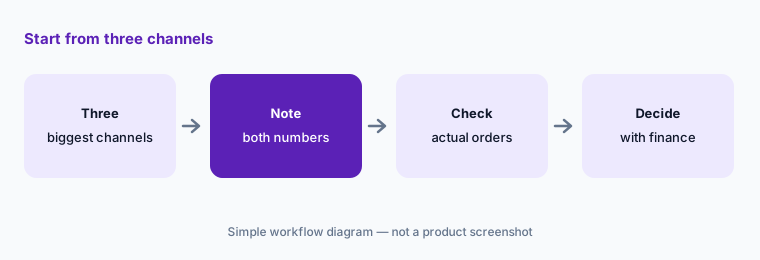
Your three channels:
Pick last month's three biggest ad channels. Write down what each tool says they drove and have the finance lead compare both with actual orders before shifting budget.
2. Attribution models and windows
What it is: Both list seven models. Triple Whale’s pricing page names Linear All, Linear Paid, First Click, Last Click, Triple Attribution, Total Impact, and Clicks & Deterministic Views, with lookback windows of 1, 7, 14, and 28 days and lifetime (Triple Whale AI). Northbeam’s docs name First Touch, Last Touch, Last Non-Direct Touch, Linear, Clicks-Only, Clicks + Modeled Views, and Clicks + Deterministic Views (Northbeam AI). Both offer a model that counts platform-verified views as well as clicks.
Similar names do not mean identical maths. Compare a channel under each tool’s closest pair of models, and write down which one each team member quotes.
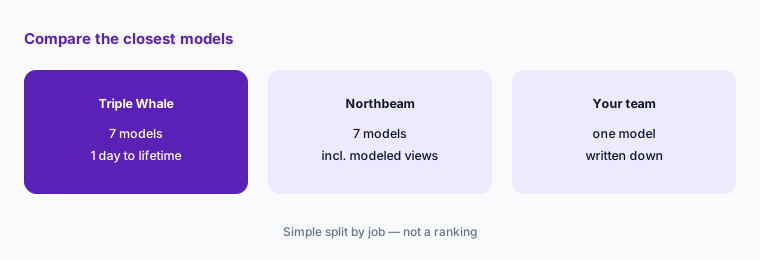
Closest pair of models:
Pick one channel and compare it under each tool’s closest pair of models for the same month and window. Have the finance lead write down which model the team will quote.
3. MMM and incrementality tests
What it is: Triple Whale puts media mix modeling and incrementality testing (GeoLift and conversion lift) together in Compass on Enterprise, calibrating against its attribution; its comparison table lists those pieces as add-ons on some other packages. Northbeam sells MMM+ as an optional Enterprise add-on and Northbeam Incrementality as optional on Professional and Enterprise; its 7 April 2026 release said the first version covered Meta channel-level tests in the United States, with more channels planned through 2026.
An incrementality test is only useful if you have agreed in advance what you will do with each verdict. Ask each vendor which channels and countries you can test on your plan today.
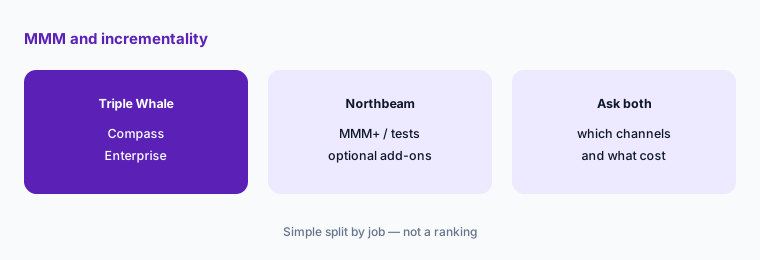
Same three questions:
Ask both vendors which channels and countries you can run an incrementality test on today, what it costs on your package, and how results feed back into attribution. Get the answers in writing.
4. Moby vs Northbeam AI
What it is: Moby answers questions from your live Triple Whale data in chat and in Slack, builds dashboards and briefs, and can turn any chat into a scheduled Automation on Automate and Enterprise; the Free plan lets you try it (Triple Whale AI). Northbeam AI answers how-to and data questions inside the dashboard on every plan, uses shared Context Center files and Custom Instructions, can file support tickets, and has a weekly usage limit (Northbeam AI).
Either assistant answers from one attribution model and window at a time. Ask the same question in both and check which settings each used before comparing the answers.
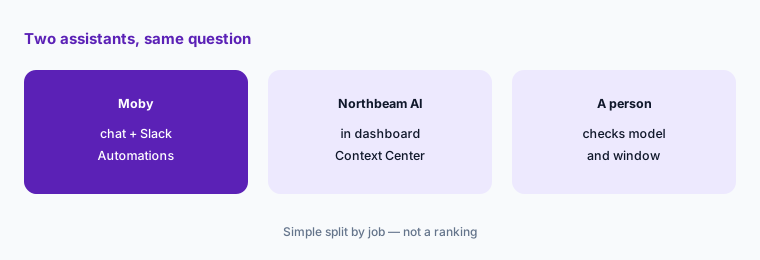
Same question, both assistants:
Ask Moby and Northbeam AI the same question about last week’s spend and revenue. Note the model and window each used, and re-ask with matching settings before comparing.
5. Actions vs read-only, and MCP
What it is: On Automate and Enterprise, Moby Actions can scale budgets, pause underperformers, and launch campaigns in connected ad accounts, within schedules, thresholds, and guardrails you set; in Ask every time mode Moby waits for approval before an Action runs. Northbeam AI reads your data and does not edit orders, spend, or connections — it can change only your own default attribution settings. Both offer MCP for outside assistants: Triple Whale MCP connects your data to tools such as Claude and ChatGPT, and Northbeam MCP is read-only and, per its docs, on every plan.
An AI that can move budget needs written guardrails and a named approver before it is switched on. A read-only AI still needs someone to check the number before a person moves the budget.
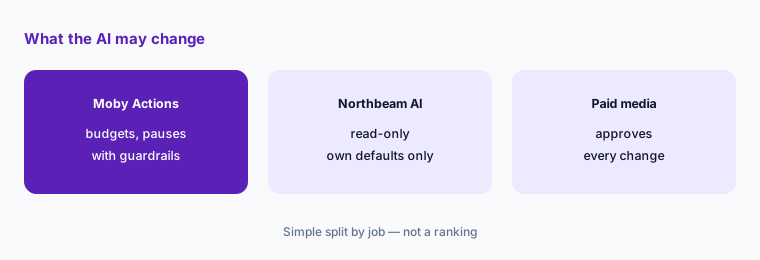
Same three rules:
Write three budget rules (largest daily change, minimum spend, campaigns never to pause). Use them as Moby guardrails or as the checklist for people making changes from Northbeam numbers, and name the approver.
6. Published prices and who signs off
What it is: Triple Whale has a Free plan; Foundation, Automate, and Enterprise are priced by annual GMV and package through a slider, and the amounts were not in the page text on 16 Oct 2026; paid packages are 12-month subscriptions billed monthly or annually (Triple Whale AI). Northbeam shows Starter at $1,500 with no stated period beside “Contact us for a quote”, Professional at $3,500 per month, and Growth and Enterprise as custom, with prices that “start at” those rates and depend on data volume (Northbeam AI).
Ask both vendors for a written twelve-month total at your real ad spend and order volume, with MMM, incrementality, and any AI usage limits named on their own lines.
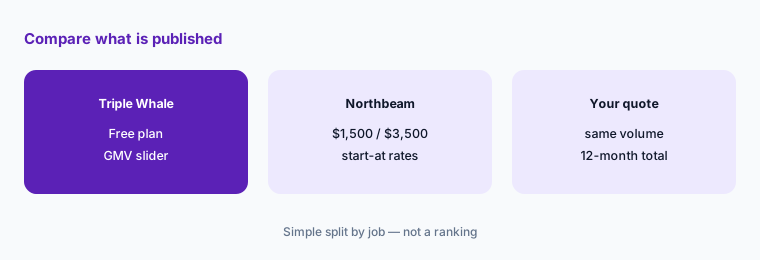
Same numbers, two quotes:
Send both vendors your annual GMV, monthly ad spend, and the add-ons you want. Ask for a written twelve-month total with MMM, incrementality, and AI usage limits on separate lines.
Pricing context (October 2026)
Triple Whale (re-read 16 Oct 2026 via Triple Whale AI): Free plan at no cost; Foundation, Automate, and Enterprise priced by annual GMV and package through a slider, with no amounts in the page text; 12-month subscriptions billed monthly, or annually with two months free; every paid plan includes unlimited users and a monthly Moby allotment.
Northbeam (read 16 Oct 2026 via Northbeam AI): Starter $1,500 (no period stated; “Contact us for a quote”); Professional $3,500 per month; Growth and Enterprise custom; “start at” rates informed by data volume; Starter month-to-month for Shopify brands; Professional and Enterprise on annual terms.
Uncertainty: Neither vendor gives a full price list: Triple Whale’s paid amounts were not in its page text and Northbeam’s Starter amount has no stated period, so any cost comparison depends on written quotes. Triple Whale’s pricing page says SSO and audit logs are “coming soon” while its FAQ lists them for Enterprise. Northbeam’s MCP plan wording changed recently (earlier guide copies said Pro and Enterprise; the docs we read say every plan), and its incrementality launch date differs between the press release (7 April 2026) and a docs label (August 2026). Vendor ROAS, CAC, and revenue figures are their claims, not our measurement. This page is not a ranking — decide from your three channels, two quotes, and named approvers.
When it’s useful (honest take)
Triple Whale is useful when you want an assistant that can also run scheduled work and act in ad accounts within guardrails, want to start on a free plan, and have a paid media lead who will write and enforce those guardrails.
Northbeam is useful when you want attribution, MMM, and incrementality with an assistant that only reads, are comfortable with a quote for most tiers, and have a finance lead who owns the model the team quotes.
Less useful when (either one) nobody will compare their numbers with actual orders, ad spend is small enough that platform reporting will do, or the bigger gap is stock (Cin7 AI) or post-purchase service (Narvar AI).
Still choosing between Triple Whale and Northbeam? The $19 AI toolkit audit gives you a written plan for which tools to keep using and which to drop across your whole AI stack, including this pair.
Prefer to do it yourself? Spreadsheet — $9
Related options (educational)
| Need | Better home | Why |
|---|---|---|
| Triple Whale on its own | Triple Whale AI | Free plan → tiers by annual GMV |
| Northbeam on its own | Northbeam AI | Starter from $1,500; Professional $3,500/mo |
| On-site behaviour and experience analytics | Contentsquare AI | See its review |
| Email and SMS retention results | Attentive vs Postscript | Not a ranking |
| One-off analysis of a sanitized export | Claude | General chat; no ad connection |
FAQ
Should I choose Triple Whale or Northbeam?
This page is not a ranking. Take your three biggest ad channels, write down what each tool credits them with, compare both with actual orders, get written quotes at the same volume, and decide who signs off — not marketing headlines.
Which one can change my ad campaigns?
Triple Whale’s Moby Actions can scale budgets, pause, and launch campaigns on Automate and Enterprise, within your approval settings. Northbeam AI reads your data and can change only your own default attribution settings; Northbeam MCP is read-only.
Which one publishes prices?
Neither publishes a full list. Triple Whale has a Free plan and shows paid prices through a GMV slider. Northbeam showed Starter at $1,500 (no period stated) and Professional at $3,500 per month on 16 Oct 2026, with Growth and Enterprise custom.
Do both offer MMM and incrementality?
Yes. Triple Whale combines them in Compass on Enterprise. Northbeam offers MMM+ as an optional Enterprise add-on and Incrementality as optional on Professional and Enterprise.
Who should sign off on budget moves from either tool?
A named finance lead compares the numbers with actual orders and approves any budget shift; the paid media lead makes or approves the change in the ad platform, including every Moby Action.
Optional next step (if seats overlap)
If you pay for two attribution tools during a trial, an analytics platform with its own AI, and a chat seat that also reads your ad data, that overlap is worth mapping. Map the overlap with the $19 AI toolkit audit or the $9 AI toolkit spreadsheet. Email Audit $19 or Toolkit spreadsheet $9.
Checkout is live via Stripe. After you pay, we email delivery (spreadsheet) or intake next steps (audit).