Role guide · Restaurant ops · Gemini · Workspace · Oct 2026
Gemini for restaurant ops (Oct 2026): Sheets food-cost trackers, Docs recipes, and Gmail catering replies
Restaurant ops role guide for chefs, kitchen managers, GMs, and catering leads whose company runs on Google Workspace — Gemini lists price jumps in a sanitized food-cost Sheet, pivots a waste log, turns approved recipe pages into Docs drafts, and drafts catering and large-party replies in Gmail. You check ten rows by hand before anyone changes a menu price, the chef approves every recipe and allergen line, and a named person sends every guest email. Companion to ChatGPT for restaurant ops and Stack map for restaurant ops.
Who this guide is for
Chefs, kitchen managers, GMs, bookkeepers, and catering coordinators — the person who exports invoice lines into a Sheet, keeps recipes in a Doc, and answers catering email — at a restaurant group that already pays for Google Workspace. If your back office already flags price jumps from invoices, use that first: see MarginEdge AI, MarketMan AI, Restaurant365 AI, or Crunchtime AI. If your team drafts in ChatGPT instead, see ChatGPT for restaurant ops.
What Google documents (its Gemini in Sheets, Gemini in Docs, and Help me write help pages and its pricing page, read 15 October 2026): in Sheets, the Ask Gemini side panel can create tables and formulas, analyze the data, and take actions such as conditional formatting, pivot tables, sorting, and filters, and Undo reverses the last Gemini action. In Docs, Gemini shows edits as suggestions you accept or reject, and you can add your own files as Sources. In Gmail, Help me write drafts or refines a message and can pull details from your other emails and Drive files — Sources shows what it used. Google's pricing page lists Gemini in Gmail on every Business plan, and Gemini in Docs and Sheets on Business Standard and above.
Ground rules for every section below: Gemini never sends a guest email, never changes a menu price in the POS, never places a supplier order, and never edits a schedule. It lists, drafts, and suggests; the chef, GM, or bookkeeper makes each change in the system that owns it, and a named person sends each email. Work from sanitized exports — item, unit, supplier, price, date — with no guest PII (names, phones, emails, card numbers), no employee Social Security numbers or pay rates tied to names, and no passport or ID scans from onboarding files. Food-safety, labor, and tip rules are local.
Major features (with how someone uses them)
Examples at a glance: each feature has a concrete example from a real job plus a short Try this you can run this week.
1. Food-cost Sheet: items up more than 5% (primary)
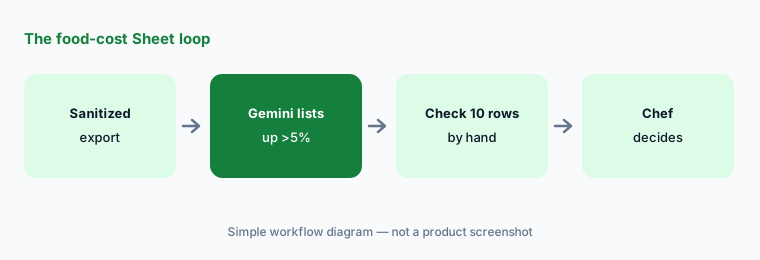
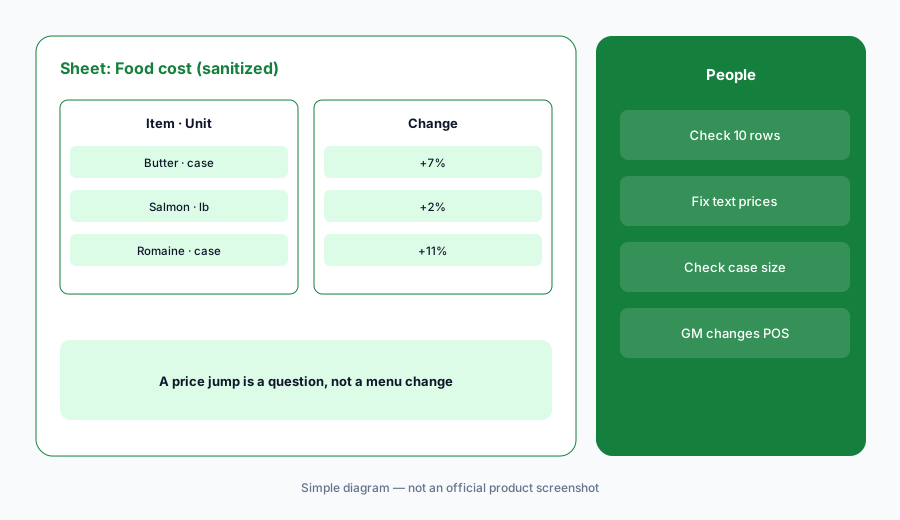
What it is: Export two months of invoice lines or a food-cost report from your back office, open it as a native Google Sheet, and keep only item, unit, supplier, last month's price, and this month's price — no account numbers, no staff names. Open Ask Gemini and ask it to list items whose cost rose more than 5% month over month. Before anyone changes a menu price or a supplier, check ten rows by hand against the invoices: some it flagged and some it didn't.
A price jump in the Sheet is a question, not a menu decision. The chef knows whether a case size changed or a substitute was shipped — and the GM makes any menu price change in the POS.
Primary workflow:
In a sanitized food-cost Sheet, ask Gemini to list items whose cost rose more than 5% month over month. Check ten rows by hand.
2. Waste log Sheet: pivot by item and day
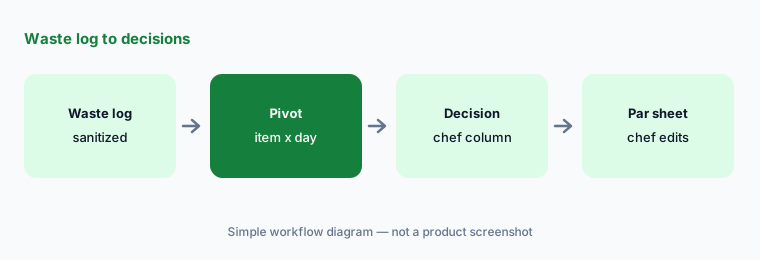
What it is: From a sanitized waste log — date, item, quantity, reason (overprep, spoilage, returned) — ask Gemini for a pivot table of waste by item and day of week, then ask it to highlight the top five items. On your own copy, add a Chef decision column. Use Undo if an action touched the wrong rows, and insert the pivot into the Sheet — Google says side-panel history is lost when you reload the browser.
The pivot shows where to look; it does not set pars. The chef changes the par sheet and the prep list.
Pivot, then decide:
On a copy of a sanitized waste log, ask Gemini for a pivot of waste by item and day of week and add a Chef decision column. Undo anything that changes the source rows.
3. Recipe and SOP drafts in Docs from approved sources
What it is: In Docs, add the approved sources — recipe book pages, station guide, cooling and labeling procedure — as Sources, and ask Gemini for a recipe card or station SOP with the source named under each step and a list of anything the sources do not cover. Gemini's edits appear as suggestions; the chef accepts or rejects each one. Allergen lines come only from the recipe book.
Mark, don't fill. Ask Gemini to label any step it cannot tie to a source as Not in sources — chef to confirm.
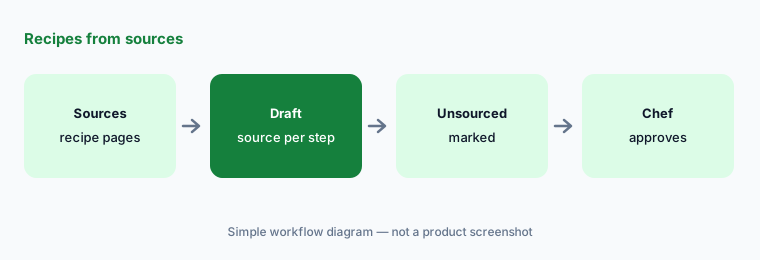
Source every step:
Add one approved recipe page as a Source in Docs and ask Gemini for a recipe card that names the source under every step. Have the chef reject every step marked not in sources.
4. Catering and large-party replies in Gmail
What it is: For a catering or large-party inquiry, draft with Help me write from facts you already confirmed — date, headcount, package name, deposit policy, lead time — not from pasted guest card data. Open Sources, remove anything that pulled the wrong Drive file (an old menu, last year's prices), and have a named catering or events person send the email.
Gemini drafts; people send. Never paste card numbers or guest contact lists into Gmail prompts.
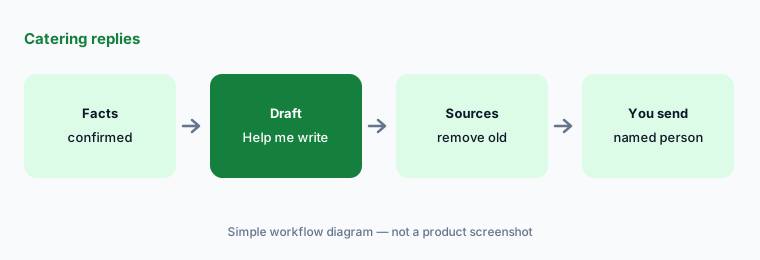
You send:
Draft one catering reply with Help me write from confirmed facts only. Open Sources, remove anything from an old menu, check the package price in your event sheet, and have a named person send it.
5. Which Workspace plan includes Gemini in Sheets
What it is: As listed on 15 October 2026, Google's pricing page shows Business Starter at $7 per user per month, Business Standard at $14, and Business Plus at $22 (list prices with a one-year commitment; introductory discounts for new customers also appear). Gemini in Docs and Sheets is on Business Standard and above; Gemini in Gmail is on all Business plans. Business plans top out at 300 users; Enterprise is via sales.
If your managers are on Business Starter, the food-cost workflow in Sheets needs an upgrade or another tool — check before you promise it.
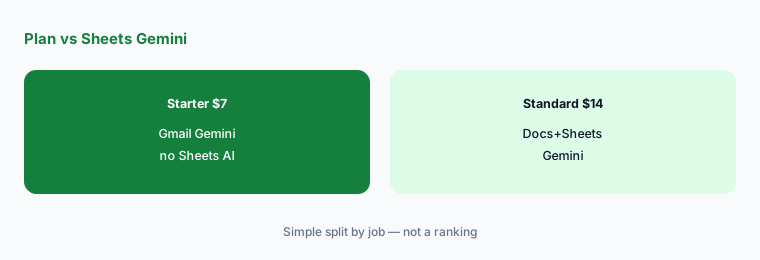
Check the plan grid:
Open workspace.google.com/pricing and confirm whether your chefs and GMs are on Business Standard or above before you standardize on Sheets Gemini workflows.
6. Sanitized exports and privacy
What it is: Google's generative AI privacy page says Workspace data is not reviewed by humans or otherwise used for generative AI model training outside your domain without permission. That does not make it safe to paste guest PII or staff records. Keep card numbers, guest contact lists, employee SSNs, and pay rates tied to names out of prompts. If someone pastes them, delete the copy, tell whoever owns that data, and re-export a sanitized file.
Deleting a prompt does not undo an exposure. Guest records belong in the POS and reservation tools; payroll records belong in payroll.
Strip before you prompt:
Before any Gemini prompt, open your export and delete guest names, phones, emails, card data, employee SSNs, and pay rates tied to names. Keep items, units, prices, dates, and counts only.
Pricing context (October 2026)
As listed on 15 October 2026 at workspace.google.com/pricing (Oct 2026): Business Starter $7, Business Standard $14, Business Plus $22 per user per month (list, one-year commitment). Gemini in Docs/Sheets requires Business Standard or above; Gemini in Gmail is on all Business plans.
Introductory discounts for new customers appear on the pricing page; budget from your invoice and the plan grid, not from memory.
Uncertainty: Workspace list prices and promo bands change. Confirm the live pricing page and your admin console before budgeting. Gemini suggests; it does not send guest mail, change menu prices, or place orders. Feature availability can vary by language and admin settings.
When it’s useful (honest take)
Useful when your restaurant group already works in Google Workspace on Business Standard or above and the chef or GM will decide in the POS and back office.
Less useful when your back office already flags price jumps from invoices (MarginEdge AI, MarketMan AI, Restaurant365 AI), or managers are on Business Starter without Sheets Gemini.
Paying for Gemini and a few other AI tools? The $9 AI toolkit spreadsheet lists every AI subscription you have, what each one costs, and how fast it pays for itself, so you can see which ones are worth the money.
Want someone to do it for you? AI toolkit audit — $19
Related options (educational)
| Need | Better home | Why |
|---|---|---|
| Food-cost lists in Sheets | Gemini for restaurant ops (this page) | Business Standard $14+ |
| Pre-shift notes in a Project | ChatGPT for restaurant ops | Business seats |
| Invoice price alerts | MarginEdge AI | Per location |
| Inventory and recipe costing | MarketMan AI | Published tiers |
| Hospitality twin guide | Gemini for hospitality ops | Workspace Standard+ |
FAQ
How should a restaurant team start with Gemini?
Start with a sanitized food-cost export in a native Google Sheet: item, unit, supplier, last month's price, this month's price — no account numbers or staff names. Ask Gemini to list items whose cost rose more than 5% month over month and check ten rows by hand. The chef and GM decide any menu change in the POS.
Can Gemini send catering replies for us?
Not in this guide. Gemini drafts with Help me write; a named person checks the facts, opens Sources, reads the email, and sends it.
Which Workspace plan do we need for Gemini in Sheets?
As listed on 15 October 2026, Google's pricing page shows Gemini in Docs and Sheets on Business Standard ($14 per user per month), Business Plus ($22), and Enterprise, but not on Business Starter ($7), which gets Gemini in Gmail. Check workspace.google.com/pricing before budgeting.
Is our restaurant data used to train Gemini?
Google's privacy page says Workspace data is not reviewed by humans or otherwise used for generative AI model training outside your domain without permission. That covers the company account; personal accounts have different terms. Still never paste guest PII or staff records.
What if someone pastes card numbers or employee SSNs into a prompt?
Delete the copy, tell whoever owns that data, and re-export a sanitized file. Deleting a prompt does not undo the exposure. The Sheet should hold items, units, prices, dates, and counts only.
Optional next step (if seats overlap)
If restaurant ops pays for Gemini, a chat assistant, a back office with its own AI, and a POS assistant that all look at the same food costs, fix that overlap before adding another seat. Map the overlap with the $19 AI toolkit audit or the $9 AI toolkit spreadsheet. Email Audit $19 or Toolkit spreadsheet $9.
Checkout is live via Stripe. After you pay, we email delivery (spreadsheet) or intake next steps (audit).