Tool · Restaurant ops · OpenTable · Oct 2026
OpenTable AI review (Oct 2026): AI restaurant tools, the diner Concierge, and booking through AI assistants
OpenTable (Booking Holdings) is the reservations and guest platform many restaurants already use for the book. In 2026 it pushed AI into diner discovery (the AI Concierge), bookings through large-language-model assistants, Pro review drafts, table automations, and a deeper Square guest-data partnership. This page is about checking what diners and assistants say about your restaurant — and fixing wrong answers at the source — while a named FOH manager still owns every guest-facing reply. Each section has a Try this.
What this OpenTable page covers
This page is for a restaurant owner, GM, or FOH manager who uses OpenTable or is comparing reservation platforms with AI. The question it answers: what the diner Concierge and AI-assistant booking channels show about your restaurant today, which operator-side AI tools are live vs in testing, what US plans cost, and who approves guest-facing answers and profile facts.
OpenTable’s AI tools page (read 15 October 2026) covers Concierge on the homepage, restaurant profile, and Dining Mode; partnerships with OpenAI, Perplexity, Amazon Alexa+, and Google’s Gemini-powered search; Voice AI integrations; AI-assisted review responses on Pro; table occupancy automation; an AI menu importer; and AI guest insights. Its 26 August 2026 release added Conversational Reporting in testing, richer Table Automations, and AI-generated profile help among 20+ features.
Ground rules: the FOH manager owns every guest-facing Concierge or review answer and every profile fact diners see; the GM approves table automations that change party size or availability; no guest card numbers, phone numbers, or notes with personal data go into any test prompt; OpenTable’s seated-diner and time-saved figures are vendor claims, not our measurement.
Major features (with how someone uses them)
Examples at a glance: each feature has a concrete example from a real job plus a short Try this you can run this week.
1. Diner Concierge: what guests hear about your restaurant (primary)
What it is: OpenTable’s Concierge is a diner-side AI assistant. On the homepage it helps diners discover restaurants by preference; on your restaurant profile it answers questions about menu details, dietary accommodations, ambiance, and dress code; in Dining Mode it handles pre-dining questions after a booking. OpenTable’s August 2026 release says Concierge has 500,000+ monthly active global users (OpenTable’s figure).
Wrong hours, wrong dress code, or a missing allergen line on Concierge usually means your OpenTable profile (or linked menu) is wrong. Fix the source this week — do not argue with the chat.
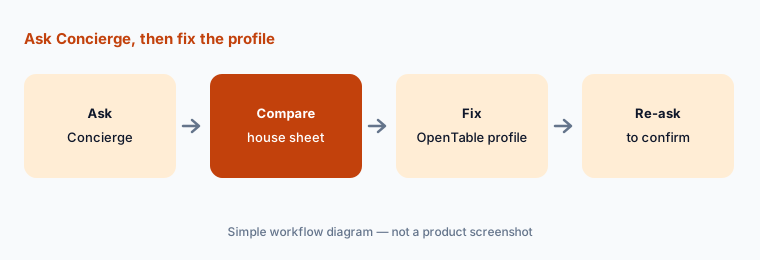
Primary workflow:
Ask OpenTable's diner Concierge five questions about your own restaurant. Fix any wrong answer at its source in your OpenTable profile this week.
2. Bookings through AI assistants (ChatGPT, Gemini, Copilot, Perplexity, Alexa+)
What it is: Diners increasingly ask assistants where to eat. OpenTable partners with OpenAI, Perplexity, Amazon Alexa+, Google (Search, Maps, and Gemini), and Microsoft Copilot so restaurants can appear with real-time availability and a path to book (AI tools page; 26 Aug 2026). What those assistants say still depends on your OpenTable listing and connected data.
Treat assistant answers like a public profile mirror. If ChatGPT or Gemini shows the wrong neighborhood hours, fix OpenTable (and your Google Business Profile) before you change ads.
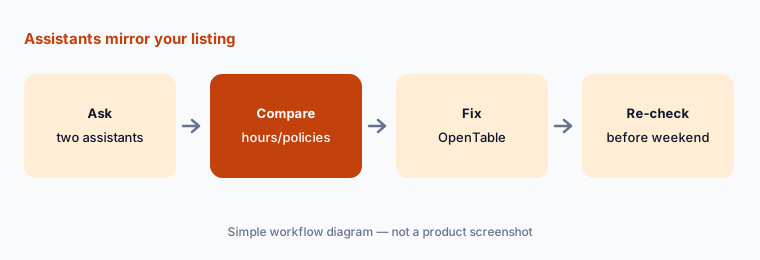
Mirror check:
Ask ChatGPT and Gemini (or Copilot) five facts about your restaurant. Have the FOH manager fix any wrong hour, deposit, or dress-code line in OpenTable before the weekend.
3. AI-assisted review responses (OpenTable Pro)
What it is: OpenTable’s AI tools page describes AI-assisted review responses on OpenTable Pro: the product drafts a reply from the guest’s feedback and your restaurant’s voice; you publish it as-is, edit it, or dismiss it. The FOH manager or GM owns every published reply.
A draft that apologizes for the wrong issue or invents a policy is worse than a delayed reply. Keep a human on every publish click for the first month.
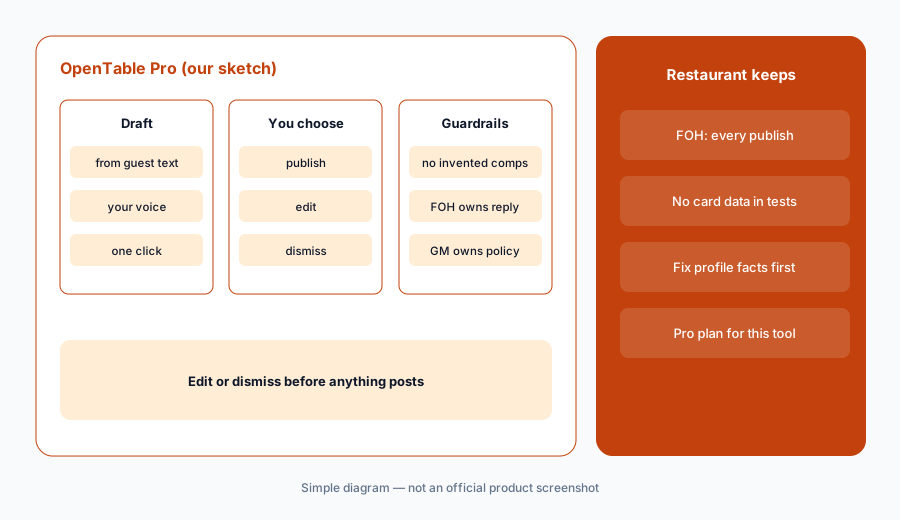
Human on every publish:
Have the FOH manager draft AI replies for ten recent guest reviews. Edit or dismiss any reply that invents a policy or offer before publishing.
4. Table Automations: availability rules the GM still owns
What it is: OpenTable’s table occupancy / Table Automations tools adjust table minimums and availability from rules or templates as demand changes (AI tools; Aug 2026). OpenTable says operators stay in control and that early tests saved about 4.5 hours per month on average — that hours figure is OpenTable’s claim, not ours.
An automation that quietly raises a four-top minimum during a slow weekday can leave money on the table — or strand a walk-in party. The GM reviews automation logs after every busy service for the first two weeks.
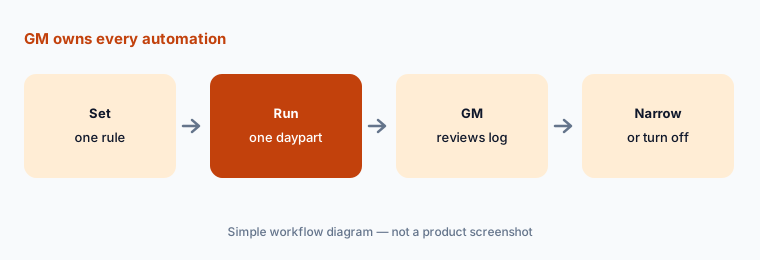
GM owns the rule:
Turn on one Table Automation for a single daypart. Have the GM review every blocked or resized party for that day before widening the rule.
5. Conversational Reporting (in testing) and guest insights
What it is: OpenTable’s 26 August 2026 release lists Conversational Reporting as in testing: operators ask natural-language questions (for example which locations gained the most covers) instead of exporting dashboards. Separately, AI guest insights and GRM enhancements surface richer guest history for personalized hospitality — still for staff use, not for unattended guest messages.
Anything labelled in testing can change or disappear. Do not build a weekly meeting around Conversational Reporting until OpenTable marks it generally available for your plan.
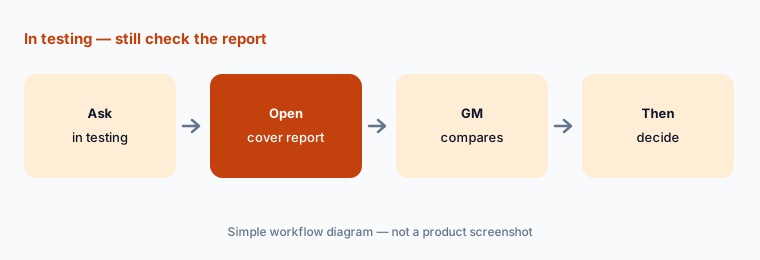
Still in testing:
If you have Conversational Reporting access, ask one covers question and have the GM check it against the standard cover report before anyone changes staffing.
6. Square partnership (18 Aug 2026): reservations meet payments
What it is: On 18 August 2026 Square and OpenTable announced an expanded preferred partnership: reservation history and dining preferences can sit with Square transaction data in a unified guest profile (opt-in), so operators can link bookings to spend and plan loyalty or marketing with fuller context. It builds on the POS partnership that began in 2022 and covers the US, Canada, UK, Australia, Ireland, and France.
A richer guest profile is still a privacy and accuracy job. The FOH manager decides what staff may see on the floor; marketing campaigns that use the joined data need the owner’s approval before anything sends.
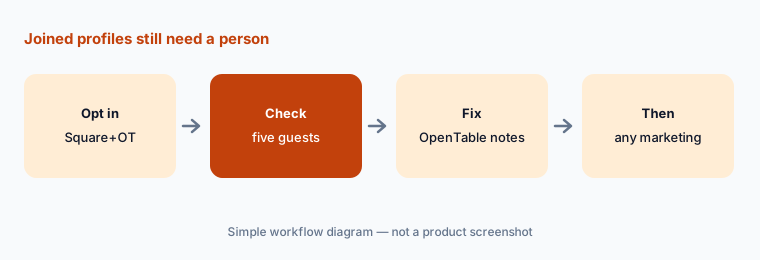
People still verify:
If you use Square and OpenTable, spot-check five regulars in the joined profile. Have the FOH manager fix any wrong preference or allergy at the OpenTable source before marketing uses the data.
Pricing context (October 2026)
OpenTable’s US plans page (read 15 Oct 2026) lists three published plans: Basic $149/month (network cover free for 30 days, then $1.50 per network cover; website reservations $0.25/cover or $49/month flat), Core $299/month ($1 per network cover; website reservations included), and Pro $499/month ($1 per network cover; website included). Prepaid experiences carry a 2% service fee on all three; prepaid ticketing 2% on Core and Pro. AI-assisted review responses are positioned on Pro.
Network cover fees apply when a diner discovers you on OpenTable’s site, app, or affiliate network (on Basic, website and affiliate bookings also incur cover fees). Phone and walk-in covers do not. Standard contract is one year with annual auto-renew; OpenTable asks for 30 days’ notice before renewal if you do not want to renew. Hardware and POS integrations are separate.
Uncertainty: Conversational Reporting was labelled in testing on 15 Oct 2026. Voice AI partner counts differ by page (AI tools page cites 10+ named providers; the Aug 2026 release cites 20+ partners globally). Seated-diner lifts, Concierge MAU, and automation time-saved figures are OpenTable’s internal claims, not our measurement. Confirm which AI features ship on Basic vs Core vs Pro on your quote.
When it’s useful (honest take)
Useful when you already run the book on OpenTable, care what diners and AI assistants say about your restaurant, and have an FOH manager who will fix profile facts and approve review replies.
Less useful when you want a CRM-first reservation stack with phone Voice AI in one vendor (SevenRooms AI), or you mainly need POS-side sales AI (Toast AI, Square for Restaurants AI).
Paying for OpenTable AI and a few other AI tools? The $9 AI toolkit spreadsheet lists every AI subscription you have, what each one costs, and how fast it pays for itself, so you can see which ones are worth the money.
Want someone to do it for you? AI toolkit audit — $19
Related options (educational)
| Need | Better home | Why |
|---|---|---|
| Reservations + Concierge + LLM booking | OpenTable AI (this page) | Basic $149 · Core $299 · Pro $499 + covers |
| Guest CRM + Voice AI + seating AI | SevenRooms AI | Quote only |
| POS + Square AI / Managerbot | Square for Restaurants AI | Free $0 · Plus $49 · Premium $149 |
| Toast IQ on the POS | Toast AI | Starter Kit $0 · Point of Sale $69 · custom |
| Compare OpenTable vs SevenRooms | Toast vs Square (POS) · later SevenRooms vs OpenTable | See also today’s compare pack |
FAQ
What is OpenTable's diner Concierge?
Concierge is OpenTable’s diner-facing AI assistant. It helps guests discover restaurants on the homepage, answers profile questions (menu, diet, ambiance, dress code), and supports pre-dining questions in Dining Mode. Wrong answers usually mean your OpenTable profile needs a fix.
Can guests book my restaurant through ChatGPT or Gemini?
OpenTable partners with OpenAI, Perplexity, Amazon Alexa+, Google (including Gemini-powered experiences), and Microsoft Copilot so diners can find real-time availability and book. Keep hours, deposits, and policies correct in OpenTable so those assistants stay accurate.
How much does OpenTable cost in October 2026?
On the US plans page we read 15 Oct 2026: Basic $149/month, Core $299/month, Pro $499/month, plus per-network-cover fees ($1.50 after a 30-day free period on Basic; $1 on Core and Pro). Website reservation fees differ by plan. Confirm add-ons and contract terms with OpenTable.
Is Conversational Reporting available to every restaurant?
OpenTable’s 26 August 2026 release lists Conversational Reporting as in testing. Treat it as early access until OpenTable marks it generally available on your plan.
Who should approve OpenTable AI output?
The FOH manager owns Concierge/profile facts and every published review reply; the GM owns table automations that change availability; the owner approves marketing that uses joined OpenTable + Square guest data. AI drafts — people publish.
Optional next step (if seats overlap)
If you pay for OpenTable, a separate review-reply tool, and a POS guest CRM that all touch the same diners, that overlap is worth mapping. Map the overlap with the $19 AI toolkit audit or the $9 AI toolkit spreadsheet. Email Audit $19 or Toolkit spreadsheet $9.
Checkout is live via Stripe. After you pay, we email delivery (spreadsheet) or intake next steps (audit).