Role guide · Research ops · Claude · Oct 2026
Claude for research ops (Oct 2026): interview guides, synthesis checks, and readouts with Projects
Research ops role guide — a research ops Project in Claude that turns a study brief into a discussion guide, checks a sanitized interview summary for findings that rest on a single participant, and drafts readouts that quote only what participants actually said. Claude reads what you paste and drafts; the researcher who ran the sessions checks every claim and decides what goes in the readout. Companion to ChatGPT for research ops and Claude for product ops.
Who this guide is for
Research ops leads, UX researchers, and the product designer who runs five interviews a month and then has to write them up. You already have Claude (or are choosing an assistant) and want help with the written side of research: discussion guides, synthesis, and readouts. If your team works in ChatGPT, see ChatGPT for research ops. If your interviews already live in a research repository, read Dovetail AI first — its own Chat answers with links to source highlights. Product deep-dive: Claude. Sibling role guides: Claude for product ops, Claude for customer success, Claude for data ops.
How Projects work (Anthropic’s help center, read 9 October 2026): a project is a self-contained workspace with its own chat history and knowledge base. Files you add to project knowledge are used in every chat in that project, and project instructions apply to all of them. Projects are on every plan; Free accounts can create up to five, and on paid plans project knowledge switches to retrieval when it nears the context limit, which Anthropic says expands capacity up to 10x. On Team and Enterprise you can share a project with colleagues as Can view or Can edit, and owners can turn project sharing off for the organization. Anthropic also says a new version of projects is in beta, starting with Claude Code; existing chat projects keep working, and this guide uses those.
Ground rules for this guide: Claude never invents a quote, a participant, or a count — anything it can’t find in what you pasted is marked “not in the source.” It never decides what the team builds; the researcher owns the finding and the product team owns the decision. Never paste participant names, emails, employers, recordings, or anything a consent form didn’t cover; replace people with a participant code (P1, P2) and a segment. Keep research in a Team or Enterprise workspace: Anthropic says it does not use inputs or outputs from its commercial products to train models by default (unless you send feedback with the thumbs buttons).
Major features (with how someone uses them)
Examples at a glance: each feature has a concrete example from a real job plus a short Try this you can run this week.
1. Project research ops + single-participant check (primary)
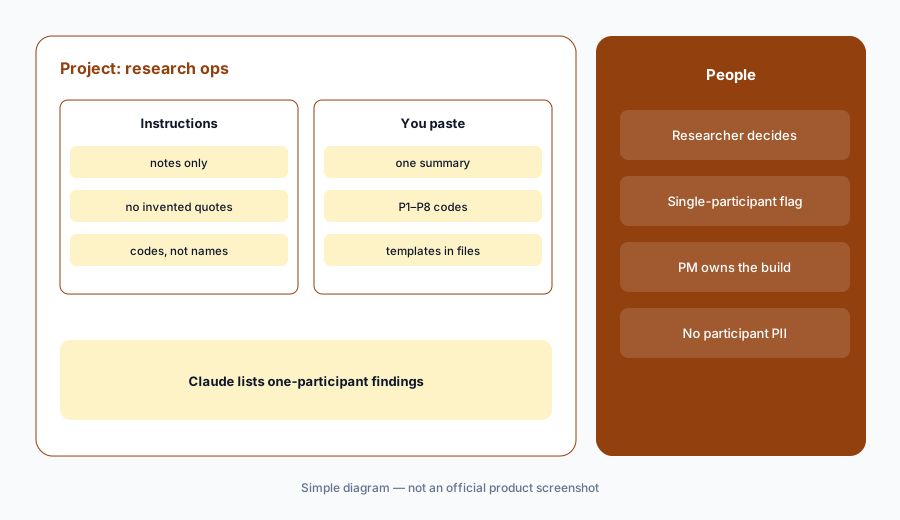
What it is: Create a project called research ops. In project instructions, write the rules once: work only from what is pasted or in project knowledge; refer to people only by participant code; never invent a quote, a participant, or a count; say “not in the source” when something is missing; never recommend what to build. Add your research question template, your readout template, and a short glossary of product terms to project knowledge. Then paste one sanitized interview summary — the findings list with the participant codes behind each — and ask which findings rest on a single participant.
This is the cheapest useful check in research: a finding that sounds strong in a summary often traces back to one vivid session. Claude can count participant codes in the text you pasted and list the findings with only one; it cannot tell you whether that one participant was right. The researcher decides whether to keep the finding, mark it as a single-participant signal, or test it in the next round.
Primary workflow:
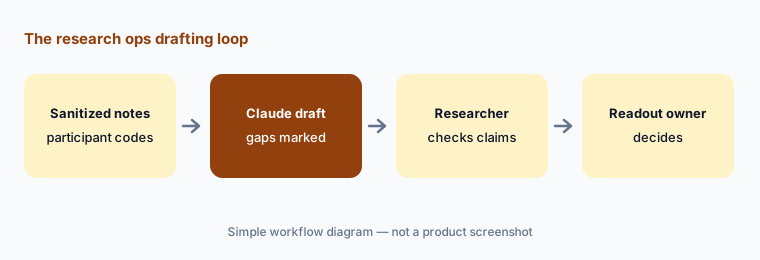
Project research ops. Paste one sanitized interview summary. Ask which findings rest on a single participant.
2. Discussion guides from a study brief
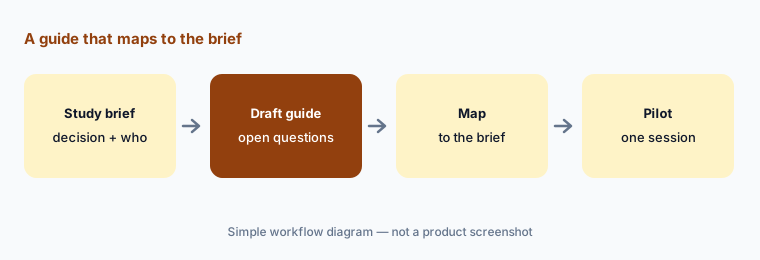
What it is: Paste the study brief — the decision it should inform, who you are talking to, and what you already know — and ask Claude for a discussion guide in your house format: warm-up, three to five topic blocks, and a wrap-up. Tell it to write open questions only, to put no product names or features in the first block, to flag any question that suggests an answer, and to map every question to one research question from the brief. Ask for the mapping as a short table so you can see which research questions have no questions at all.
Guides drift: a stakeholder adds “Would you use a feature that…?” and the study turns into a sales pitch. The mapping table is the guard — any question that maps to nothing in the brief is cut, and any leading wording is rewritten before the pilot session.
Map every question:
Paste your next study brief. Ask Claude for a discussion guide with every question mapped to one research question and leading wording flagged. Cut anything that maps to nothing and pilot the guide once.
3. Synthesis checks on sanitized notes
What it is: After the sessions, paste sanitized notes for each participant (code, segment, and notes — no names) and your draft findings. Ask Claude to list, for each finding, the participant codes whose notes support it, the codes whose notes contradict it, and any finding with no support in the notes at all. Ask it to quote the supporting line word for word with its participant code. Contradictions matter as much as support: a finding with four supporters and three people saying the opposite is a split, not a theme.
Counts from a chat are a starting point. Before you write “most participants,” count the codes yourself in the notes. If your interviews live in Dovetail, its Chat can answer the same question with links to highlights, and the Dovetail connector for Claude (announced 21 April 2026) lets Claude search projects and reference quotes with the same permissions you have in Dovetail.
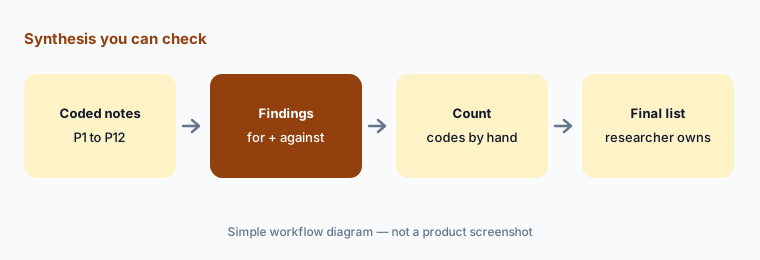
Support and contradiction:
Paste coded notes from one study and your draft findings. Ask Claude for supporting and contradicting participant codes per finding, with exact lines. Count the codes yourself before you write “most.”
4. Readout drafts that never invent a quote
What it is: Once findings are final, paste them with their participant codes and the exact quotes you chose, plus your readout template. Ask for a draft readout: summary, findings with evidence, open questions, and what the study did not cover. Tell Claude to use only the quotes you pasted, word for word, and to write “no quote selected” rather than paraphrase one into quotation marks. Ask for a separate list of claims in the draft that go beyond the findings.
The most common way a readout misleads a roadmap meeting is a paraphrase in quotation marks. Search the notes for every quoted line before you share, and keep recommendations in the product team’s hands — the readout says what participants did and said, and what the team still doesn’t know.
Quotes from the notes only:
Paste your final findings and chosen quotes. Ask Claude for a readout draft that uses those quotes word for word and lists any claim beyond the findings. Search the notes for every quote before sharing.
5. Share the project with the research team
What it is: On Team and Enterprise plans, share the project with the researchers and designers who use it. Give most people Can view (they can chat in the project and see its knowledge and instructions) and one or two owners Can edit (they change instructions and knowledge). Keep project knowledge small and current: the guide template, the readout template, the glossary, and your participant-code convention. Keep study notes in per-study chats or your repository, not in shared project knowledge, so one study’s participants don’t leak into another’s synthesis.
If your interviews live in Dovetail, decide whether people should paste notes into Claude at all or use the connector instead, which follows Dovetail permissions. Either way, the research ops lead writes that rule down in the project instructions.
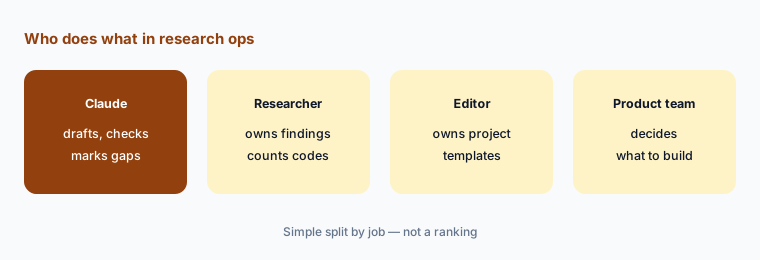
Two editors, everyone else views:
Share your research ops project with your researchers as Can view and one senior researcher as Can edit. Ask the editor to date the templates in project knowledge and remove anything study-specific.
6. What never goes into the project
What it is: Write a short list and pin it in the project instructions: no participant names, emails, phone numbers, employers, or job titles that identify someone; no recordings or raw transcripts with personal details; nothing the consent form didn’t cover; no incentive or payment details; no credentials. Replace people with a participant code and a segment (“P4, mid-market admin”). If someone pastes personal data by mistake, delete the chat and tell the project owner. Use the company’s Team or Enterprise workspace, never a personal Free, Pro, or Max account, for research data.
Anthropic’s commercial privacy article says inputs and outputs from products such as Claude for Work are not used for training by default, but that conversations you send as feedback with the thumbs buttons may be stored for up to five years and used. Team and Enterprise owners can turn that feedback button off for the organization.
Pin the rules:
Add a “never paste” list of five items to your research ops project instructions, then paste a test note with a fake participant name and check that Claude flags it.
Pricing context (October 2026)
Anthropic’s pricing page (as listed 9 Oct 2026, USD): Free $0 (projects up to five, no project sharing); Pro $17 per month with annual billing ($200 billed up front) or $20 billed monthly; Max from $100 per month. Team (2 to 150 people): Standard seat $20 per seat per month billed annually or $25 monthly; Premium seat $100 annually or $125 monthly, with 5x the usage of Standard. Enterprise: a seat price plus usage at API rates, listed as US$20 per seat per month billed annually with usage cost on top.
Project sharing is listed for Team and Enterprise only; Free, Pro, and Max projects are personal. For a research team that shares one project, that makes Team the starting point. The Dovetail connector for Claude needs a Dovetail workspace; Dovetail lists Free ($0) and Enterprise (custom) on its pricing page as of 9 October 2026.
Uncertainty: Plan names, seat prices, usage limits, and the new version of projects can change; Anthropic says the new projects are rolling out in stages, and the Enterprise usage component depends on models and tasks, so it has no fixed monthly total. Consent and data rules for research participants are your organization’s call. This is product education, not legal or privacy advice.
When it’s useful (honest take)
Useful when your team writes guides, synthesis, and readouts by hand every week, someone owns the shared project and its templates, and researchers are willing to check drafts against coded notes.
Useful when findings tend to travel further than their evidence and you want a fast second reader that counts participant codes before the review — with the researcher still deciding.
Less useful when notes can’t be sanitized before they reach a chat tool, your research repository already answers the same questions with links to highlights, or anyone expects Claude to say what to build.
Paying for Claude and a few other AI tools? The $9 AI toolkit spreadsheet lists every AI subscription you have, what each one costs, and how fast it pays for itself, so you can see which ones are worth the money.
Want someone to do it for you? AI toolkit audit — $19
Related options (educational)
| Need | Better home | Why |
|---|---|---|
| Screeners, survey drafts, and feedback summaries in ChatGPT | ChatGPT for research ops | Business workspace; GPTs moving to plugins |
| Interview themes with source highlights | Dovetail AI | Research repository with Chat and Agents |
| AI-moderated and unmoderated studies | Maze AI or UserTesting AI | Where the sessions run |
| In-product survey themes | Sprig AI | Open-text analysis at the source |
| Product ops drafting in Claude | Claude for product ops | Readouts, release notes, feedback themes |
| Inventory before adding a seat | Stack map for research ops | One row per job and tool |
FAQ
How should a research ops team set up Claude?
Create a research ops Project with instructions that forbid invented quotes, participants, or counts and require participant codes instead of names. Add your guide and readout templates and a glossary to project knowledge, share it on a Team plan, and paste only sanitized, coded notes.
Can Claude do our research synthesis?
It can check your synthesis: list which participant codes support or contradict each finding, flag findings that rest on one participant, and quote lines word for word from what you pasted. The researcher owns the findings and counts codes before writing “most.”
Will Claude make up participant quotes?
It can if you let it paraphrase. Put “never quote a line that isn’t in the pasted notes” in the instructions, ask for “no quote selected” instead of paraphrases, and search your notes for every quoted line before a readout goes out.
Is research data used to train Claude?
Anthropic says inputs and outputs from its commercial products, such as Claude for Work, are not used for training by default; feedback you send with the thumbs buttons may be stored and used. Keep participant names and identifying details out of the project either way.
What does Claude cost for a research team in October 2026?
As listed on 9 October 2026: Team Standard seats $20 per seat per month billed annually or $25 monthly, Premium seats $100 annually or $125 monthly, for 2 to 150 people. Pro is $17 a month annually or $20 monthly but has no project sharing. See claude.com/pricing.
Optional next step (if seats overlap)
If research ops pays for Claude, ChatGPT, a repository’s AI add-on, and a testing tool’s summaries that all synthesize the same interviews, that overlap is worth a look. Map the overlap with the $19 AI toolkit audit or the $9 AI toolkit spreadsheet. Email Audit $19 or Toolkit spreadsheet $9.
Checkout is live via Stripe. After you pay, we email delivery (spreadsheet) or intake next steps (audit).