Compare · Learning ops · LMS · Oct 2026
Docebo vs 360Learning (Oct 2026): AI LMS platforms for enterprise and collaborative learning
Docebo and 360Learning are both learning platforms with a lot of new AI — course drafts from documents, assistants that answer learners and admins, agents, and MCP servers that bring training into Claude and ChatGPT. They start from different ideas of who writes the training. Docebo is built for a central L&D or customer-education team running large audiences, with AI that drafts lessons, coaches through roleplay, and reports. 360Learning is built around internal experts writing and updating courses themselves, with AI that helps them draft and helps admins act on the catalog. This page compares them by who authors, AI authoring, assistants and agents, MCP, practice and skills, and pricing transparency — not as a ranking — with a Try this for each.
What this comparison covers
This page is for an L&D or learning operations lead choosing between Docebo and 360Learning, or replacing an older LMS and shortlisting both. The question it answers: for the training programs you actually run, who would write each one, how would each platform’s AI help that person, and who approves before learners see it.
The short version: Docebo puts AI in the hands of a central team — Creator drafts lessons with knowledge checks from a document, AI roleplay gives practice feedback against your rubric, the AI assistant tutors learners and answers data questions, and Docebo Agents and Knowledge are in beta. 360Learning puts AI in the hands of the experts who write courses and the admins who run the catalog — the AI course builder drafts from an expert’s own material, and the AI Companion searches, answers training-data questions, and carries out bulk changes with a confirmation step. Both have an MCP server in beta. Docebo publishes no prices; 360Learning publishes its Team plan.
Facts were read on each vendor’s website, help center, and release notes on 11 October 2026, the same day as our Docebo AI and 360Learning AI reviews. Ground rules for either platform: the policy or process owner approves every AI-drafted course; completion is not competence; bulk AI changes are confirmed by the course owners they affect; and vendor statistics on either site are vendor claims, not repeated here.
| Question | Docebo | 360Learning |
|---|---|---|
| What it sells | An enterprise learning platform for employees, customers, and partners, with Creator, AI roleplay, an AI assistant, MCP, and the Companion browser extension | A collaborative learning platform where internal experts write courses, with an AI course builder, the AI Companion, skills features, and MCP |
| Who usually authors | L&D and customer-education teams, with policy owners as reviewers | Subject-matter experts as authors and co-authors (including a contributor role), with L&D running the program |
| AI authoring | Creator: a lesson with knowledge checks from a document or prompt, voiceover, avatar video, one-click translation, SCORM export | AI course builder: outline first, then generate; inline AI editing; AI quizzes that follow Company culture settings |
| Assistant and agents | AI assistant (formerly Harmony) with in-course tutor and plain-language reporting; Docebo Agents and Knowledge in beta since 28 Sep 2026 | AI Companion modes: Search, Insights, Action (bulk changes with confirmation and revert), Coach, Support; Companion inside courses since 16 Sep 2026 |
| MCP server | Beta since 23 Mar 2026; ChatGPT, Copilot via Copilot Studio, Claude, and Gemini listed; Power User tools since 28 Sep | Beta since 21 Sep 2026, on request; Claude, ChatGPT, and Dust at launch |
| Practice and skills | AI roleplay add-on with custom rubrics and human review | Automatic AI skill tagging (off by default), content gap dashboard, positioning quizzes |
| Published pricing | No prices; Elevate and Enterprise by quote, AI features on usage-based AI credits | Team plan $8 per active user per month (up to 100 users); Business and Enterprise by quote |
Major features (with how someone uses them)
Examples at a glance: each feature has a concrete example from a real job plus a short Try this you can run this week.
1. Who writes your three biggest programs (primary)
What it is: The clearest difference is who the AI is built to help. In Docebo, a content team drafts in Creator and brings in owners as reviewers through real-time comments; the platform is designed for training employees, customers, and partners at scale from one place. In 360Learning, the expert is the author: the AI course builder starts from their documents, co-author suggestions point to colleagues with the right skills, and a contributor role lets experts create and edit only their own courses while L&D runs the program. Most companies have both kinds of programs.
List the programs that take most of your effort — onboarding, compliance, product training, customer academy — and write down who really writes each today and who approves it. A program owned by a central team with a policy owner signing off fits Docebo’s model naturally; one where engineers or store managers know the content best and change it often fits 360Learning’s. Then ask each vendor to show that author using the AI on your material.
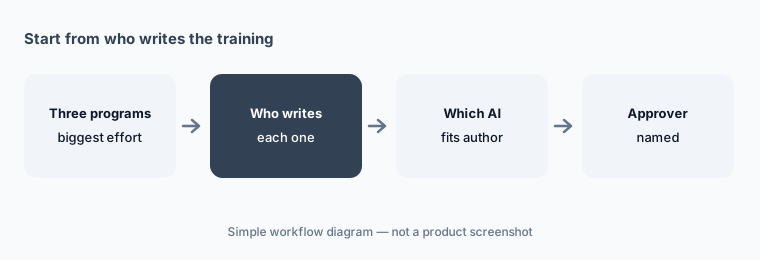
Primary workflow:
List your three biggest training programs and who writes each. Note which platform’s AI authoring fits each author and who approves.
2. AI authoring: Creator vs the AI course builder
What it is: Docebo Creator turns a document or prompt into a structured lesson with screens, images, and knowledge checks, then lets you add AI voiceover, an avatar video from a script, games, and one-click translation; you publish in Docebo or export SCORM (added 15 June 2026), and AI captions should be reviewed before publishing. The 360Learning AI course builder works outline-first: the author refines an outline with the AI and adds documents before clicking Generate course; inline AI editing reworks text, AI quizzes follow your Company culture settings, and learners see a disclaimer on courses with AI-generated content.
Run both on the same source and have the same owner review both drafts. Compare how many corrections each needed, not how fast it drafted — speed is similar and the review is where the time goes.
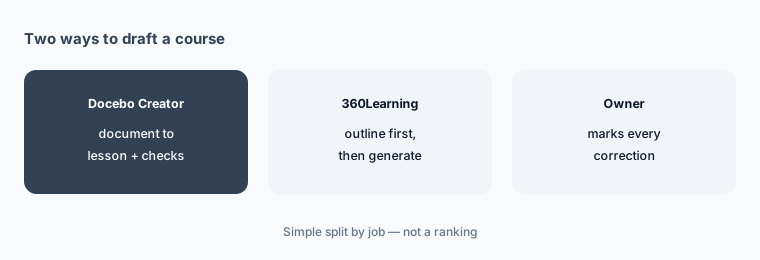
Same source, both tools:
Give both trials the same policy document. Have the same owner mark corrections on each draft and count them before you compare anything else.
3. Assistants and agents: AI assistant and Agents vs the AI Companion
What it is: Docebo’s AI assistant (renamed from Harmony on 31 August 2026) does semantic search and recommendations, acts as an AI tutor inside courses, answers admins’ how-to questions, and answers plain-language questions about learning data; Docebo Agents (beta) run defined workflows and Docebo Knowledge (beta) connects outside sources. 360Learning’s AI Companion works in modes: Search quotes the source course, Insights answers training-data questions for all roles except learners, Action carries out bulk changes across up to 500 courses with a confirmation step and instant revert, Coach recommends one next course or path, and Support answers platform questions.
Test the data answers the same way in both: ask a question you can check against a standard report. For anything that changes the catalog or enrollments — an Action Mode bulk change or a Docebo agent — send the list to the owners it affects before you confirm.
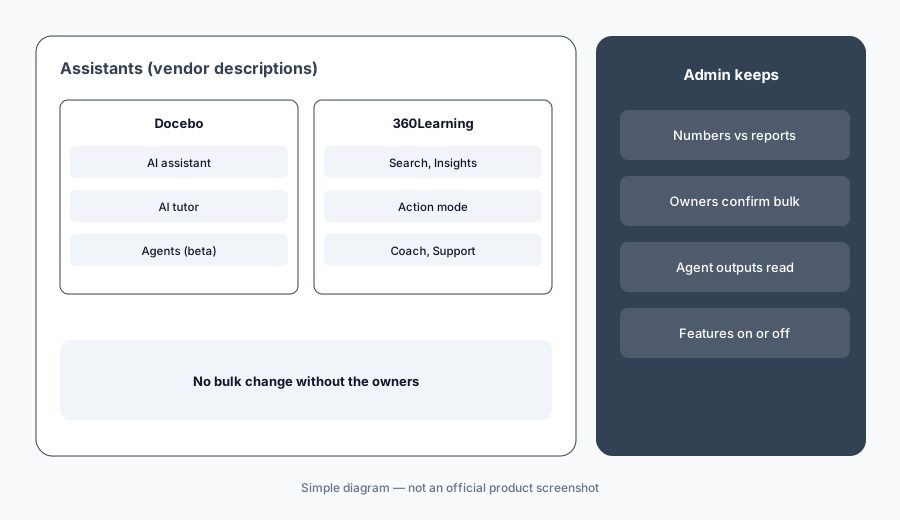
One checkable question:
Ask each platform’s assistant the same overdue-training question. Compare both answers with the standard report before trusting either.
4. MCP servers: Docebo’s wider beta vs 360Learning’s new beta
What it is: Both connect training to AI assistants through the Model Context Protocol, and both are in beta. The Docebo MCP server (beta since 23 March 2026) lists ChatGPT Enterprise/Team, Microsoft Copilot via Copilot Studio, Claude Enterprise/Team, and Gemini Enterprise; a Superadmin sets it up, users sign in with OAuth, and since 28 September Power Users can manage courses and enrollments within their existing permissions. The 360Learning MCP server (beta since 21 September 2026, on request through your Customer Success Partner or Solutions Engineer) lets people search courses, paths, and activities they have access to from Claude, ChatGPT, and Dust.
Start read-only in either: learners asking about their own deadlines or searching for a course. Write tools that enroll people are access to training records — give them to a small named group and keep bulk changes in the platform itself until you’ve seen how the assistant reads requests.
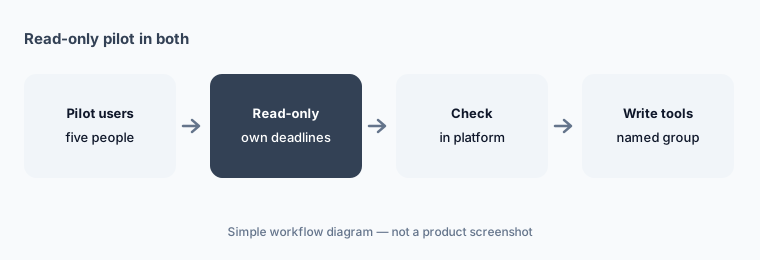
Read-only pilot in both:
Connect each platform’s MCP server for five pilot users. Ask for training on one topic and check every suggested course is current and visible to that person.
5. Practice and skills: AI roleplay vs skill tagging and content gaps
What it is: Docebo sells AI roleplay as an add-on: learners practice a conversation by voice or chat with an AI character, with custom rubrics (22 June 2026), AI-suggested criteria, multilingual scenarios, and since 21 July a human review step where reviewers see the AI evaluation. 360Learning leans on skills: automatic AI skill tagging of courses (off by default), a content gap dashboard showing where skills lack courses, and positioning quizzes. Docebo’s strength here is practice; 360Learning’s is mapping what the catalog covers.
Decide which problem you have. If people know the policy but freeze on the call, practice matters — have the coaching manager review early roleplay attempts. If nobody knows which skills your courses cover, tagging matters — have course owners remove tags they wouldn’t defend before tags drive recommendations.
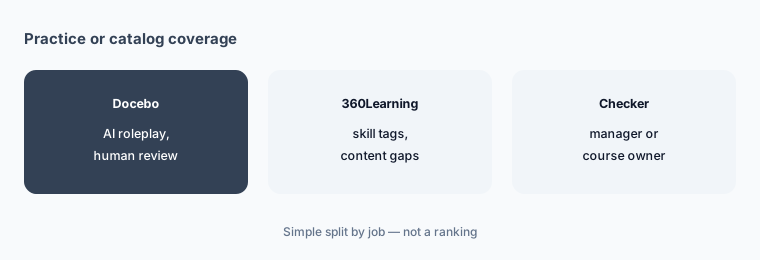
Name the gap first:
Write down whether your bigger gap is practice or knowing what your catalog covers. Pilot only the matching feature, with a manager or course owner reviewing every result.
6. Pricing transparency: custom credits vs a published Team plan
What it is: Docebo publishes no prices: its pricing page shows Elevate and Enterprise tiers with custom pricing based on monthly, yearly, or registered active users, lists AI features and the roleplay add-on as usage-based AI credits, and says it suits organizations training at least 250 learners. 360Learning publishes its Team plan at $8 per active user per month for up to 100 users, with add-ons at $2 per user per month each and a 30-day trial; Business and Enterprise plans are custom, usually annual. Neither says publicly which AI features come with each plan.
Send both the same scope: learners by audience (employees, customers, partners), number of authors, AI features you plan to use by name, MCP access, integrations, and languages. Ask Docebo how AI credits are counted and what overages cost; ask 360Learning which AI Companion modes and the MCP beta are in your plan.
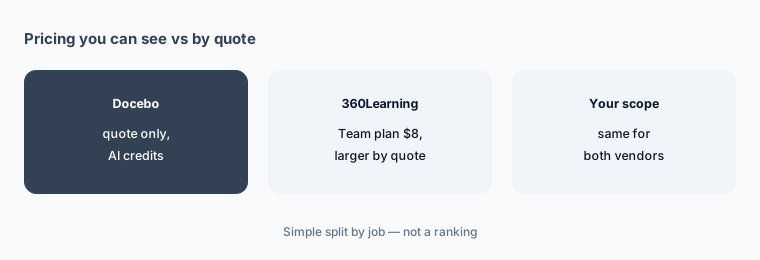
Quote the same scope:
Send both vendors the same scope: learners by audience, authors, named AI features, MCP access, and languages. Ask how AI use is counted in each quote.
Pricing context (October 2026)
Docebo publishes no prices (checked 11 Oct 2026). Its pricing page lists Elevate and Enterprise with custom pricing on monthly, yearly, or registered active-user models, and AI features and the Docebo Roleplay add-on as usage-based AI credits; the cost of credits isn’t published.
360Learning publishes its Team plan at $8 per active user per month for up to 100 users, billed monthly, with add-ons at $2 per user per month each and a 30-day free trial (checked 11 Oct 2026). Business and Enterprise plans are custom-priced, usually on annual contracts.
Uncertainty: Docebo’s AI credit costs and allowances are unknown until you get a quote, and 360Learning doesn’t publish which AI Companion modes or the MCP beta are in the Team plan. Several features on both sides are beta (Docebo Agents and Knowledge, both MCP servers) or switched on by request, and both vendors shipped AI changes in September 2026 — confirm what your trial includes. Vendor statistics on both sites are not repeated here.
When it’s useful (honest take)
Docebo is useful when a central L&D or customer-education team trains large, mixed audiences from one platform, wants AI drafting, practice through roleplay, and reporting in one place, and can work with custom pricing and AI credits.
360Learning is useful when internal experts already write much of your training and you want AI that helps them draft and helps admins keep the catalog current — and, for a small team, a published price to start from.
Less useful when (either one) you have a handful of courses and a few dozen learners, nobody owns course content after launch, or anyone expects AI drafts or bulk changes to go out without the owner’s approval.
Still choosing between Docebo and 360Learning? The $19 AI toolkit audit gives you a written plan for which tools to keep using and which to drop across your whole AI stack, including this pair.
Prefer to do it yourself? Spreadsheet — $9
Related options (educational)
| Need | Better home | Why |
|---|---|---|
| Enterprise LMS with AI authoring, roleplay, and MCP | Docebo AI | Creator, roleplay, AI assistant |
| Collaborative courses written by internal experts | 360Learning AI | AI course builder, AI Companion |
| Skills, learning, and talent on one enterprise platform | Cornerstone AI | Skills inference, readiness agents |
| LMS for several audiences with AI course drafts | Absorb LMS AI | Aura agents, Absorb Create |
| Deeply custom courses you can publish to any LMS | Articulate 360 AI | Rise, Storyline, SCORM |
| Learning experience layer with an AI coach | Degreed AI | Maestro, skill reviews |
Related comparisons
FAQ
Is Docebo or 360Learning better?
Neither in general, and this page is not a ranking. Docebo suits a central team training large audiences with AI drafting, roleplay, and reporting; 360Learning suits companies where internal experts write courses and admins use AI to keep the catalog current. List your three biggest programs and who writes each to see which fits.
How much do Docebo and 360Learning cost in October 2026?
Docebo publishes no prices and uses custom quotes with usage-based AI credits. 360Learning publishes its Team plan at $8 per active user per month for up to 100 users, with Business and Enterprise by quote (both checked 11 October 2026).
Do both have an MCP server?
Yes, both in beta. Docebo’s has been in beta since 23 March 2026 and lists ChatGPT, Copilot via Copilot Studio, Claude, and Gemini; 360Learning’s launched in beta on 21 September 2026, on request, for Claude, ChatGPT, and Dust.
Which one has AI roleplay?
Docebo sells AI roleplay as an add-on, with custom rubrics and a human review step. 360Learning’s AI focuses on authoring, the AI Companion, and skills tagging rather than roleplay practice.
Can either platform’s AI change courses in bulk?
360Learning’s AI Companion Action Mode can update up to 500 courses at once with a confirmation step and instant revert. Docebo Agents (beta) run defined workflows. In both, send the list of affected courses to their owners before you confirm.
Optional next step (if seats overlap)
If you pay for an LMS, a separate authoring tool, an AI video tool, and chat seats that all draft the same courses, that overlap is worth mapping. Map the overlap with the $19 AI toolkit audit or the $9 AI toolkit spreadsheet. Email Audit $19 or Toolkit spreadsheet $9.
Checkout is live via Stripe. After you pay, we email delivery (spreadsheet) or intake next steps (audit).