Compare · Learning ops · LMS · Oct 2026
Absorb vs Cornerstone (Oct 2026): AI in enterprise LMS and talent platforms
Absorb LMS and Cornerstone both sell enterprise learning with a lot of new AI, but they are different sizes of answer. Absorb is a learning management system — courses, audiences, reports — whose AI, Absorb Aura, mostly drafts courses and answers learners and admins. Cornerstone is a talent platform — learning plus performance, succession, and internal mobility — whose AI, now branded Cornerstone Workforce AI, starts from skills: what a role needs and what a person probably has. This page compares them by scope, AI authoring vs skills inference, admin effort, extended-enterprise training, agents and MCP, and pricing transparency — not as a ranking — with a Try this for each.
What this comparison covers
This page is for an L&D, HR, or learning operations lead at a mid-sized or large organization choosing between Absorb and Cornerstone, or replacing an older LMS and shortlisting both. The question it answers: for the jobs your learning system has to do next year, does an LMS with AI cover them, or do you need a talent platform — and who owns each job either way.
The short version: Absorb puts its AI into course work — Aura Create drafts a course from a document, Absorb Create adds reviewers and approvals, Aura Admin Assist answers reporting questions, and learner agents answer from assigned training in the LMS, Teams, and Chrome. Cornerstone puts its AI into skills — the Skills Engine and People Graph infer skills, Skills Architect keeps your own skills language, and readiness agents act on that data for goals, onboarding, mobility, and insights. Both also do the other side, less centrally. Neither publishes prices.
Facts were read on each vendor’s website on 11 October 2026, the same day as our Absorb LMS AI and Cornerstone AI reviews. Ground rules for either: the process owner approves every AI-drafted course; HR and the managers who know each role own skills decisions; completion is not competence; and vendor statistics on either site are vendor claims, not repeated here.
| Question | Absorb LMS | Cornerstone |
|---|---|---|
| What it sells | An LMS for employees, customers, partners, and franchisees, with Absorb Create authoring, Absorb Skills, and the Aura AI agents | An enterprise talent platform — learning, performance, succession, internal mobility — now called Cornerstone Workforce AI (formerly Galaxy) |
| Where AI starts | Course work: Aura Create drafts courses from your documents; Aura Admin Assist answers admin questions | Skills: the Skills Engine and People Graph infer skills for roles and people; Skills Architect governs your own skills language |
| AI authoring | Aura Create and Create AI drafts, AI quizzes and voiceover, reviewer and approval workflows in Absorb Create | AI knowledge checks and summaries from your content (content vectorization), Content Studio curation, Cornerstone Create |
| Admin help | Aura Admin Assist and Intelligent Assist turn plain-language questions into reports | Admin dashboard with compliance risks and nudges; Reporting Assistants; Workforce Insights agent |
| External audiences | Separated portals for vendors, franchisees, distributors, and resellers; PCI-compliant eCommerce | Extended Enterprise+ package: self-registration, ecommerce, and payments for external audiences |
| Agents and MCP | Learner agents in the LMS, Teams, and Chrome; Aura Rehearse and an MCP connector marked coming soon | Readiness agents (bought one by one, need Intelligence+) working through MCP and A2A; Copilot and Agentforce options |
| Published pricing | No prices; quote form by number of learners | No prices; packages licensed per employee per year, Intelligence+ and agents in tiered bands |
Major features (with how someone uses them)
Examples at a glance: each feature has a concrete example from a real job plus a short Try this you can run this week.
1. Scope: the two jobs your LMS must do next year (primary)
What it is: The biggest difference is how much each product is trying to be. Absorb is an LMS: build and deliver courses to several audiences, track completions and certifications, sell courses, and report — with Absorb Skills as an add-on for tagging and recommendations. Cornerstone is a talent suite: its packages run from Learn+ (learning, content, AI assistants) to Elevate+ (performance, talent marketplace) and Intelligence+ (workforce intelligence, People Graph, Skills Architect). Absorb’s AI helps you run training; Cornerstone’s AI tries to connect training to skills, roles, and careers.
Write down the two jobs that matter most next year — for example “keep 4,000 frontline staff compliant” and “train resellers on each release,” or “build a skills framework HR can govern” and “move people into open roles.” For each, note whether the platform covers it in its core product or needs an add-on or higher package, and who in your company would own it. If both jobs are about delivering and tracking training, an LMS may be the whole answer; if one is about skills and careers, you are buying a talent platform.
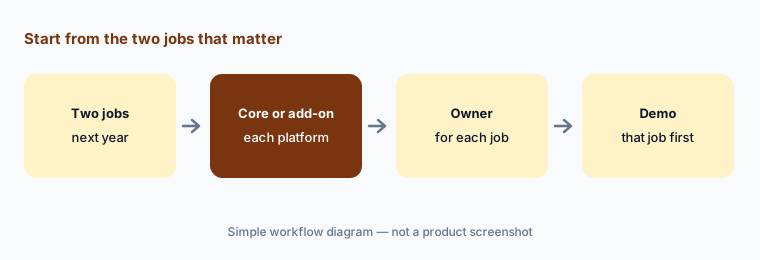
Primary workflow:
Write down the two jobs your LMS must do next year. Note which platform covers each without an add-on and who owns it.
2. AI course authoring vs skills inference
What it is: Absorb’s headline AI is authoring: Aura Create turns an uploaded document, a prompt, or files from SharePoint, OneDrive, Confluence, Google Drive, Box, or Dropbox into an outline, content, and assessments “ready for your review,” and Absorb Create adds AI quizzes, AI voiceover, and reviewer and approval workflows. Cornerstone’s headline AI is skills: “real-time skills inference connected to global labor market data,” a skills library, and Skills Architect for a customer-specific job and skills architecture. Cornerstone also generates knowledge checks and summaries from your content, and Absorb Skills auto-tags your courses with skills — but each vendor leads with the other job.
Test each where it leads. Give Absorb one real policy document and have its owner count the corrections in the draft. Give Cornerstone one job role and have the manager mark the inferred skills they would remove. Both are drafts; what you learn is how much review each would cost your team every month.
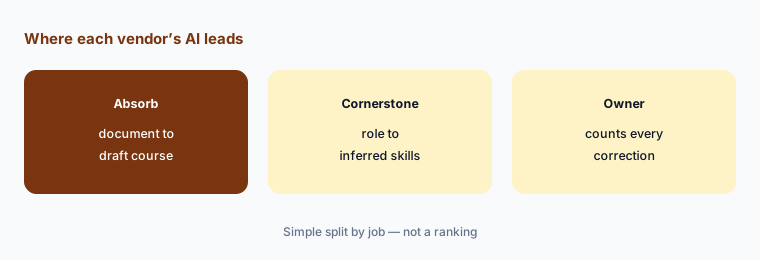
Test each where it leads:
Give Absorb one policy document and Cornerstone one job role. Have the owner of each count the corrections the AI draft needed.
3. Admin effort: plain-language reports, dashboards, and agents
What it is: For admins, Absorb offers Aura Admin Assist — reports from plain-language questions, help resolving completion gaps, setup answers “with sources you can verify” — and the older Intelligent Assist, which opens a pre-populated report from a request such as “Show me all users who didn’t pass Security Compliance training.” Cornerstone offers an admin dashboard (March 2026) with this week’s compliance risks, recommended actions, and nudges, Reporting Assistants, and the Workforce Insights readiness agent for plain-language workforce questions. Cornerstone also says learning pathways “can be assigned automatically” when a critical skill gap emerges.
Ask both the same overdue-training question in the demo and compare each answer with that platform’s standard report. Then ask what each can do without a person: in Cornerstone, decide deliberately whether automatic assignment is on; in Absorb, decide who sends reminders from an AI list.
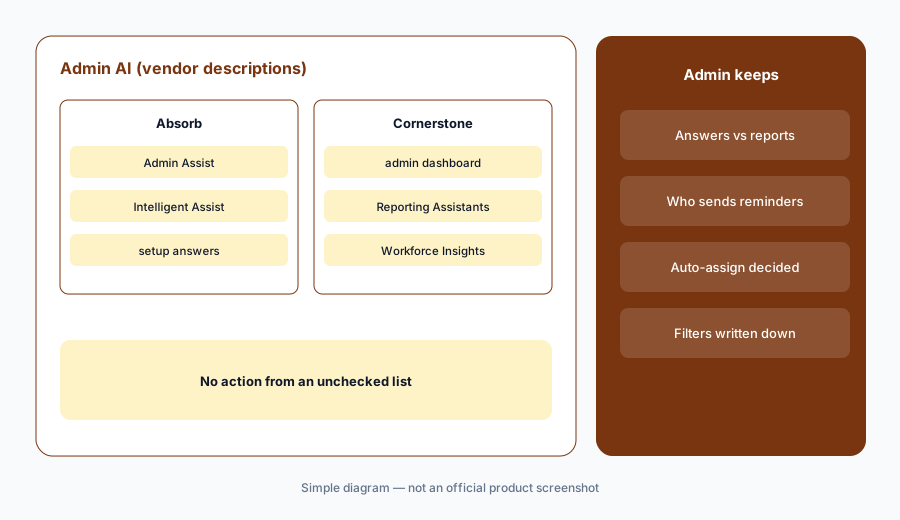
Same question, same report:
Ask both platforms the same overdue-training question. Compare each answer with that platform’s standard report before trusting either.
4. Extended enterprise: customers, partners, and franchisees
What it is: Absorb builds external training into the core story: its site describes training “vendors, franchisees, distributors, and resellers in one platform with secure, separated portals,” learner agents that answer partners from their assigned training, and a “PCI-compliant eCommerce platform” for selling courses “without paying us any commission.” Cornerstone sells it as a package: Extended Enterprise+ to “create, manage, and monetize learning for external audiences with self-registration, ecommerce, payments, content, and enterprise learning capabilities.”
If external audiences are one of your two jobs, demo that portal first, with a real partner’s journey: sign-up, the first course, a question mid-task, and a certificate. Ask how external learners are counted in each quote, because that is usually where the cost of partner training hides.
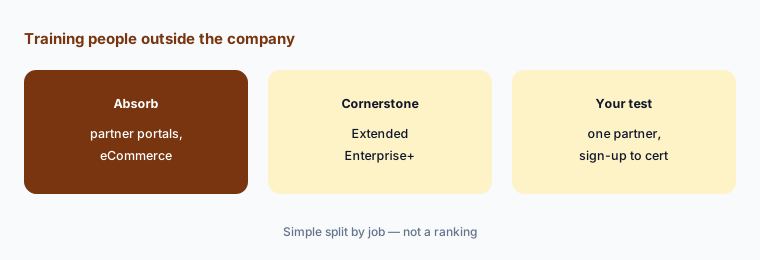
One partner journey in both:
Ask both vendors to demo one partner’s path from sign-up to certificate. Ask each how external learners are counted in the quote.
5. Agents and MCP: Aura agents vs readiness agents
What it is: Absorb Aura (launched 19 May 2026) is a set of agents — Learner, Discovery, and Q&A agents with sourced answers, Admin Assist, and Aura Create — that work in the LMS, Microsoft Teams, and a Chrome extension; on 11 October 2026 Aura Rehearse (AI roleplay) and an MCP connector for ChatGPT, Claude, and Copilot were marked coming soon. Cornerstone’s readiness agents include Skills Architect, Workforce Insights, Embedded Work (Teams, Slack, Salesforce, ServiceNow), Dynamic Goals, Internal Mobility, Embark Navigator, and Proactive Coaching; Cornerstone says they work through MCP and A2A, and each is bought individually and requires Intelligence+.
Separate what ships today from what is announced. Ask each vendor which agents your quote includes by name, which are generally available, and which act on their own — Cornerstone’s mobility and goals agents touch employment decisions, so HR approval belongs in the design, and Absorb’s MCP connector should start read-only when it arrives.
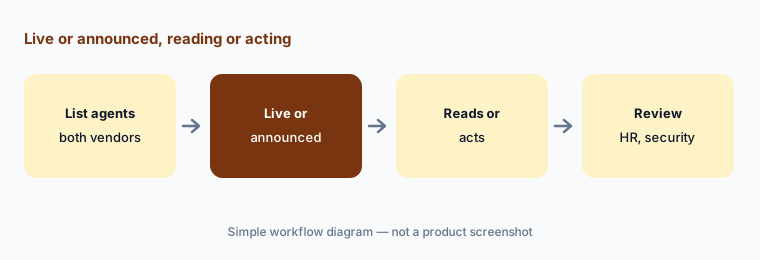
Live or announced:
List every agent each vendor proposes. Mark each as live or announced, and read-only or able to act, before you compare anything else.
6. Pricing transparency: two quote-only models
What it is: Neither publishes prices. Absorb’s pricing page is a quote form that starts by asking how many learners you have, in bands from 1–50 to 25,000+, and doesn’t say which Aura agents, Absorb Create, or Absorb Skills are in a base subscription. Cornerstone’s packages page says Learn+, Elevate+, and HCM+ are licensed per employee per year, Intelligence+ and readiness agents use tiered bands by total employee count, AI experiences and assistants are included in relevant packages, and readiness agents are bought individually. Cornerstone describes its AI as “priced around outcomes, not consumption.”
Send both the same one-page scope: employees and external learners by audience, number of authors, the AI features you want by name, the agents you want by name, integrations, and languages. Ask each to separate the base, every add-on, and every agent in the quote, and to state how learners or employees are counted.
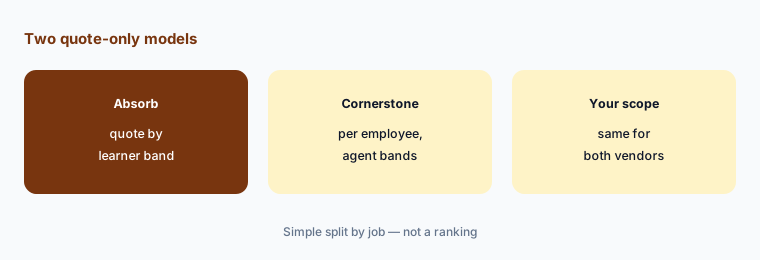
Quote the same scope:
Send both vendors the same scope with every AI feature and agent named. Ask each to list the base, add-ons, and agents separately.
Pricing context (October 2026)
Absorb publishes no prices (checked 11 Oct 2026). Its pricing page is a quote form that asks for your number of learners in bands from 1–50 up to 25,000+; a free trial and a demo are offered. Absorb doesn’t say publicly which Aura agents, Absorb Create, Absorb Skills, or content libraries are in a base subscription.
Cornerstone publishes no prices (checked 11 Oct 2026). Its packages page lists Learn+, Elevate+, Intelligence+, HCM+, and Extended Enterprise+; Learn+, Elevate+, and HCM+ are licensed per employee per year, Intelligence+ and readiness agents use tiered bands by total employee count, and readiness agents are purchased individually and require Intelligence+.
Uncertainty: Both vendors are quote-only, so neither total is knowable until you get quotes. Absorb’s Aura Rehearse and MCP connector were marked coming soon on 11 October 2026, and its pages mix older names (Create AI, Intelligent Assist) with Aura names. Cornerstone’s naming is mid-change (Galaxy and Workforce AI pages both live), and some features described as shipped in its March 2026 release appear among “coming features” in its May article. Vendor statistics on both sites are not repeated here.
When it’s useful (honest take)
Absorb is useful when your main jobs are building, delivering, and tracking training for several audiences — employees, customers, partners, franchisees — and you want AI that drafts courses and answers admins, with process owners reviewing every draft.
Cornerstone is useful when learning is one part of a larger talent problem — skills, performance, succession, internal mobility — you have HR people who will own a skills architecture, and you are ready to buy packages and agents to match.
Less useful when (either one) you have a few hundred learners and mostly need courses tracked (a lighter LMS will do), nobody owns content or skills after launch, or anyone expects AI drafts, inferred skills, or agents to act without a named approver.
Still choosing between Absorb and Cornerstone? The $19 AI toolkit audit gives you a written plan for which tools to keep using and which to drop across your whole AI stack, including this pair.
Prefer to do it yourself? Spreadsheet — $9
Related options (educational)
| Need | Better home | Why |
|---|---|---|
| LMS for several audiences with AI course drafts | Absorb LMS AI | Aura agents, Absorb Create |
| Skills, learning, and talent on one enterprise platform | Cornerstone AI | Skills inference, readiness agents |
| Enterprise LMS with AI roleplay, agents, and MCP | Docebo AI | Creator, roleplay, AI assistant |
| Learning experience layer with an AI coach | Degreed AI | Maestro, skill reviews, agents |
| Employee and customer learning, recently renamed | WorkRamp AI | Now Learn:Up and Academy |
| HR system of record with AI | Workday AI | Core HR, skills |
FAQ
Is Absorb or Cornerstone better?
Neither in general, and this page is not a ranking. Absorb suits teams whose main job is building and delivering training to several audiences; Cornerstone suits organizations that want learning tied to skills, performance, and internal mobility on one platform. Write down the two jobs your system must do next year to see which fits.
How much do Absorb and Cornerstone cost in October 2026?
Neither publishes prices (checked 11 October 2026). Absorb quotes by number of learners; Cornerstone licenses its Learn+, Elevate+, and HCM+ packages per employee per year, with Intelligence+ and readiness agents in tiered bands by employee count.
Which one is better for training customers and partners?
Both do it. Absorb describes separated portals for vendors, franchisees, distributors, and resellers and a commission-free eCommerce platform in its core story; Cornerstone sells an Extended Enterprise+ package with self-registration, ecommerce, and payments. Demo one real partner journey in both.
Does either connect to ChatGPT, Claude, or Copilot?
Cornerstone says its readiness agents work through MCP and A2A and offers Cornerstone for Microsoft Copilot. Absorb’s Aura works in Teams and Chrome today, and its MCP connector for ChatGPT, Claude, and Copilot was marked coming soon on 11 October 2026.
Does Cornerstone draft courses like Absorb?
Cornerstone generates knowledge checks and summaries from your content and offers Content Studio and Cornerstone Create, but its AI leads with skills inference. Absorb leads with Aura Create, which drafts whole courses from your documents for review.
Optional next step (if seats overlap)
If you pay for an LMS, a skills tool, an authoring tool, and chat seats that all try to draft or recommend the same training, that overlap is worth mapping. Map the overlap with the $19 AI toolkit audit or the $9 AI toolkit spreadsheet. Email Audit $19 or Toolkit spreadsheet $9.
Checkout is live via Stripe. After you pay, we email delivery (spreadsheet) or intake next steps (audit).