Tool · Learning ops · Degreed · Oct 2026
Degreed AI review (Oct 2026): AI coaching, skills signals, and learning pathways
Degreed is a learning experience platform (LXP) that sits alongside a company’s LMS: it pulls learning from many content sources into pathways and keeps a record of each person’s skills. Its AI is now three things. Degreed Maestro is the AI coach — coaching conversations by text or voice, roleplays, and AI skill reviews. Degreed agents, announced in October 2026, draft personalized pathways and audit your catalog. And Degreed.AI with Skills+ holds the skills data and connects it to assistants such as Claude, ChatGPT, Gemini, and Copilot through MCP. This page is about using those while managers and L&D keep the say on what counts as a skill and what learners get. Each section has a Try this.
What this Degreed page covers
This page is for an L&D, talent, or upskilling program lead at a large company — someone running a push like AI fluency, leadership development, or reskilling across thousands of people, usually with an LMS already in place for compliance. The question it answers: what Degreed’s AI coaches, drafts, and records for you, where a manager or L&D approves, and how the skills data it builds should and shouldn’t be used.
Naming, checked on 11 October 2026: the AI coach is still called Degreed Maestro (with Maestro Studio for building your own coaches, roleplays, and quizzes). Degreed’s newsroom lists the release of Degreed agents on 6 October 2026, which at launch build pathways from skill data and audit content, with more agents previewed for Degreed’s 14 October event. Degreed.AI is the name for the intelligence layer — skills context, an MCP gateway and A2A tools, and the agents. Degreed describes Degreed Learning as an LXP that “works alongside an existing LMS rather than replacing it.”
Ground rules: an AI skill review is a starting point that the person’s manager confirms or corrects, not a verdict; completion is not competence; AI coaching and roleplay feedback are coaching input, not performance evidence; and no agent-drafted pathway reaches learners until L&D approves it — which is also how Degreed says its agents work. Facts below come from Degreed’s website and newsroom as read on 11 October 2026; Degreed’s published customer results are not repeated here.
Major features (with how someone uses them)
Examples at a glance: each feature has a concrete example from a real job plus a short Try this you can run this week.
1. Maestro AI coach: a 30-day plan for one skill (primary)
What it is: Degreed Maestro is, in Degreed’s words, “AI built specifically for how people learn at work.” Its on-demand AI coach is available by text and voice, uses each person’s skill profile and learning history, and for managers draws on the team’s actual skill data and learning activity. Degreed lists coaching, roleplays, skill reviews, automated pathway curation, and real-time feedback in one product, and says Maestro is trained on learning science (a vendor claim). Maestro can also be embedded in Degreed pathways as a tutor that answers questions and gives feedback.
A coach’s plan sounds personal because it uses your profile, but it can only see what Degreed knows — not that the team switched tools last quarter or that the skill matters only for one client. Bring the plan to the learner’s manager and let them cut anything that isn’t the actual job. Keep personal performance notes out of the conversation.
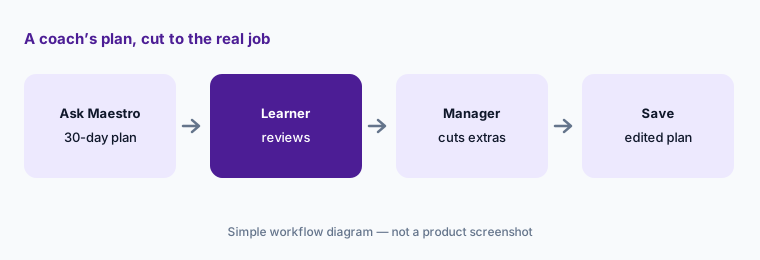
Primary workflow:
Ask Degreed’s AI coach for a 30-day plan for one skill. Have the learner’s manager cut anything that doesn’t match the actual job.
2. Skill reviews and Skills Check-In: proficiency your managers confirm
What it is: Maestro’s AI-powered Skill Reviews assess each person’s current strengths and gaps against your organization’s own skill definitions and proficiency levels, then surface learning to close the gaps; a Skill Review Coach can run at the start and end of a pathway or academy to show change. Skills Check-In (announced at LENS 2026 on 3 March) guides employees to place themselves on your proficiency scales, which Degreed calls “human-in-the-loop skill data.” Degreed also lists manager review and assessments among the sources for a person’s skill record.
Skill data ends up feeding staffing, mobility, and workforce planning, so decide up front who confirms a level before it counts. Our suggestion: an AI review or self check-in proposes, the manager confirms or corrects, and only confirmed levels are used for decisions about people. Tell employees how the results are used — a practice tool that quietly feeds promotion decisions won’t get honest answers.
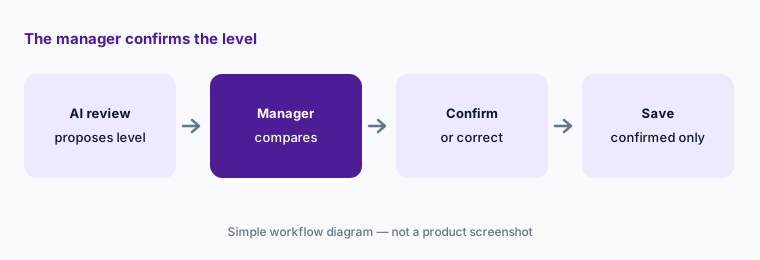
Manager confirms the level:
Run one Maestro skill review with a volunteer. Have their manager compare the proposed level with what they’ve seen on the job before it’s saved.
3. Roleplays, custom rubrics, and Maestro Studio
What it is: Maestro runs AI roleplays — Degreed highlights sales pitches, objection handling, and leadership conversations — with custom rubrics that give structured feedback on where to improve. Maestro Studio lets L&D build custom AI coaches, roleplays, quizzes, surveys, and forms. Guided Conversations use AI interviews to surface confidence, sentiment, and adoption blockers that completion data misses. Degreed packages some of this into Solution Accelerators for leadership transformation and AI fluency.
A rubric is the coaching manager’s judgment written down; if the AI feedback disagrees with your best people, the rubric is what to fix. Have two managers review the same few recordings with the AI feedback and adjust the rubric where both disagree with it. Guided Conversations collect what people tell you about their confidence — say who will see it before you ask.
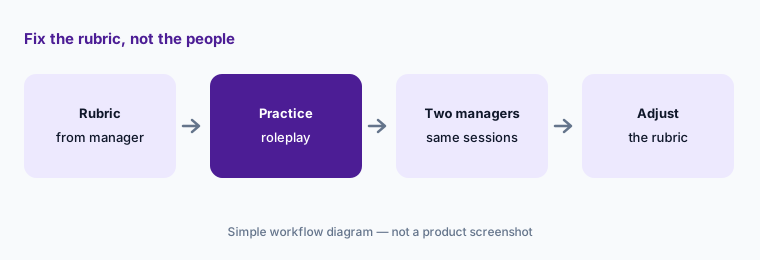
Two reviewers, same sessions:
Build one Maestro roleplay with a rubric written by the coaching manager. Have two managers review the same five sessions and the AI feedback, and change the rubric where they both disagree.
4. Degreed agents: pathways drafted, L&D approves
What it is: Degreed’s October 2026 release describes Degreed agents as “a connected system of AI agents” for personalized learning. At launch, an agent takes a skill gap or priority a leader flags, pulls current proficiency against target, searches your catalog for content that already closes the gap, applies your instructional design and compliance guidelines, and drafts a sequenced pathway for the team that needs it. In Degreed’s words, “L&D reviews, edits, and approves,” and “a person approves every action before it reaches a learner or a system of record.” Agents can also be used from MCP-compatible assistants such as Claude, Gemini, and Copilot.
The draft will lean on whatever your catalog contains, including the outdated courses nobody removed, so pair it with the content audit (feature 5). Have the L&D reviewer open every item, not just read the titles, and check that the pathway’s length is realistic for people doing their jobs.
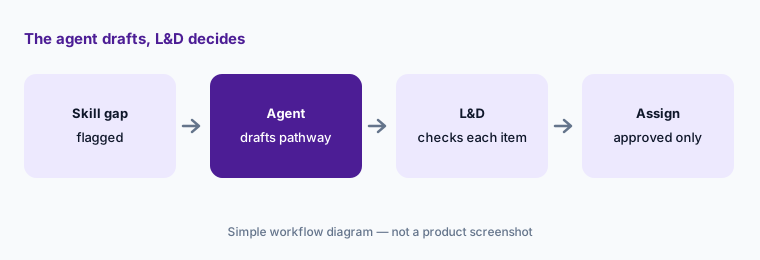
Review every item:
Let a Degreed agent draft one pathway for a skill gap your team flagged. Have L&D open and approve every item before it’s assigned.
5. Content audit agent and Open Library pathways
What it is: The second launch agent audits your content for broken links and stale material — on a schedule, on demand, or from an MCP-compatible assistant — and gives admins one prioritized report. Separately, Degreed Open Library offers 500+ pathways on in-demand topics that Degreed says are curated by AI agents and reviewed by human editors, with gaps filled by AI-generated podcasts, videos, and summaries; it is available to Degreed Learning customers and can embed Maestro as a tutor.
Let the agent find; let the content owner decide. A link that looks stale may be the only version of an approved procedure, and an Open Library pathway written for everyone may not match your policies. Preview pathways before assigning them, and add or swap in your own material where the job is specific to your company.
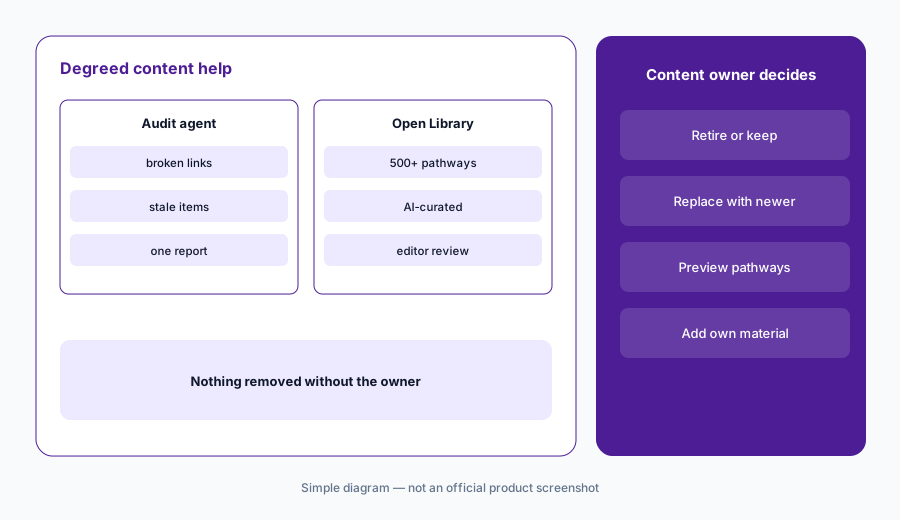
Owner decides each item:
Run Degreed’s content audit on one catalog area. Have the content owner decide on every flagged item before anything is removed.
6. Skills+, Degreed.AI, and the MCP gateway
What it is: Degreed Skills+ lets you define skill names, descriptions, synonyms, and proficiency levels your way, normalize skill data from other systems, and auto-tag content by skill and level; Degreed says AI recommends descriptions and tags “with human-in-the-loop controls so your team reviews and approves before anything goes live,” and the pricing page lists skill inference to fill gaps in employee skill data. Degreed.AI exposes a bidirectional MCP gateway and A2A protocols; Degreed’s LENS 2026 release says its MCP works in ChatGPT and Claude, with organizations controlling which capabilities are available. Degreed says API keys carry explicit scopes and that agents can write back skill data, completions, and pathways within granted scopes.
Write access to skill records is write access to data that affects careers. Start any MCP connection read-only, let people ask about their own plans and learning, and check the answers in Degreed. Grant write scopes to a small named group only after you have decided who confirms skill changes (feature 2).
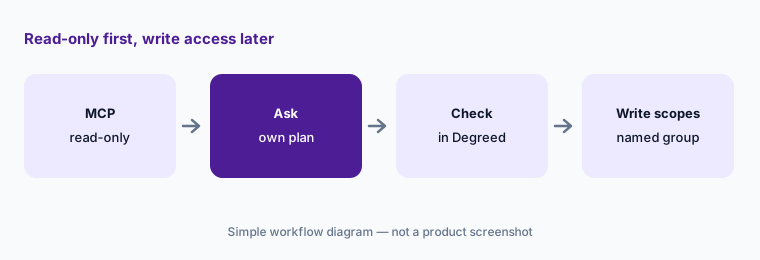
Read-only first:
Connect Degreed’s MCP to one assistant with read-only scopes. Ask for your own skill plan and check it in Degreed before anyone gets write access.
Pricing context (October 2026)
Degreed publishes no prices (checked 11 Oct 2026); pricing is quote-only. Its pricing page lists Degreed Learning (LXP), Degreed Skills+, and Degreed Academies, says every product includes basic skills, AI and machine-learning capabilities, automation, and reporting, and offers bundles for two or more products. Its FAQ says pricing is “personalized and flexible based on your company, needs, budget, and headcount.”
Degreed Maestro and the new Degreed agents aren’t priced or placed on that page, and Open Library is described as available to Degreed Learning customers. Ask in the quote which Maestro features (coach, roleplays, skill reviews, Studio), which agents, and what MCP access are included, and how people are counted.
Uncertainty: Degreed publishes no prices, so the cost of Maestro and the agents is unknown until you get a quote. Degreed agents were announced on 6 October 2026 with more previewed for 14 October, so availability may differ by customer. Degreed’s own pages use a different word for a person’s skill level; we say “proficiency level.” Degreed’s published customer results and survey figures are vendor claims and aren’t repeated here.
When it’s useful (honest take)
Useful when you’re running a large upskilling or reskilling program across many content sources, you already have an LMS for compliance, you want AI coaching and practice at a scale human coaches can’t reach, and managers will confirm skill levels before they’re used.
Less useful when you mainly need compliance courses delivered and tracked (that’s an LMS job), you have a small workforce and a short catalog, or you expect AI skill reviews to make decisions about people on their own. Completion records show who finished something, not who can do the job.
Paying for Degreed AI and a few other AI tools? The $9 AI toolkit spreadsheet lists every AI subscription you have, what each one costs, and how fast it pays for itself, so you can see which ones are worth the money.
Want someone to do it for you? AI toolkit audit — $19
Related options (educational)
| Need | Better home | Why |
|---|---|---|
| Learning experience layer with an AI coach and skills record | Degreed AI (this page) | Maestro, agents, Skills+ |
| Skills, learning, and talent on one enterprise platform | Cornerstone AI | Skills inference, readiness agents |
| LMS with AI course drafts and admin help | Absorb LMS AI | Aura agents, Absorb Create |
| Enterprise LMS with AI roleplay and MCP | Docebo AI | Creator, roleplay, AI assistant |
| Performance reviews, goals, and growth plans | Lattice AI | Reviews and check-ins |
| Sales call recordings and coaching | Gong | Real calls, not practice |
FAQ
What is Degreed Maestro?
Degreed Maestro is Degreed’s AI for learning at work: an on-demand AI coach by text or voice, AI roleplays with custom rubrics, AI skill reviews against your proficiency levels, Guided Conversations, and Maestro Studio for building your own coaches, roleplays, and quizzes.
How much does Degreed cost?
Degreed publishes no prices (checked 11 October 2026). Its pricing page says pricing is personalized based on company, needs, budget, and headcount, with bundles for two or more products. Ask which Maestro features and agents your quote includes.
What do Degreed agents do?
Degreed’s October 2026 release says agents build personalized pathways from your skill data and catalog, and audit content for broken links and stale material. Degreed says L&D reviews, edits, and approves, and a person approves every action before it reaches a learner or a system of record.
Does Degreed replace our LMS?
Degreed says no: Degreed Learning is a learning experience platform that works alongside an existing LMS, and it integrates with systems such as Workday, SAP SuccessFactors, Cornerstone, Salesforce, ServiceNow, and Microsoft Teams and Copilot.
Who should confirm the skill levels Degreed’s AI suggests?
The person’s manager, using your organization’s own proficiency definitions. Let the AI skill review or self check-in propose a level, have the manager confirm or correct it, and use only confirmed levels for decisions about people.
Optional next step (if seats overlap)
If you pay for an LXP, an LMS, a coaching tool, a content library, and chat seats that all recommend learning to the same people, that overlap is worth a look. Map the overlap with the $19 AI toolkit audit or the $9 AI toolkit spreadsheet. Email Audit $19 or Toolkit spreadsheet $9.
Checkout is live via Stripe. After you pay, we email delivery (spreadsheet) or intake next steps (audit).