Role guide · Property ops · ChatGPT Business · Oct 2026
ChatGPT for property ops (Oct 2026): resident notices, listing drafts, and maintenance triage help
Property ops role guide — a shared Property drafts project in a ChatGPT Business workspace that drafts resident notices only from an uploaded, sanitized, approved template and marks any line that changes the legal wording, plus listing description drafts from a verified fact sheet and maintenance triage checklists from an approved emergency procedure. ChatGPT drafts; the property manager approves every notice before a resident sees it, and a named person reviews anything prospect-facing for fair-housing language. Use Projects, not new custom GPTs — OpenAI is retiring custom GPTs on December 11, 2026. Pair with a property-management system such as AppFolio AI or Yardi AI.
Who this guide is for
Property managers, assistant managers, leasing staff, and short-term rental hosts — the manager who drafts late-rent reminders from the approved template, the host who rewrites a listing description, the maintenance coordinator who wants a triage checklist from the emergency procedure — whose company already has ChatGPT Business or Enterprise. If your property-management system already drafts notices and replies inside the product, see AppFolio AI, Buildium AI, Yardi AI, or Entrata AI; for vacation rentals, Guesty AI or Hostaway AI. Product deep-dive: ChatGPT.
Use Projects, not new custom GPTs. OpenAI’s help center (read 13 October 2026) says custom GPTs are scheduled to retire on December 11, 2026 (February 11, 2027 for Enterprise workspaces with an approved deferral), that the change affects all ChatGPT plans, and that it plans to help creators migrate GPTs to plugins. For affected Enterprise workspaces it lists October 26, 2026 (planned) as the end of new custom GPT creation. Putting property-ops instructions in a project keeps related chats, files, and instructions together and costs nothing extra on qualifying plans.
Ground rules: never paste tenant, applicant, guest, or owner PII — names, unit-and-name pairs, phone numbers, emails, ledgers, bank details, screening reports, or door and lock codes. Notices come only from a sanitized template the property manager approved, and any line that changes the legal wording is marked, not rewritten. Anything prospect-facing gets a fair-housing review by a person. ChatGPT does not decide rent, nightly rates, screening, or approvals, and local notice rules are checked with counsel, not with a chat tool.
Major features (with how someone uses them)
Examples at a glance: each feature has a concrete example from a real job plus a short Try this you can run this week.
1. Project property drafts: late-rent reminder (primary)
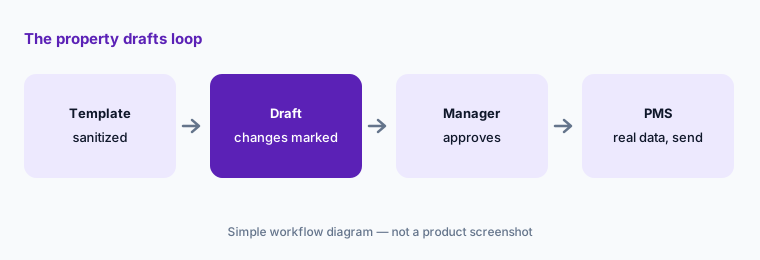
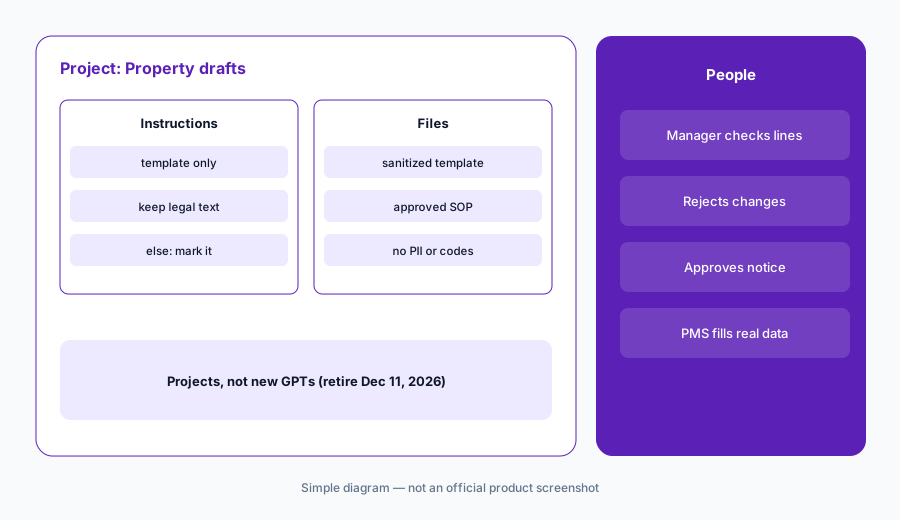
What it is: Select New project in the sidebar and name it Property drafts. Upload one sanitized notice template — the approved late-rent reminder with bracketed fields such as [resident], [unit], [amount], [date], and no real names or balances. In Project settings, add instructions: draft only from the uploaded template; keep the legal wording exactly as written; if any sentence would change, add, or remove legal wording, mark it “Changes legal wording — property manager to review” instead of rewriting it; leave bracketed fields as brackets. OpenAI says project instructions apply only within that project and override your global custom instructions, and Business projects support up to 40 files.
The marked lines are the useful part. If ChatGPT wants to soften a notice period sentence or add a fee, that is not a drafting improvement — it is a change the property manager, and sometimes counsel, must decide on. Real amounts and names are filled in later inside your property-management system.
Primary workflow:
Project property drafts. Upload one sanitized notice template. Ask for a late-rent reminder and mark any line that changes the legal wording.
2. Listing description drafts from a verified fact sheet
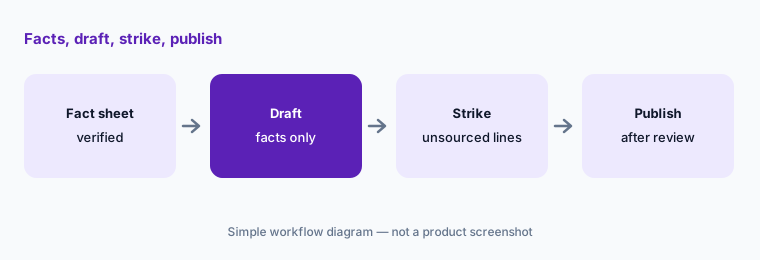
What it is: Upload a one-page fact sheet for one unit or rental — bedrooms, bathrooms, square footage, amenities, parking, pet policy, and fees, each checked by the person who owns the listing. Ask for a listing description that uses only those facts and lists any claim it could not source. For apartments, describe the property and its features, not the kind of person it suits; a named person reviews the draft for fair-housing language before it is published.
Delete any distance, view, or amenity claim that is not on the fact sheet. “Five minutes to the beach” or “perfect for young professionals” are the two kinds of lines to strike first.
Facts only:
Upload one verified fact sheet and ask for a listing description. Delete every amenity, distance, or “ideal for” claim that is not on the sheet before anyone publishes it.
3. Maintenance triage checklists from an approved procedure
What it is: Upload the approved emergency and maintenance procedure — what counts as an emergency (gas smell, active leak, no heat in winter, lockout), who is on call, and what a resident should be told. Ask for a triage checklist for office staff with the source step for each item and a list of situations the procedure does not cover. Paste only sanitized request text — no names, unit numbers, or access codes. The maintenance supervisor reviews the checklist before staff use it.
The emergency path always ends with a person and a phone number, never with a chat reply. Cross out any step without a source in the procedure and send the gaps to the procedure owner.
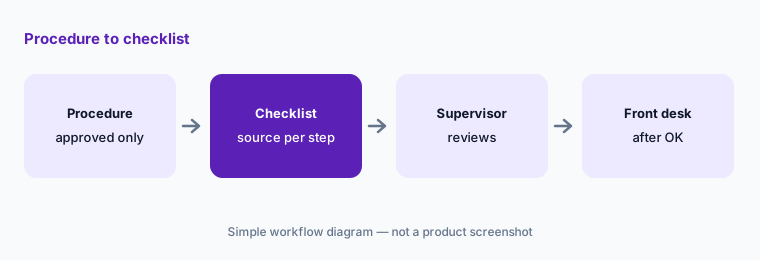
Source every step:
Upload one approved maintenance procedure and ask for a triage checklist with a source step for each item. Have the maintenance supervisor cross out anything it cannot source.
4. Who can see the project
What it is: A project can be shared with individual colleagues or whole workspace groups. According to OpenAI’s Projects help article, edit access lets someone update the instructions, upload or remove files, and invite others, while chat access lets them see and use the project’s chats, files, and instructions without changing them. Every member can view and download the uploaded files, so a template in the project is readable by everyone you add. Shared projects use project-only memory. Workspace owners decide who may create and share projects, and a workspace project tops out at 100 collaborators.
Give edit access only to the people who keep the approved templates and procedures current; give leasing and front-desk staff chat access. Otherwise an old notice template starts showing up in drafts.
Two editors, everyone else chat:
Open Share on your property project. Give edit access to the people who own the templates and procedures and chat access to everyone else, then list who can download the files.
5. What never goes in: tenant and guest PII, screening data, codes
What it is: OpenAI’s Business pricing page lists SAML SSO, SOC 2 Type 2, and no training on business data by default. That does not make a project the right place for resident or guest data. Keep out names, phone numbers, emails, unit-and-name pairs, ledgers and balances, bank details, screening and background reports, IDs, and door or lock codes. Screening decisions, rent and nightly-rate changes, and approvals stay with people and your property-management system. The pricing page lists SCIM, role-based access controls, the Compliance API, and data residency for Enterprise, not Business.
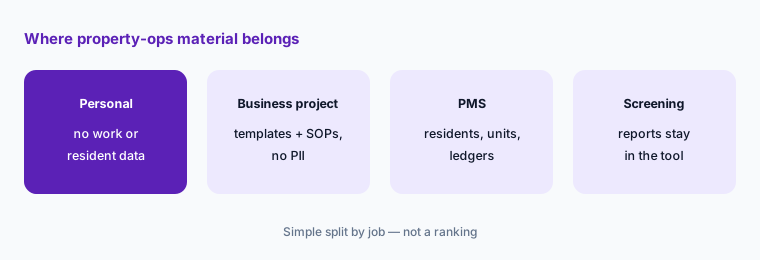
Write the three rules:
Write three rules for your property project — what may go in, what never goes in, and who approves anything that reaches a resident, guest, or prospect — and paste them at the top of the project instructions.
6. If you already have a property GPT
What it is: OpenAI says existing custom GPTs keep working until retirement on December 11, 2026, that migration is to plugins (My GPTs → Migrate to plugin when it reaches your account), and that the GPT’s instructions become a skill and its knowledge files become reference files. The selected model, custom actions, and sharing settings don’t carry over; migration uses the latest published version; the original becomes read-only; and the new plugin starts private. Chats created with a GPT can’t be moved into a project. Existing conversations stay accessible after retirement.
For a notice-drafting GPT, the simplest move is often a project: copy its instructions into Project settings and upload the same sanitized templates. Test with the same requests and check that the “mark legal wording changes” rule survived — a replacement that quietly rewrites a notice period is worse than the GPT it replaced.
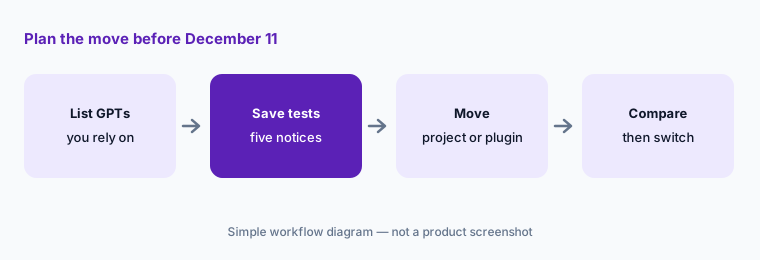
Test the replacement:
Before December 11, 2026, save five notice requests your property GPT already handled. Move its instructions into a project, rerun them, and compare every marked line before anyone switches.
Pricing context (October 2026)
OpenAI’s Business pricing page (as listed 13 Oct 2026, USD): Standard seat $20 per user per month billed annually or $25 billed monthly; Premium seat $100 per user per month billed annually or $125 billed monthly, with 5x the usage of Standard and no 5-hour limit. Business is for teams of 2 to 200 and seat types can be mixed. Enterprise is priced through sales.
OpenAI’s Projects help article says projects cost nothing extra on qualifying plans; usage charges for models or tools apply the same as in regular chats. Pricing may vary by country and currency. Full dated notes are on the ChatGPT deep-dive.
Uncertainty: OpenAI says its retirement dates are subject to change and that migration may reach accounts at different times; the October 26 creation cutoff is listed for affected Enterprise workspaces. Project limits (40 files, 100 collaborators on Business) and memory behaviour come from the help center and can change. Skills is labelled beta on the pricing page. Nothing here is legal advice: notice periods, late fees, and short-term rental rules are local — the property manager and counsel decide, not ChatGPT.
When it’s useful (honest take)
Useful when your company already pays for ChatGPT Business or Enterprise, you have approved, sanitized notice templates and procedures with named owners, and someone owns the project’s instructions and files.
Useful when managers and hosts want first drafts of notices, listing descriptions, and triage checklists they can check against a source, without putting resident or guest data into a general chat tool.
Less useful when your property-management system already drafts notices and replies from live data (AppFolio AI, Entrata AI), templates are not written down, the team cannot keep PII and screening data out, or anyone expects ChatGPT to set rent or decide an application.
Paying for ChatGPT and a few other AI tools? The $9 AI toolkit spreadsheet lists every AI subscription you have, what each one costs, and how fast it pays for itself, so you can see which ones are worth the money.
Want someone to do it for you? AI toolkit audit — $19
Related options (educational)
| Need | Better home | Why |
|---|---|---|
| Notices and replies inside the PMS | AppFolio AI · Buildium AI | Realm-X / Lumina on live data |
| Multifamily AI platforms | Yardi vs Entrata | Virtuoso vs ELI+ |
| Guest messaging for vacation rentals | Guesty vs Hostaway | ReplyAI / AI Replies |
| Commercial lease abstraction | MRI Software AI | Contract Intelligence |
| Short-term rental pricing | PriceLabs vs Wheelhouse | Not a chat drafting job |
| The same work in Claude | Claude Projects | Projects with files |
FAQ
How should a property team set up ChatGPT?
In a Business or Enterprise workspace, create a project (for example, Property drafts), upload one sanitized, approved notice template, and add project instructions: draft only from the template, keep the legal wording, mark any line that changes it, and leave names and amounts as brackets. Share it at chat access and have the property manager approve every notice.
Should we build a custom GPT for resident notices?
Not a new one. OpenAI says custom GPTs are scheduled to retire on December 11, 2026 (February 11, 2027 for Enterprise workspaces with an approved deferral) and plans migration to plugins. Use a project instead; if you already have a GPT, save test requests and compare the replacement before switching. See OpenAI’s retirement FAQ.
Can we paste resident or guest messages into the project?
Don’t paste names, phone numbers, emails, unit-and-name pairs, ledgers, bank details, screening reports, or door codes. Sanitize the text first. Resident, applicant, and guest records belong in your property-management system and screening tools, not in a general chat tool.
Who can see files in a shared project?
Everyone you add can view and download the uploaded files, whether they have edit or chat access, OpenAI says. Edit access also allows changing the instructions and files and inviting people; chat access only allows using the project, which keeps its own project-only memory. See Projects in ChatGPT.
What does ChatGPT Business cost in October 2026?
As listed on 13 October 2026: Standard seats $20 per user per month billed annually or $25 monthly, and Premium seats $100 annually or $125 monthly with 5x the usage, for teams of 2 to 200. Projects cost nothing extra. See openai.com/business/pricing.
Optional next step (if seats overlap)
If property ops pays for ChatGPT, a PMS with its own AI, a guest-messaging add-on, and an answering service that all draft from different copies of the same templates, fix that overlap before adding another seat. Map the overlap with the $19 AI toolkit audit or the $9 AI toolkit spreadsheet. Email Audit $19 or Toolkit spreadsheet $9.
Checkout is live via Stripe. After you pay, we email delivery (spreadsheet) or intake next steps (audit).