Compare · Field service · Oct 2026
ServiceTitan vs Jobber (Oct 2026): AI field service platforms for trade contractors
ServiceTitan and Jobber both run the office side of a field service business — booking, dispatch, quotes, invoices — and both now put AI into answering calls, drafting messages, and answering questions about the business. They are built for different-sized companies and sold in very different ways: ServiceTitan by written quote per technician, Jobber on a public price list. This page compares how each one’s AI works and who has to approve what it books or drafts. It is not a ranking, and each section has a Try this.
What this comparison covers
This page is for an owner, general manager, or office lead at a trade or home-service business who is choosing between ServiceTitan and Jobber, or who runs one and keeps hearing about the other’s AI. The question it answers: for the jobs your office handles every day, what each platform’s AI does, what it costs to find out, and who has to approve an AI-booked job or an AI-drafted quote before a customer sees it.
We checked both vendors’ pages on 12 October 2026. ServiceTitan’s pricing page describes “per-technician pricing” with three packages — Starter, Essentials, and The Works — each marked “Request Pricing”. ServiceTitan’s Atlas help article says Atlas is a Core product for all customers, that Field Pro features need a Field Pro subscription, that the Atlas mobile app needs ServiceTitan Max, and that Atlas “may generate inaccurate, incomplete, or outdated responses.” Jobber’s pricing page (last modified 23 September 2026) publishes Core, Connect, Grow, and Plus prices that change with team size and billing term, and Jobber’s Receptionist help article lists the answering add-on price.
Ground rules for either platform: an AI-booked job isn’t a sold job until a person confirms time, scope, and price; an AI-drafted quote isn’t accurate until the estimator checks it against your price book; an AI receptionist is not a licensed technician; and no customer payment details go into a chat prompt. Facts come from the same vendor pages as our ServiceTitan AI and Jobber AI reviews; both vendors’ marketing statistics are left out.
| Question | ServiceTitan | Jobber |
|---|---|---|
| Built for | Trade contractors with multiple trucks, a call center or dispatch desk, and replacement sales — residential and commercial | Home and commercial service businesses from solo operators to growing crews — lawn care, cleaning, HVAC, plumbing, and similar |
| AI brand | Titan Intelligence (the engine) and Atlas (the plain-language sidekick); Max is the AI-native package | Jobber AI: Chat and Voice, Rewrite, Custom Report Builder, suggested automations, AI Receptionist; Jobber Teammate announced 23 Sep 2026 |
| Ask the business | Atlas in mobile, Field Pro, Help Center, and Adaptive Capacity; Atlas mobile app needs Max | AI Chat (web and mobile) and Voice (mobile), labelled beta in Jobber’s help center |
| Answering and booking | Virtual Agent: inbound conversations, follow-ups, unsold-estimate recovery (ST-81, Sep 2026), reschedule and cancel permissions by job type | AI Receptionist: answers calls and texts, takes messages, books inside limits you set; needs a Jobber phone number |
| Pricing help and drafts | Price Insights (Pricebook Pro), invoice summaries, payment-collection email drafts | Rewrite for client messages, auto-drafted quotes from requests on higher plans |
| Published pricing | None: Starter, Essentials, and The Works per-technician packages, each “Request Pricing” | Yes: Core, Connect, Grow, and Plus monthly prices by team size; Receptionist included on Plus, USD 29/mo add-on elsewhere |
| Who should approve AI bookings | A named dispatcher or call-center lead reads Virtual Agent transcripts and confirms each booked job | The owner or office lead reviews every Receptionist booking and every AI-drafted quote |
Major features (with how someone uses them)
Examples at a glance: each feature has a concrete example from a real job plus a short Try this you can run this week.
1. Start from your three busiest job types (primary)
What it is: Both platforms can answer the phone, book work, draft quotes, and answer questions about your numbers. A feature list won’t separate them; your job mix will. A plumbing shop whose top jobs are drain calls, water-heater swaps, and maintenance plans needs different booking rules from a lawn-care crew whose top jobs are weekly mowing, spring clean-ups, and one-off quotes. Write down your three busiest job types, and for each one note which platform’s AI could book it, which could draft the quote, and which person approves it.
Keep the list short and real: use last quarter’s job counts, not the jobs you wish you had. If nobody can name the approver for a job type, the AI should not book that job type yet.
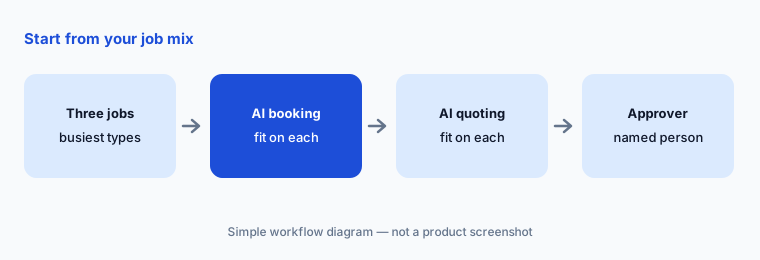
Your job mix first:
List your three busiest job types. Note which platform’s AI booking and quoting fit each, and who approves.
2. Who each platform is built for
What it is: ServiceTitan sells per-technician packages (Starter, Essentials, The Works) plus Pro modules and the AI-native Max package, and its features — dispatch boards, call booking, pricebooks, payroll, commission tracking, memberships — assume a company with an office team and several trucks. Jobber sells four plans (Core, Connect, Grow, Plus) priced by team size, and its features — quotes, scheduling, invoicing, client hub, crew scheduling on higher plans — fit solo operators through growing crews. Many shops could run either; the question is how much office structure you have to feed the AI.
Count your technicians and your office staff separately. AI that drafts dispatch changes helps most when someone is already dispatching full time.
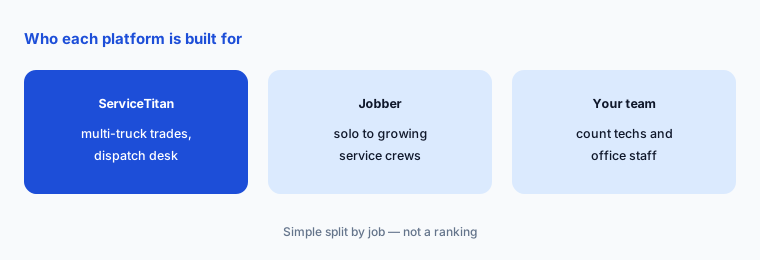
Count your team:
Write down how many technicians and office staff you have. Read Jobber’s published price for that team size, and ask ServiceTitan for a written per-technician quote for the same headcount.
3. Asking the business: Atlas vs Jobber AI Chat and Voice
What it is: On ServiceTitan, Atlas is the sidekick you talk to and Titan Intelligence is the engine underneath. Atlas sits in the technician mobile app, Field Pro, the Help Center, and Adaptive Capacity; administrators control which capabilities each employee gets in Settings, with personas assigned from each person’s company position. On Jobber, AI Chat (web and mobile) and Voice (mobile) answer questions, draft quotes, and handle field tasks hands-free; Jobber’s help center labels them beta. Both vendors say the answers can be wrong.
Ask each assistant one question whose answer you can check in a built-in report the same day — and treat the answer as a lead, not a fact.
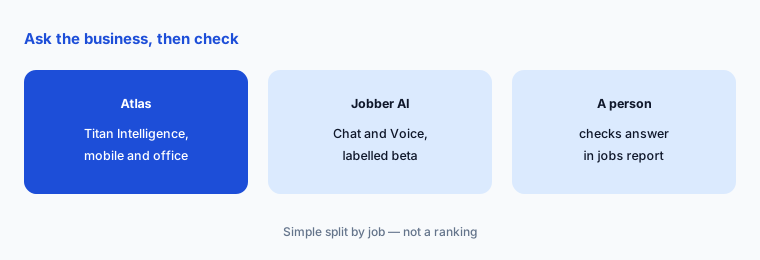
Same question, both tools:
Ask each assistant (or each demo rep) the same question about last week’s jobs. Check both answers against the jobs list before you believe either.
4. Answering and booking: Virtual Agent vs AI Receptionist
What it is: ServiceTitan’s Virtual Agent handles inbound conversations and follow-ups; September 2026 release notes add recovering unsold estimates, escalation rules, and separate reschedule and cancel permissions by job type. Jobber’s AI Receptionist answers calls and texts, takes messages, and books work inside limits you set. Jobber’s help center says Receptionist is included on Plus with unlimited usage and is an add-on elsewhere at USD 29 per month for 30 conversations, then $0.79 per extra conversation. Either one is talking to your real customers.
Write the booking rules on one page before you turn either on: which services the AI may book, during which hours, and who reviews every booking — and how fast.
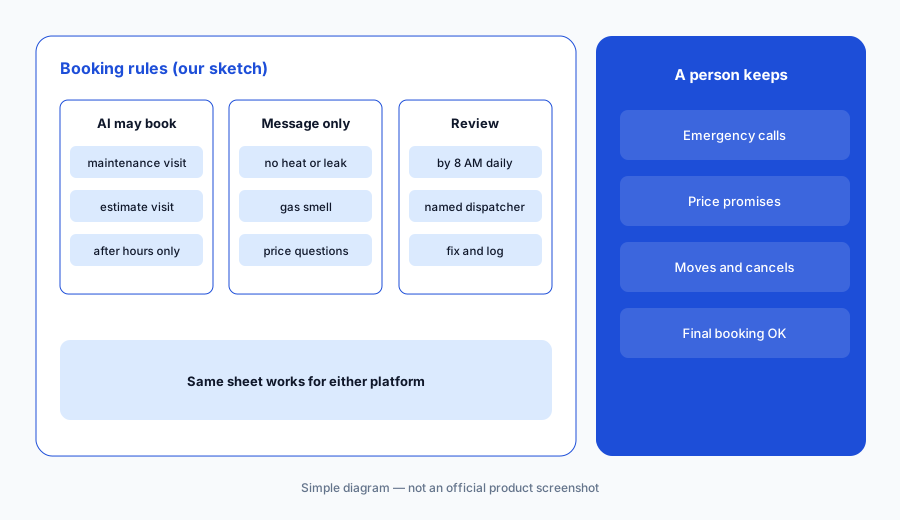
One-page rules:
Write a one-page booking rule sheet — services the AI may book, hours, and what always goes to a person — and name who reviews every AI booking by the next morning.
5. Quotes, prices, and customer messages
What it is: ServiceTitan’s Titan Intelligence lists Price Insights in Pricebook Pro (regional average selling prices), invoice summaries, and payment-collection email drafts. Jobber offers Rewrite for client messages and auto-drafted quotes from requests on higher plans, and AI Chat can draft quotes. In both, the AI can make a quote or message faster; it cannot know a promise made on site unless someone typed it in, and a regional average is not your price.
Keep one checklist for every AI-drafted quote or customer message: what’s included, what’s excluded, how change orders work, and what you never promise.
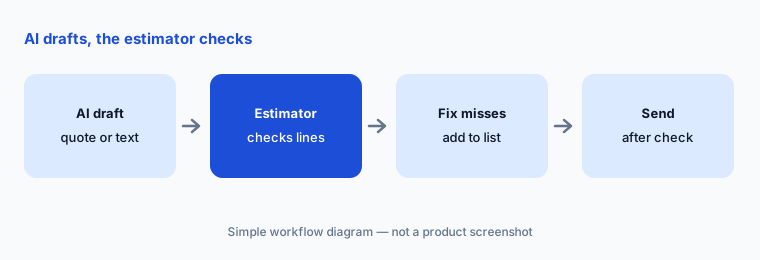
Line-by-line check:
Pick one recent quote. Have each platform’s AI draft or polish it (trial or demo), then have the estimator check every line against your price book before anything is sent.
6. Pricing transparency and who approves
What it is: The biggest practical difference is how you find out the cost. Jobber publishes plan prices by team size and lists add-ons such as Receptionist, Marketing Suite, and Pipeline. ServiceTitan publishes no prices: packages, Pro modules, Max, and implementation come in a written quote. That doesn’t make either one cheaper for you — it means the ServiceTitan number arrives later in the process, so ask for it in writing with each AI feature named.
Put both on one cost sheet with the same headcount and the AI features you would actually turn on, plus the named approver for AI bookings in each.
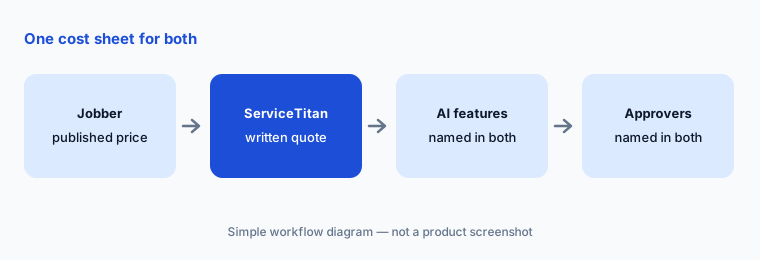
One cost sheet:
Build one cost sheet for both: Jobber plan plus Receptionist at your headcount, and ServiceTitan’s written quote with each AI module named. Add who approves AI bookings in each.
Pricing context (October 2026)
ServiceTitan publishes no prices (checked 12 Oct 2026). Its pricing page describes per-technician pricing with Starter, Essentials, and The Works packages, each “Request Pricing”; Pro modules and the Max package are part of the quote. Third-party sites publish guesses; this page does not repeat them.
Jobber publishes prices. Its pricing page lists Core from USD 29/mo, Connect from USD 99/mo, Grow from $149/mo, and Plus from $399/mo on annual billing for the smallest team size shown; prices rise with users and with monthly billing. Receptionist is included on Plus and is otherwise USD 29/mo for 30 conversations, then $0.79 each. Card processing fees are separate. See our Jobber AI and ServiceTitan AI reviews for detail.
Uncertainty: ServiceTitan’s package and AI-module costs are unknown until you get a quote, and several Max and Atlas features are Early Access or private preview. Jobber AI Chat and Voice are labelled beta, and Jobber Teammate (announced 23 September 2026) may not be in every account yet. Plan names, add-on prices, and which AI features sit on which tier change often — re-read both pricing pages for your headcount. Vendor productivity and booking claims are not repeated here.
When it’s useful (honest take)
ServiceTitan is useful when you run several trucks with a dispatch desk or call center, want Virtual Agent and Titan Intelligence inside dispatch and pricebook, and have a dispatcher or call-center lead who will read AI transcripts and approve bookings.
Jobber is useful when you want published prices, AI Chat and Receptionist without a long sales process, and an owner or office lead who reviews every AI booking and quote.
Less useful when (either one) nobody owns the booking rules, you want AI to send quotes or move appointments without a person, or you haven’t priced the answering add-on at your real call volume.
Still choosing between ServiceTitan and Jobber? The $19 AI toolkit audit gives you a written plan for which tools to keep using and which to drop across your whole AI stack, including this pair.
Prefer to do it yourself? Spreadsheet — $9
Related options (educational)
| Need | Better home | Why |
|---|---|---|
| ServiceTitan’s AI on its own | ServiceTitan AI | Atlas, Virtual Agent, Max |
| Jobber’s AI on its own | Jobber AI | Chat, Receptionist, Teammate |
| Home-service AI team | Housecall Pro AI | AI Team, CSR AI add-on |
| Answering and booking for trades | Workiz AI | Genius, quote-only plans |
| Trade office with published prices | Service Fusion AI | Notes+, unlimited users |
| Maintenance work orders, not customer jobs | Limble AI · Fiix AI | CMMS, different buyer |
FAQ
Should I choose ServiceTitan or Jobber?
This page is not a ranking. List your three busiest job types, note which platform’s AI could book and quote each, and name who approves. ServiceTitan is built around multi-truck trade shops with dispatch; Jobber fits solo operators through growing crews with published prices.
How much do ServiceTitan and Jobber cost in October 2026?
ServiceTitan publishes no prices — Starter, Essentials, and The Works are per-technician packages marked Request Pricing. Jobber lists Core from USD 29/mo up to Plus from $399/mo on annual billing for the smallest team size, with prices rising by team size and monthly billing.
What is the difference between Atlas and Jobber AI Chat?
Atlas is ServiceTitan’s sidekick, powered by Titan Intelligence, in mobile, Field Pro, the Help Center, and Adaptive Capacity. Jobber AI Chat and Voice answer questions, draft quotes, and handle field tasks. Both vendors say answers can be wrong, so check them against reports.
Can the AI book jobs without a person?
Both can book inside rules you set — Virtual Agent on ServiceTitan, AI Receptionist on Jobber. Keep booking limited to simple job types and have a named person review every AI booking before it counts as sold work.
Is Jobber AI Receptionist included?
Jobber’s help center says Receptionist is included on Plus with unlimited usage. On other plans it is an add-on at USD 29 per month for 30 conversations, then $0.79 per additional conversation; spam and no-conversation tags don’t count.
Optional next step (if seats overlap)
If you pay for a field service platform, a separate answering service, and chat seats that all draft the same customer messages, that overlap is worth mapping. Map the overlap with the $19 AI toolkit audit or the $9 AI toolkit spreadsheet. Email Audit $19 or Toolkit spreadsheet $9.
Checkout is live via Stripe. After you pay, we email delivery (spreadsheet) or intake next steps (audit).