Tool · Learning ops · Litmos · Oct 2026
Litmos AI review (Oct 2026): AI course and compliance training for enterprise teams
Litmos is a learning management system for employee, partner, and customer training, with a large compliance course library. It is no longer part of SAP: Francisco Partners bought it in December 2022, and it now calls itself a “Learning Acceleration Platform.” Litmos AI drafts course outlines, module text, and quiz questions, refreshes existing courses, recommends content, and automates enrollment and reminders. This page is about using that AI on compliance training while the compliance owner approves every change. Each section has a Try this.
What this Litmos page covers
This page is for an L&D manager, a compliance training owner, or an LMS administrator at a mid-size or large company who runs — or is considering — Litmos for mandatory training, onboarding, or customer and partner courses, and wants to know what Litmos AI does and which plan carries it. The question it answers: which parts of building and running compliance training Litmos’s AI can start, and where the compliance owner signs off.
Ownership and naming, checked on 11 October 2026. Litmos’s newsroom carries the 1 December 2022 announcement that Francisco Partners “completed the acquisition of Litmos … from SAP,” so the older “SAP Litmos” name no longer applies. Litmos named Eric Vermillion chief executive on 24 February 2026 and opened an engineering office in Pune, India, on 1 September 2026. The product continues as Litmos, with AI features described on its Litmos AI page.
Ground rules: Litmos says its AI writes first drafts that “your team reviews, edits, and publishes,” and its AI principles put “human oversight and judgment” first. An AI-updated compliance course isn’t accurate or compliant until the compliance owner has approved each change, and a completion record is not proof of competence. Litmos’s AI principles also say customer data is not shared with third-party LLM providers and is not used to train the Litmos AI model. Litmos’s customer counts and percentages are not repeated here.
Major features (with how someone uses them)
Examples at a glance: each feature has a concrete example from a real job plus a short Try this you can run this week.
1. AI updates to an annual compliance course (primary)
What it is: Litmos says its AI “rewrites, expands, and refreshes existing modules and assessments in minutes, so your content keeps up with your products, policies, and relevant regulations,” and that Content Quality & Refresh helps “identify outdated content and generate refreshed versions fast.” Litmos courses can also be imported as SCORM, xAPI, or AICC and managed alongside AI-generated ones.
Why it matters: an annual course is where small changes pile up — a new reporting threshold, a renamed hotline, a different policy owner. AI can propose those updates quickly, but it doesn’t know which changes your regulator or lawyers have signed off. Review the suggestions as a list of changes, and have the compliance owner approve or reject each one before the course is republished.
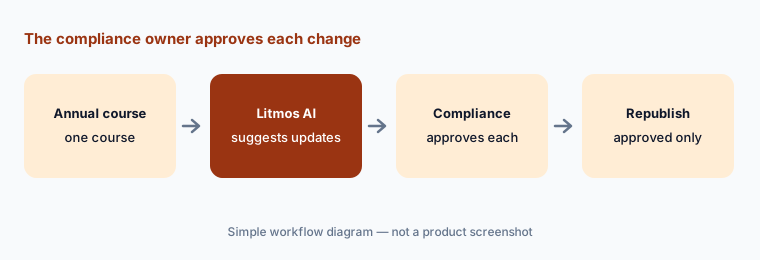
Primary workflow:
Pick one annual compliance course. Let Litmos’s AI suggest updates and have the compliance owner approve each change.
2. AI Content Authoring: outlines and module drafts
What it is: AI Content Authoring turns “a topic or objective into a structured, ready-to-edit course”: chapter and module structures grounded in your learning objective, then “first-draft module text based on your outline and objectives.” Litmos also has a native SCORM authoring tool, video and document uploads, and localized content for global teams.
Why it matters: a draft built from an objective, rather than your policy, will fill gaps with general advice. Give it your approved policy or procedure as the source, and have the subject expert mark anything the draft says that the source doesn’t. On the plans page, AI Content Authoring is listed only in the Platinum AI plan — check yours before planning around it.
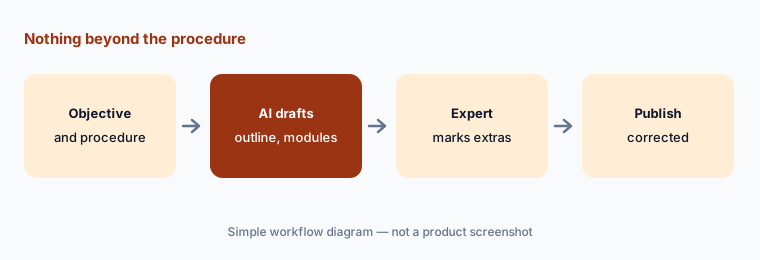
Nothing beyond the source:
Generate a course outline and module drafts from one learning objective and its approved procedure. Have the subject expert mark anything the procedure doesn’t say.
3. AI quiz questions and knowledge checks
What it is: Litmos AI can “automatically generate quiz questions and knowledge checks from your course content,” aligned to learning objectives. Assessments sit alongside e-signatures, surveys, learner uploads, and enrollment approvals, and the Platinum AI plan adds AI video assessments and role-play scenarios with automated feedback.
Why it matters: in compliance training the answer key is the evidence. A question with two defensible answers, or a key that contradicts the policy, undermines the completion record you may show an auditor. Have the course owner check every question and key, and decide the pass mark yourself rather than accepting a default.
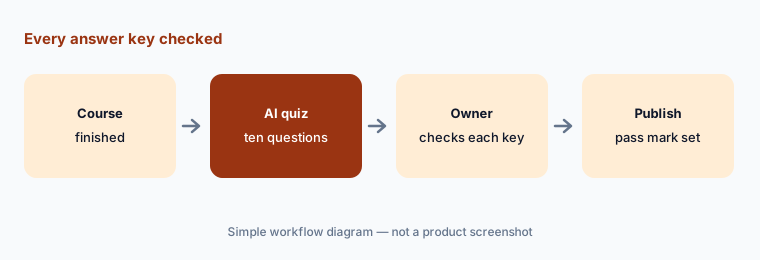
Every key checked:
Generate ten quiz questions from one finished Litmos course. Have the course owner check every answer key before learners see it.
4. Automated enrollment, reminders, and renewals
What it is: Litmos AI “automates enrollment triggers, reminder sequences, compliance assignment, and reporting workflows”: training can be assigned by hire date, role change, certification expiry, location, or custom events, with reminders and manager escalation. The compliance solution adds automatic re-enrollment before certificates lapse, eSignature acknowledgments, and time-stamped training records.
Why it matters: a rule runs for everyone it matches, so a wrong condition can assign the wrong course to hundreds of people or miss a whole state. Have the compliance owner approve each rule in writing, test it on a small group, and check the first run’s assignment list before switching it on for the whole company. Administrators “configure the rules once,” so the review has to happen before that.
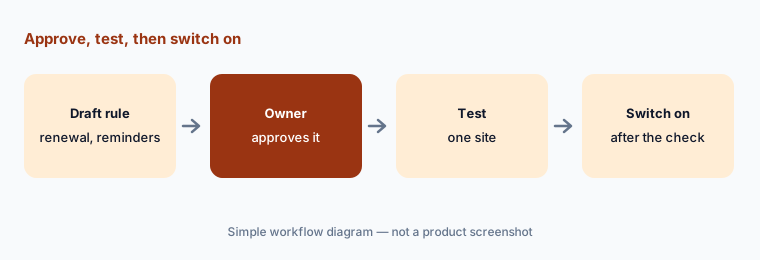
Approve and test the rule:
Draft one renewal rule for an expiring certification. Have the compliance owner approve it and test it on one small group before it runs company-wide.
5. AI Insights, the AI assistant, and recommendations
What it is: On the Platinum AI plan, AI Insights answers “natural language queries” about learning data and writes summaries, alongside learner, leader, and admin dashboards. Litmos also lists an AI assistant, AI/ML video tagging, and playlists (Platinum and Platinum AI), plus content recommendations based on role, learning history, and goals, and skill gap analysis with AI-personalized development paths (Platinum AI).
Why it matters: a plain-English answer about who is overdue is easy to act on and easy to get wrong if the question was ambiguous. Check the first answers against a standard report, and don’t paste names or HR details into prompts outside Litmos — ask the question in the LMS, where permissions apply.
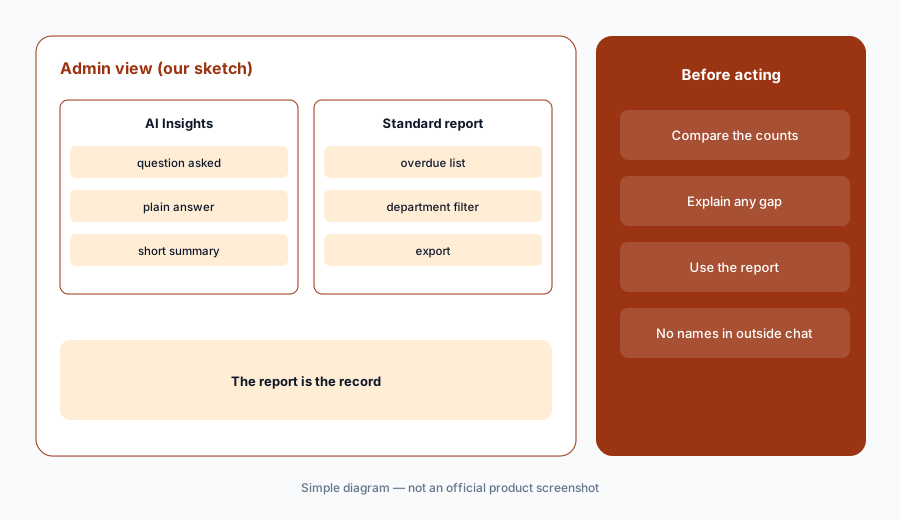
Answer against a report:
Ask AI Insights one question about overdue compliance training. Check the answer against a standard report before you act on it.
6. Compliance libraries, and which plan has which AI
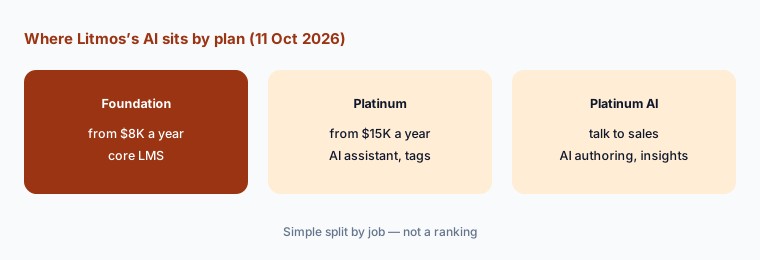
What it is: Litmos sells Premium Content Libraries and partner libraries as add-ons; its compliance page says the library “runs to more than 17,700 courses,” including OSHA Outreach training from HSI and environmental health and safety content from dss+, plus anti-bribery, harassment prevention, data privacy, cybersecurity, and healthcare compliance. The plans page shows three tiers, and the AI features are spread across them (see Pricing below).
Why it matters: an off-the-shelf course is written for everyone, so it can conflict with your own policy — a different reporting route, a state-specific rule, or a threshold you set lower. Have the compliance owner compare each library course with your policy before it is assigned, and add a short policy module where they differ.
Library course against your policy:
Pick one library course on a topic you already train. Have the compliance owner compare it with your policy before it is assigned.
Pricing context (October 2026)
Litmos publishes starting prices on its plans page (as published 11 Oct 2026, USD): Foundation “Starting at $8K per year”; Platinum “Starting at $15K per year”; Platinum AI “Talk to sales.” Each plan has a “Request Pricing” form, so the final price depends on your audiences and users.
The plan comparison puts AI-enhanced content management (AI/ML video tagging, AI assistant, playlists, video assessments) in Platinum and Platinum AI, and AI Content Authoring, AI Insights, AI video assessments and role plays, and AI skill gap analysis in Platinum AI only. Premium and partner content libraries, extra tenants, business intelligence, sandboxes, API packages, and managed services are add-ons on every plan. Ask for a written quote that names the plan, users, libraries, and AI features.
Uncertainty: Litmos’s AI page says Litmos AI is “built directly into the Litmos platform — not a separate add-on,” while the plans page lists the main AI features only in Platinum AI; confirm which AI features your plan includes. Platinum AI has no published price, and the starting prices don’t say how many users they cover. Litmos’s organization counts differ between pages, and its percentages and customer figures are not repeated here.
When it’s useful (honest take)
Useful when you run mandatory training at scale — rule-based assignment, renewals, acknowledgments, and audit records — want a large compliance library to start from, and want AI to refresh courses and draft modules and quizzes while the compliance owner approves every change.
Less useful when you need sales practice and coaching more than courses (a readiness platform may suit), you won’t pay for the plan that carries AI authoring, or nobody will review AI changes and library courses against your own policies.
Paying for Litmos AI and a few other AI tools? The $9 AI toolkit spreadsheet lists every AI subscription you have, what each one costs, and how fast it pays for itself, so you can see which ones are worth the money.
Want someone to do it for you? AI toolkit audit — $19
Related options (educational)
| Need | Better home | Why |
|---|---|---|
| Compliance and multi-audience LMS with AI authoring | Litmos AI (this page) | Platinum AI plan |
| Enterprise LMS with AI agents | Docebo AI | Agents, quote-only |
| LMS for several audiences with AI course drafts | Absorb LMS AI | Absorb Aura |
| Course LMS for small teams with published prices | TalentLMS AI | TalentCraft |
| Sales readiness and AI roleplay | Mindtickle AI | ElevateOS |
| Sales content and training in one platform | Seismic AI | Aura, Lessonly inside |
FAQ
Is Litmos still part of SAP?
No. Litmos’s newsroom carries the 1 December 2022 announcement that Francisco Partners completed its acquisition of Litmos from SAP. Litmos named Eric Vermillion chief executive on 24 February 2026.
What does Litmos AI do?
Litmos AI drafts course outlines, module text, and quiz questions, refreshes existing courses, recommends content by role and history, automates enrollment, reminders, and compliance assignments, and on the Platinum AI plan answers natural-language questions about learning data.
How much does Litmos cost in October 2026?
As published on 11 October 2026: Foundation starts at $8K per year and Platinum at $15K per year; Platinum AI, which carries AI Content Authoring and AI Insights, is by quote. Content libraries and several services are add-ons.
Does Litmos use our data to train AI?
Litmos’s AI principles say customer data is not shared with third-party LLM providers and is not used to train the Litmos AI model. Confirm the details in your contract and security review.
Can I let Litmos AI update compliance courses on its own?
Don’t. Use AI suggestions as a list of proposed changes and have the compliance owner approve each one before the course is republished, and test renewal rules on a small group before they run company-wide.
Optional next step (if seats overlap)
If you pay for an LMS, a separate compliance library, an authoring tool, and chat seats that all draft the same mandatory training, that overlap is worth mapping. Map the overlap with the $19 AI toolkit audit or the $9 AI toolkit spreadsheet. Email Audit $19 or Toolkit spreadsheet $9.
Checkout is live via Stripe. After you pay, we email delivery (spreadsheet) or intake next steps (audit).