Tool · Learning ops · Mindtickle · Oct 2026
Mindtickle AI review (Oct 2026): AI roleplay, coaching, and sales readiness
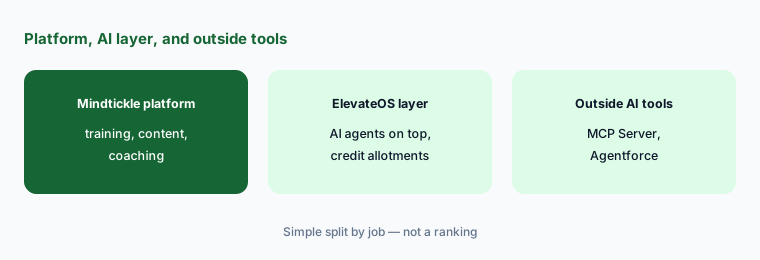
Mindtickle is a sales readiness platform: training, practice, coaching, content, and call insights for revenue teams. Its AI now sits under the name ElevateOS — Mindtickle calls it an “agentic revenue operating system” built on top of the existing platform, with agents such as AI Roleplay, AI Tutor, AI Content Creation, Deal Guides, and Copilot. This page is about using those agents for practice and readiness while managers stay the judges of how a rep is doing. Each section has a Try this.
What this Mindtickle page covers
This page is for a sales enablement lead, a sales manager, or a revenue operations lead whose team uses Mindtickle — or is weighing an AI roleplay and readiness platform — and wants to know what the AI does for practice, training, and call review, and where a person still has to check. The question it answers: which readiness jobs Mindtickle’s AI can take on, and who decides what the results mean.
Naming, checked on 11 October 2026. Mindtickle’s AI page says “ElevateOS is the AI layer built on top of the Mindtickle platform”; existing customers keep the platform they use and get AI agents on top. Its newsroom lists the ElevateOS launch announcement (dated 21 April 2026 in the page data); an October 2025 announcement from its Elevate summit introduced Real Deal AI Role Plays, AI Deal Guides, and AI Content Creation for video, rolling out with beta programs. Mindtickle also still uses the names Copilot and Call AI.
Ground rules: an AI roleplay review is coaching input, not a verdict on a rep — the manager reviews the recording and the AI feedback together and decides what to work on. Mindtickle’s FAQ says customer data “isn’t retained or used to train AI models.” Mindtickle’s customer results, time-saved figures, and award claims are not repeated here.
Major features (with how someone uses them)
Examples at a glance: each feature has a concrete example from a real job plus a short Try this you can run this week.
1. AI Sales Role Play reviewed with a manager (primary)
What it is: AI Sales Role Play lets reps practise with “a dynamic AI buyer,” where “no conversation is the same,” and get immediate feedback that cites areas to improve. Admins can create a scenario from a few prompts, pick the buyer’s voice and personality, run role plays in 25+ languages, and use screen share to practise demos. Feedback also covers soft-skill measures such as talk ratio, pace, and filler words, and AI can review large numbers of submissions.
Why it matters: AI review is fast, but it judges against the scenario it was given. A manager watching the recording will catch what the scenario didn’t cover — a promise the rep can’t keep, or a competitor claim that’s out of date. Review the recording and the AI feedback side by side, and treat the AI feedback as the start of the coaching conversation.
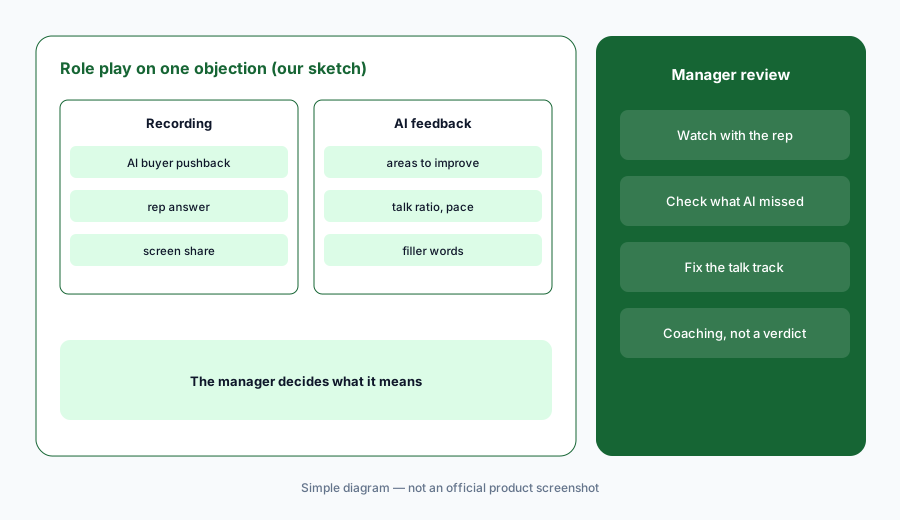
Primary workflow:
Run one AI roleplay on your most common objection. Have the rep’s manager review the recording and the AI feedback together.
2. Personalized and Real Deal role plays
What it is: Personalized AI Role Plays are “auto-created for individual reps based on their skill gaps.” Mindtickle’s Behavior Intelligence uses signals from each rep’s call recordings, past role plays, and assessments to choose what to practise. Real Deal AI Role Plays (announced October 2025) pull current deal context from the CRM, buyer engagement, persona information, and notes into the scenario.
Why it matters: auto-created practice is only as fair as the signals behind it. A rep who joined last month has fewer calls, so the system has less to go on. Pilot it with one team and have the manager check that each suggested scenario matches something the rep is really working on, and tell reps which signals are used.
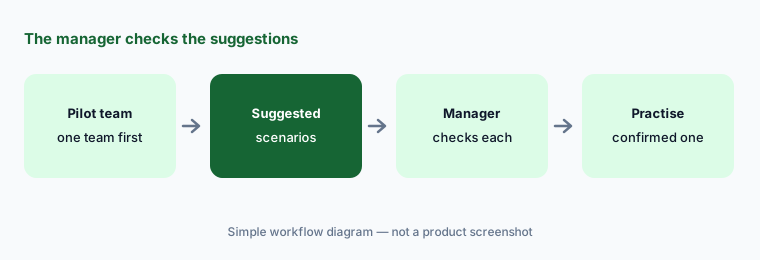
Manager checks the suggestions:
Turn on personalized role plays for one pilot team. Have the team’s manager check that each suggested scenario matches a skill the rep is actually working on.
3. AI Tutor: tutorials from your own source content
What it is: AI Tutor builds conversational tutorials from content you upload: admins “upload raw source content, define roles that need to be trained,” and the tutorial is generated with videos, flashcards, infographics, and chat. It asks questions first and lets learners skip what they know. Mindtickle lists governance controls on “topic, methodology, and mastery criteria” to limit made-up answers.
Why it matters: a tutorial that lets reps skip ahead is only as good as its mastery bar. Have the product owner set the mastery criteria and check the generated flashcards and answers before launch — completion of a tutorial is not the same as being ready to explain the product to a customer.
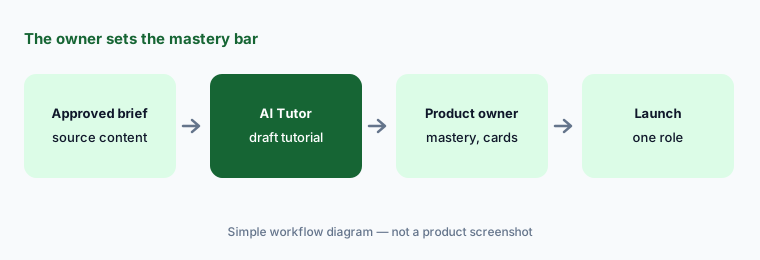
Owner sets the bar:
Build one AI Tutor tutorial from an approved product brief. Have the product owner set the mastery criteria and check every flashcard before launch.
4. AI Content Creation: video, podcasts, decks, and translation
What it is: AI Content Creation turns a document into a training video “with digital avatars, lip-synced audio, and visuals,” a podcast-style conversation or monologue, or a themed deck, with the option to customize the script, narration, and visuals before publishing. AI translation, “supported across 28 languages,” narrates video and podcasts in the rep’s language, and new content added to a module is translated automatically.
Why it matters: a generated script can sound confident about something the source document only hints at, and automatic translation keeps adding content nobody fluent has read. Have the document owner approve the script before the video is generated, and have a fluent colleague check each new language before it reaches reps.
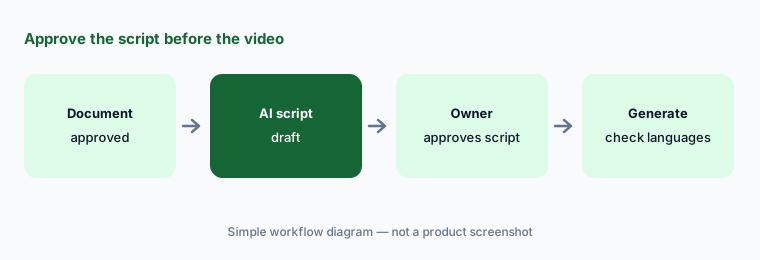
Approve the script first:
Turn one approved document into a short training video with AI Content Creation. Have the document owner approve the script before the video is generated.
5. Call AI, Copilot, and Deal Guides
What it is: Mindtickle’s conversation intelligence (Call AI) records and transcribes calls, tracks competitor mentions, objections, and questions, and supports coaching comments on calls. Copilot summarizes calls, drafts follow-up emails, answers prospects’ questions from your content, and helps enablement create role-play scenarios, program outlines, and assessments. AI Deal Guides send nudges in Slack or Teams when a deal changes and suggest a next action.
Why it matters: a call summary that adds a commitment goes straight into the CRM and the follow-up email. Have the rep compare the summary with the recording before it is saved, and have the manager decide which call snippets are good enough to reuse as training examples.
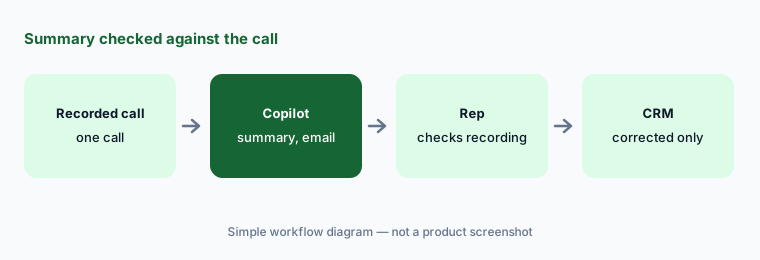
Summary against the recording:
Compare one Copilot call summary with the recording. Have the rep fix any wrong action item before it is saved to the CRM.
6. Readiness Index, ElevateOS, and the MCP Server
What it is: The Readiness Index lets you define an ideal rep profile with competencies by role, use pre-built competency frameworks, and relate skills to CRM outcomes such as win rates. ElevateOS ties practice, learning, coaching, deal guidance, content, and buyer engagement to one context engine, and the Mindtickle MCP Server lets outside AI agents (Mindtickle names Salesforce Agentforce) use approved content, call summaries, and buyer rooms, with “safeguards for high-impact actions.”
Why it matters: a readiness view can turn into a label on a person. Agree with sales leadership what evidence counts for each competency — a manager’s observation as well as AI practice results — and who can see it. Completion and practice counts are signals, not proof that someone is ready for a customer.
Agree on the evidence first:
Define one competency for one role in the Readiness Index. Have sales leadership and enablement agree on what evidence counts before any rep is marked as ready.
Pricing context (October 2026)
Mindtickle doesn’t publish prices (checked 11 Oct 2026; there is no public pricing page). Its ElevateOS FAQ says packages include “unmetered access to the Mindtickle revenue enablement platform, along with credit allotments that can be applied to prioritized agents and AI capabilities,” and asks you to get in touch for a quote.
Because AI use is credit-based, ask for the credit allotment in writing, what one role play, tutorial, video, or translation uses, what happens when credits run out, and whether unused credits roll over. Mindtickle says teams can start with a single capability such as AI role plays, so price a small pilot before a full platform deal.
Uncertainty: Mindtickle doesn’t publish prices or the credit cost of each AI capability. The ElevateOS launch page carries no visible date (the newsroom data shows 21 April 2026), and some October 2025 features launched as betas; check what is generally available on your plan. Pages mix older and newer names (Copilot, Call AI, ElevateOS agents). Mindtickle’s customer results, ramp-time and cost-cut percentages, and award claims are not repeated here.
When it’s useful (honest take)
Useful when your revenue team needs frequent, realistic practice on objections, demos, and launches, managers will review recordings with their reps, and you want AI tutorials, training videos, and call summaries built from approved content — with owners checking each one.
Less useful when you mainly need a general employee LMS or a content library, managers won’t review practice, you can’t predict AI usage well enough for a credit-based package, or you need published prices.
Paying for Mindtickle AI and a few other AI tools? The $9 AI toolkit spreadsheet lists every AI subscription you have, what each one costs, and how fast it pays for itself, so you can see which ones are worth the money.
Want someone to do it for you? AI toolkit audit — $19
Related options (educational)
| Need | Better home | Why |
|---|---|---|
| AI roleplay, tutors, and readiness for revenue teams | Mindtickle AI (this page) | ElevateOS, credits |
| Sales content, coaching, and role play in one platform | Highspot AI | Part of Seismic |
| Enablement with Aura Roleplay and Lesson Agents | Seismic AI | Lessonly inside |
| Call recording and deal insights | Gong | Calls first |
| Course LMS with compliance libraries | Litmos AI | Employees and partners |
| AI avatar training videos | Colossyan | Video-first |
FAQ
What is Mindtickle ElevateOS?
ElevateOS is Mindtickle’s name for its agentic AI layer on top of the Mindtickle platform. It includes agents such as AI Tutor, AI Roleplay, AI Manager Coach, AI Content Creation, Deal Guides, AI Simulator, and Copilot. Existing customers keep their platform and add AI on top.
How does Mindtickle’s AI role play work?
Reps practise with a dynamic AI buyer in 25+ languages and get immediate feedback, including talk ratio, pace, and filler words. Admins create scenarios from prompts, and personalized role plays can be auto-created from each rep’s skill gaps. Managers should review the recording and the feedback with the rep.
How much does Mindtickle cost in October 2026?
Mindtickle doesn’t publish prices. Its FAQ says packages include unmetered access to the platform plus credit allotments for AI agents, quoted by sales. Ask what each AI capability uses in credits.
Does Mindtickle use our data to train AI models?
Mindtickle’s ElevateOS FAQ says your data is used only for you and your team and “isn’t retained or used to train AI models.” Confirm the details in your contract and security review.
Should AI role play feedback decide whether a rep is ready?
No. Treat AI feedback as coaching input. Agree with sales leadership what evidence counts for readiness — including a manager’s observation of real calls — and have the manager review recordings with the rep.
Optional next step (if seats overlap)
If you pay for a readiness platform, a separate call recorder, an AI video tool, and chat seats that all draft the same training, that overlap is worth mapping. Map the overlap with the $19 AI toolkit audit or the $9 AI toolkit spreadsheet. Email Audit $19 or Toolkit spreadsheet $9.
Checkout is live via Stripe. After you pay, we email delivery (spreadsheet) or intake next steps (audit).