Compare · Hospitality ops · Oct 2026
Duetto vs IDeaS (Oct 2026): AI revenue management systems for hotels
Duetto and IDeaS are the two hotel revenue management vendors most hotel groups shortlist. Duetto leads with Open Pricing — every segment, channel, and room type priced on its own — and Autopilot; IDeaS (a SAS company) leads with G3 RMS automated pricing decisions, forecasts, and a redesigned Group Pricing Evaluation. Both are quote-only. This page compares pricing approach, forecasting, groups, overrides, integrations, and who approves automated rate pushes — it is not a ranking, and each section has a Try this.
What this comparison covers
This page is for a director of revenue, commercial director, or hotel group owner choosing a hotel RMS, or running one and hearing about the other. The question it answers: how do Duetto and IDeaS G3 RMS differ in approach, groups, and controls — and who approves the rates they push.
Facts match our Duetto AI and IDeaS G3 RMS AI reviews and were re-read 14 October 2026: Duetto’s Buyer FAQ says pricing is “based on property size, product configuration, and contract terms”; IDeaS’s buyer’s guide says RMS costs vary by rooms or units, properties, and features; IDeaS’s February 2026 G3 update redesigned Group Pricing with Wish and Walk Price and approval workflows.
Ground rules for either system: the revenue manager owns floors, ceilings, overrides, and every automated rate push; sales quotes groups only after the revenue manager approves; vendor RevPAR figures are attributed only, never our measurement. This comparison is not a ranking.
| Question | Duetto | IDeaS G3 RMS |
|---|---|---|
| Pricing approach | Open Pricing — each segment, channel, and room type priced independently, not tied to a BAR ladder (GameChanger) | Automated pricing and rate-availability decisions at room-type and key-product level |
| Automation | Autopilot executes your strategy 24/7 within rules you set | Automated decisions delivered to your systems; manage by exception with overrides |
| Forecasting | Forecasting and commercial reporting module; Advance adds demand intelligence with explainable recommendations | Demand forecasts feeding pricing, restrictions, and overbooking decisions |
| Groups | BlockBuster for group business and displacement | Group Pricing Evaluation — redesigned Feb 2026 with Wish and Walk Price and approval workflows |
| Wider suite | HotStats profit benchmarking; GameTime for select-service | IDeaS (a SAS company) family of revenue products |
| Question | Duetto | IDeaS G3 RMS |
|---|---|---|
| Published price | None — “based on property size, product configuration, and contract terms” (Buyer FAQ) | None — costs vary by rooms or units, properties, and features (buyer’s guide) |
| Floors and ceilings | Set in your strategy rules; Autopilot stays inside them | Set as limits and overrides; decisions stay inside them |
| Who approves automated pushes | Revenue manager approves every Autopilot rule and rate push | Revenue manager owns every override and decision-delivery setting |
| Group quotes | Sales proposes, revenue manager approves displacement | Sales evaluates, revenue manager explains the recommended rate before quoting |
| Vendor results | RevPAR uplift claims — vendor figures only | RevPAR growth case studies — vendor figures only |
Major features (with how someone uses them)
Examples at a glance: each feature has a concrete example from a real job plus a short Try this you can run this week.
1. Write your floor, ceiling, and override rules first (primary)
What it is: Before comparing algorithms, write the rules a person owns: the lowest and highest rate per room type, the dates that always need a person, and who may override an automated rate. Then check how each RMS lets you set those rules and who in your team can change them.
Duetto expresses this as strategy rules that Autopilot stays inside; IDeaS G3 as limits and overrides on automated decisions. The words differ; the question is the same — can you see, set, and lock the limits?
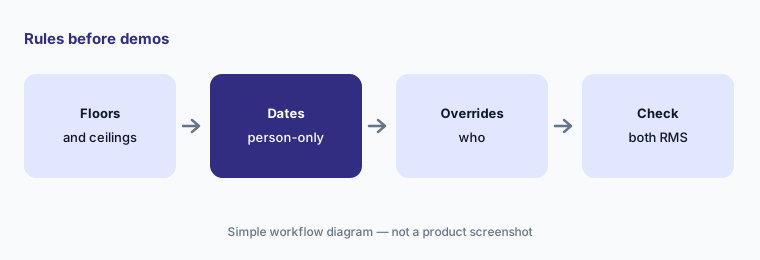
Rules before demos:
Write down your floor, ceiling, and override rules. Check how each RMS lets you set them and who can change them.
2. Open Pricing vs automated decisions
What it is: Duetto’s Open Pricing prices each segment, channel, and room type independently rather than moving everything off one Best Available Rate. IDeaS G3 RMS sends automated pricing and rate-availability decisions at room-type and key-product level. Both aim to price closer to demand; they expose it differently.
Ask each vendor to show one date where the system priced two channels or segments differently, and to explain why in plain words. If nobody on your team can explain the output, it is not ready to push unattended.
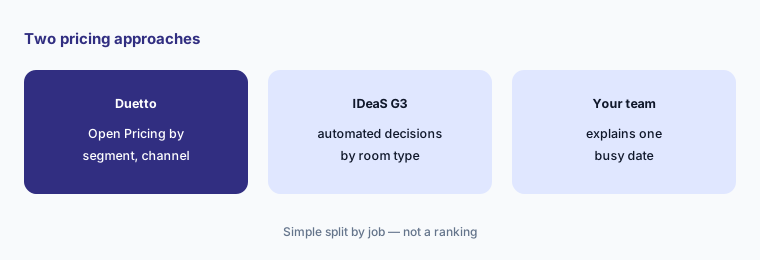
Explain one date:
Pick one busy date. Ask each vendor to explain, in plain words, why its system priced two segments or channels differently.
3. Group evaluation: BlockBuster vs Group Pricing Evaluation
What it is: Duetto handles group business and displacement with BlockBuster. IDeaS redesigned G3’s Group Pricing Evaluation in February 2026 with Wish and Walk Price up front, expanded insights, and built-in approval workflows. Both estimate what a group displaces from transient demand.
The approval step matters more than the screen. Sales should not quote until the revenue manager has seen the displacement and agreed the rate.
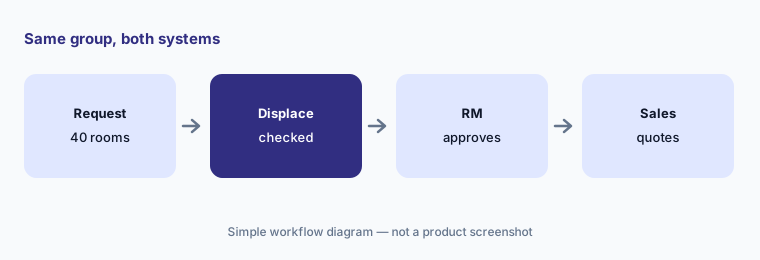
Same group, both systems:
Run the same group request through both demos. Compare the walk-away rate and note who must approve before sales quotes it.
4. Overrides, Autopilot, and decision delivery
What it is: Duetto’s Autopilot executes your strategy around the clock inside the rules you set. IDeaS G3 delivers automated decisions to your PMS and channel systems and lets you manage by exception with overrides. In both, the dangerous setting is the one that pushes rates to channels without a person seeing them.
List every automated push each system can make and who can switch it on. Night and weekend managers should know they may not widen automation.
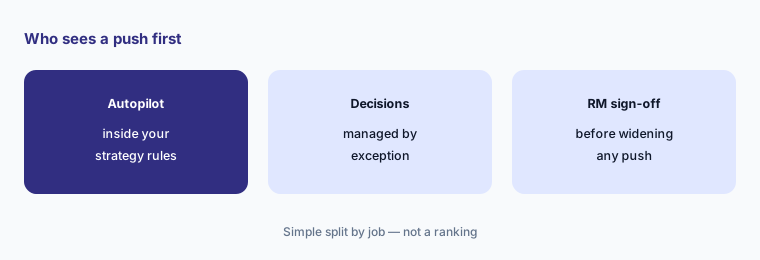
List every push:
List every automated rate or restriction push each RMS can make. Mark which are on by default and who can switch them on.
5. Integrations and pricing transparency (both quote-only)
What it is: Neither vendor publishes a price on the pages we read 14 October 2026. Duetto prices on property size, product configuration, and contract terms; IDeaS on rooms or units, properties, and features. Both connect to major PMS and channel systems — confirm yours by name.
Ask for quotes at the same scope: same properties, same modules (groups, forecasting, benchmarking), same contract length, with integrations named. Third-party price estimates are not either vendor’s published terms.
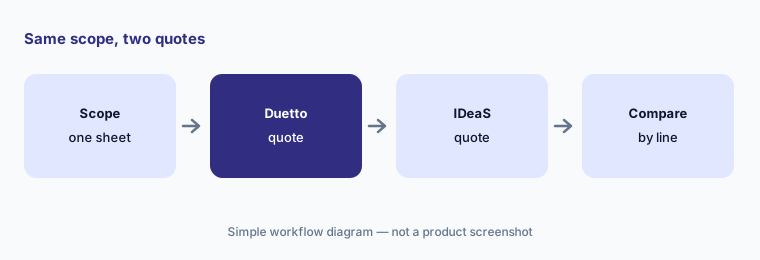
Same scope, two quotes:
Send both vendors the same scope sheet — properties, modules, contract length, PMS and channel manager — and compare the written quotes line by line.
6. Who approves automated rate pushes on either system
What it is: On both systems the revenue manager owns floors, ceilings, overrides, and automation settings; sales owns group requests but not group rates; the GM or owner signs off the strategy. The approval sheet is the same whichever you choose.
Keep one page per hotel: rules owner, override rights, automation switches, group approval, and a monthly review date.
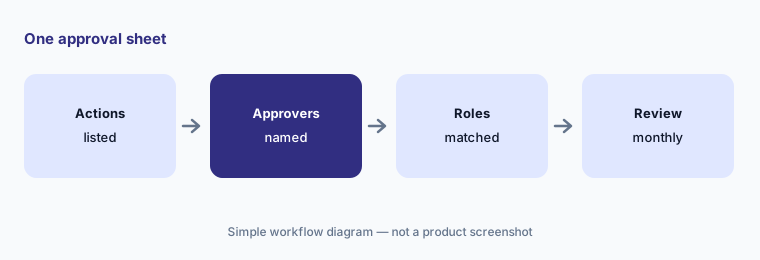
One approval sheet:
Write one approval sheet per hotel for floors, overrides, automation switches, and group rates, and ask each vendor to set user roles to match it in the trial.
Pricing context (October 2026)
Duetto’s Buyer FAQ (re-read 14 Oct 2026): pricing “is based on property size, product configuration, and contract terms”; no public rate card. Products include GameChanger, BlockBuster, Advance, GameTime, HotStats, and a forecasting and reporting module.
IDeaS’s buyer’s guide (re-read 14 Oct 2026): costs vary by rooms or units, properties supported, and features; no public price. See Duetto AI and IDeaS G3 RMS AI for detail.
Uncertainty: Both vendors are quote-only and package modules differently, so like-for-like quotes need the same scope. Feature names and AI labelling change; confirm current module names in the demo. This page is not a ranking.
When it’s useful (honest take)
Duetto is useful when you want Open Pricing across segments and channels, Autopilot inside your rules, and a suite that reaches profit benchmarking.
IDeaS G3 RMS is useful when you want automated pricing decisions with manage-by-exception overrides and a structured group evaluation with approval workflows.
Less useful when (either one) nobody owns floors and overrides, you mainly need rate shopping and market data (Lighthouse AI), you want pricing built into your PMS (Atomize AI / Mews RMS), or you run a small hotel that needs simpler AI pricing (RoomRaccoon AI).
Still choosing between Duetto and IDeaS? The $19 AI toolkit audit gives you a written plan for which tools to keep using and which to drop across your whole AI stack, including this pair.
Prefer to do it yourself? Spreadsheet — $9
Related options (educational)
| Need | Better home | Why |
|---|---|---|
| Duetto on its own | Duetto AI | Quote |
| IDeaS G3 RMS on its own | IDeaS G3 RMS AI | Quote |
| Rate shopping + pricing for independents | Lighthouse AI | From €99/month |
| RMS inside your PMS | Atomize AI (Mews RMS) · Cloudbeds AI | Quote |
| Small-hotel AI pricing | RoomRaccoon AI | RaccoonRev Plus on Pro |
FAQ
Should I choose Duetto or IDeaS?
This page is not a ranking. Write your floor, ceiling, and override rules, check how each system lets you set and lock them, run the same group request through both, and compare quotes at the same scope.
How much do Duetto and IDeaS cost in October 2026?
Neither publishes a price. Duetto prices on property size, product configuration, and contract terms; IDeaS on rooms or units, properties, and features (both re-read 14 October 2026).
What is the main difference in pricing approach?
Duetto’s Open Pricing prices segments, channels, and room types independently with Autopilot inside your rules; IDeaS G3 RMS sends automated pricing and availability decisions you manage by exception.
Which handles group business better?
Both evaluate groups — Duetto with BlockBuster, IDeaS with a Group Pricing Evaluation redesigned in February 2026. Run the same request through both and check who approves before sales quotes.
Who should approve automated rate pushes?
The revenue manager on either system: floors, ceilings, overrides, and automation switches. Sales quotes groups only after the revenue manager approves.
Optional next step (if seats overlap)
If you pay for an RMS, a rate-shopping tool, and pricing inside your PMS that all try to set the same rates, that overlap is worth mapping. Map the overlap with the $19 AI toolkit audit or the $9 AI toolkit spreadsheet. Email Audit $19 or Toolkit spreadsheet $9.
Checkout is live via Stripe. After you pay, we email delivery (spreadsheet) or intake next steps (audit).