Compare · Hospitality ops · Oct 2026
Mews vs Cloudbeds (Oct 2026): AI hotel PMS platforms for independent hotels and groups
Mews and Cloudbeds both sell cloud hotel platforms with PMS, payments, channels, and a growing AI layer. Mews leads with the Mews Agent, Automations, and Mews RMS inside its operating system; Cloudbeds leads with the Signals data layer, Cloudbeds RMS (Autopilot inside your limits), the Guest Experience Agent, and Ask Signals. Both are quote-only on public pricing pages. This page compares property fit, guest AI, RMS, channels, and who approves — it is not a ranking, and each section has a Try this.
What this comparison covers
This page is for an independent hotel owner, GM, or multi-property ops lead choosing between Mews and Cloudbeds, or running one and hearing about the other’s AI. The question it answers: by property type, guest AI, RMS, channels, and pricing transparency, how do the two compare — and who approves replies and rate automation.
Facts align with our Mews AI and Cloudbeds AI reviews (read 14 October 2026). Mews pricing lists Core / Pro / Enterprise per room by quote. Cloudbeds pricing lists Flex / One / Experience / Enterprise with no amounts. Guest Messaging and Automations launched on Mews 1 October 2026; Cloudbeds RMS launched 15 September 2026.
Ground rules for either platform: a named front-office or guest-experience lead approves every AI reply rule; the revenue owner sets every RMS / Autopilot limit; no guest PII, card numbers, or door PINs in tests; vendor lift figures are left out or attributed only. This comparison is not a ranking.
| Question | Mews | Cloudbeds |
|---|---|---|
| Who it is for | Hotels, hostels, serviced apartments — “operating system for hospitality” | Independent hotels, hostels, B&Bs, and groups on one data layer (Signals) |
| Published price | Mews Core / Mews Pro / Enterprise — per room by quote; no amount on the page (14 Oct 2026) | Flex / One / Experience / Enterprise — no public prices (14 Oct 2026); WhatsApp billed per outbound message |
| Guest AI | Mews Agent in Guest Messaging (SMS, WhatsApp, Booking.com, Expedia, Guest Portal; launched 1 Oct 2026); Automations | Guest Experience Agent (listings + SOPs); website / WhatsApp / SMS chatbot; unified inbox |
| Ask / summaries | AI summaries in Business Intelligence; Smart Tips on guest history; Smart Tasks coming soon | Ask Signals (unveiled 21 May 2026 as early pilot; FAQ still “coming soon” in places) |
| RMS | Mews RMS — dynamic pricing with autopilot inside the PMS | Cloudbeds RMS (launched 15 Sep 2026) — accept / edit / Autopilot within limits you set |
| Channels | Mews Channel Manager powered by SiteMinder (400+ OTAs, one contract) | Cloudbeds Channel Manager on the same platform |
| AI controls on the pages we read | Approval gates, uncertain-decision flags, audit log + rollback; Property AI Guidance coming soon | Autopilot limits and exceptions set by the property; revenue owner accepts or edits recommendations |
| Who approves | Front-office manager for replies and automations; revenue owner for RMS limits | Guest-experience lead for agent workflows; revenue owner for Autopilot limits |
Major features (with how someone uses them)
Examples at a glance: each feature has a concrete example from a real job plus a short Try this you can run this week.
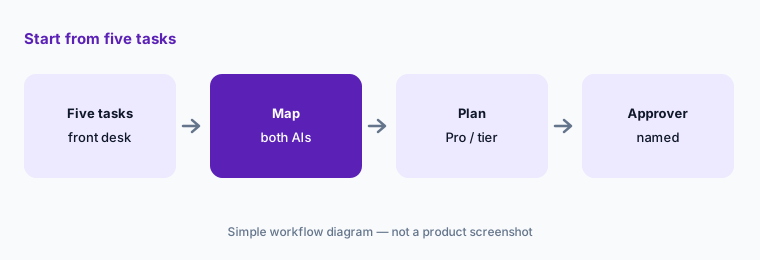
1. Start from five repetitive front-desk tasks (primary)
What it is: Before comparing AI product names, list the five front-desk tasks you most want help with — after-hours guest questions, pre-arrival messages, upsell offers, room-status updates, and rate checks are common. For each, note which platform’s AI covers it, on which plan, and who approves the output before it reaches a guest or a channel.
A task with no named approver is not ready on either platform. Plan names matter: Mews Automations and AI messaging lean Pro; Cloudbeds Autopilot and Guest Experience Agent depend on your Cloudbeds plan and add-ons.
Your five tasks:
List your five most repetitive front-desk tasks. Note which platform’s AI covers each, on which plan, and who approves the output.
2. Property fit and pricing transparency
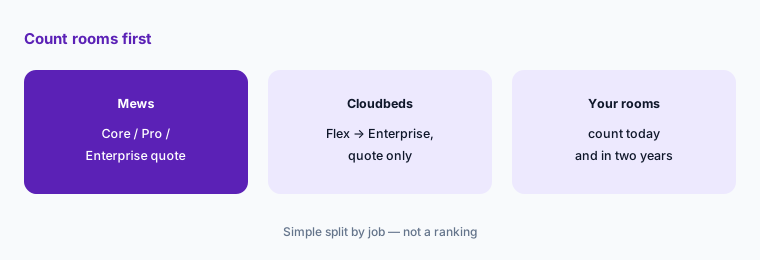
What it is: Mews markets to hotels and hospitality groups that want PMS, payments, POS, messaging, and RMS on one operating system, priced per room across Core, Pro, and Enterprise — quote only on the pricing page we read 14 Oct 2026. Cloudbeds markets to independent hotels and groups on the Signals data layer, with Flex through Enterprise and no public prices on its pricing page; WhatsApp outbound messages are billed per message.
Ask both vendors for a written quote at the same room count with the AI features you would switch on named line by line — including Automations / AI messaging on Mews and RMS Autopilot / Guest Experience Agent on Cloudbeds.
Same room count, two quotes:
Write down your room count today and in two years. Ask both vendors for a written quote at that count with every AI feature you want named on the quote.
3. Mews Agent and Automations vs Guest Experience Agent and Ask Signals
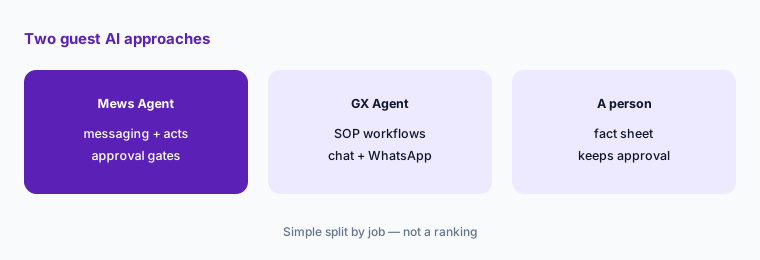
What it is: Mews Guest Messaging puts OTA, WhatsApp, SMS, and portal threads in one guest timeline; the Mews Agent can draft replies and act (tasks, orders, reservation changes) with approval gates and an audit log — see Mews AI. Automations turn rules into workflows from templates, a visual builder, or plain words. Cloudbeds’s Guest Experience Agent turns plain-language instructions into workflows trained on listings and SOPs; Ask Signals is a conversational pilot over Signals data (Cloudbeds AI).
Test both with the same ten guest questions from your fact sheet. Keep human approval on until fee, policy, and amenity answers match.
Same ten questions:
Ask each platform’s guest AI your ten most common guest questions. Mark any wrong fee, policy, or amenity answer before you remove human approval.
4. Mews RMS vs Cloudbeds RMS Autopilot
What it is: Mews RMS embeds dynamic pricing in the PMS with autopilot optimization. Cloudbeds RMS (15 Sep 2026) lets you accept a recommendation, edit it, or run Autopilot inside limits and exceptions you set, with changes flowing through the Cloudbeds PMS and channel manager. On both, floors and event dates stay with the revenue owner.
Start recommend-only on one room type for two weeks on either platform. Write why you accept or edit each rate before Autopilot widens.
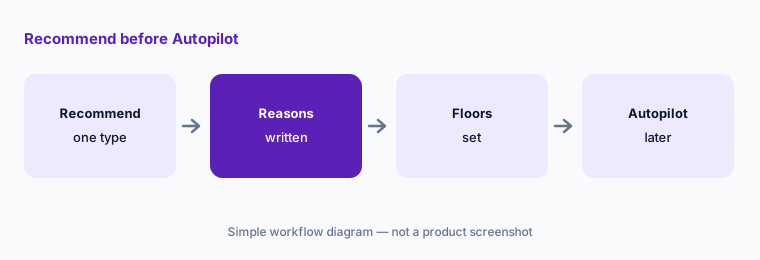
Recommend-only first:
On either platform, set RMS to recommend-only for one room type for two weeks. Have the revenue owner write why they accept or edit each rate before Autopilot.
5. Channel management: SiteMinder-powered Mews vs Cloudbeds Channel Manager
What it is: Mews distributes through Mews Channel Manager powered by SiteMinder (400+ OTAs, one contract) — see also SiteMinder AI. Cloudbeds runs its own channel manager on the same platform as PMS and RMS. Both push rates that AI may have suggested; a bad rate still becomes a live OTA price.
Whoever owns channels should see every Autopilot or Agent-driven rate change in the same morning report as manual changes.
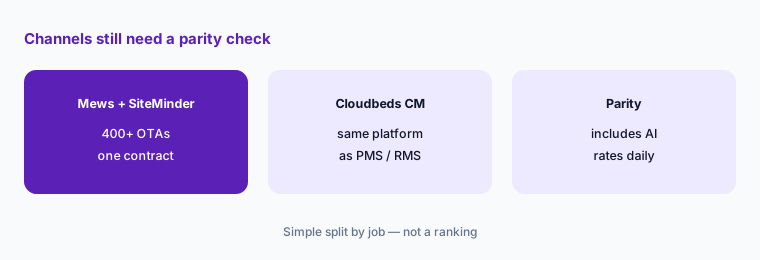
Parity includes AI rates:
Add AI-origin rate changes to your morning channel parity check. Note who must sign off before Autopilot may push to OTAs.
6. Who approves replies and rate automation on either platform
What it is: On Mews, the front-office manager owns reply approval and automations; the revenue owner owns RMS limits; the audit log is read weekly. On Cloudbeds, the guest-experience lead owns agent workflows and chatbot sources; the revenue owner owns Autopilot limits. Room moves, folio charges, and accessible-room assignments stay with people on both.
Keep one approval sheet with four columns — guest replies, automations / agent workflows, RMS Autopilot, channel pushes — and a named person in each. The same sheet works whichever platform you pick.
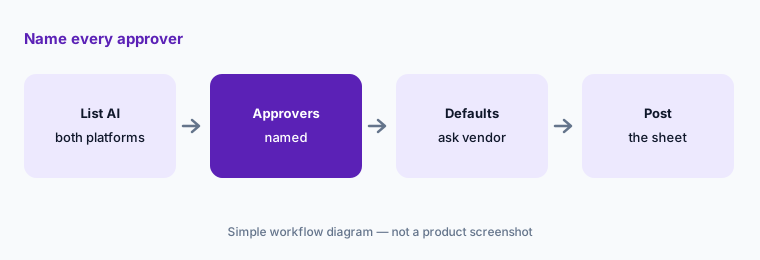
One approval sheet:
Make one approval sheet for guest replies, automations, RMS Autopilot, and channel pushes. Name the approver for each and ask both vendors which AI actions run without approval by default.
Pricing context (October 2026)
Mews’s pricing page (read 14 Oct 2026): Mews Core, Mews Pro, and Enterprise, priced per room through a quote; no amount on the page. Automations and AI messaging over WhatsApp/SMS are positioned on Pro (or add-on). Payment processing is separate; POS and Spaces are add-ons.
Cloudbeds’s pricing page (read 14 Oct 2026): Flex, One, Experience, and Enterprise with no published prices. WhatsApp outbound messages are billed per message. Cloudbeds RMS and Guest Experience Agent availability by plan should be confirmed on the quote. See Mews AI and Cloudbeds AI for feature detail.
Uncertainty: Exact AI feature packaging by plan changes — confirm Automations / Agent messaging on Mews and RMS Autopilot / Ask Signals status on Cloudbeds in writing. Ask Signals was still described as an early pilot / coming soon in places on 14 Oct 2026. This page is not a ranking.
When it’s useful (honest take)
Mews is useful when you want PMS + Agent messaging + Automations + RMS on one operating system, with approval gates and an audit log, and you are fine with a per-room quote.
Cloudbeds is useful when you want the Signals data layer, Cloudbeds RMS Autopilot inside limits, and a Guest Experience Agent trained on your SOPs, and you are fine working from a plan quote.
Less useful when (either one) nobody owns reply approval, you mainly need a channel manager beside a PMS you keep (SiteMinder AI), or you run a tiny B&B that wants a simpler all-in-one (Little Hotelier AI).
Still choosing between Mews and Cloudbeds? The $19 AI toolkit audit gives you a written plan for which tools to keep using and which to drop across your whole AI stack, including this pair.
Prefer to do it yourself? Spreadsheet — $9
Related options (educational)
| Need | Better home | Why |
|---|---|---|
| Mews on its own | Mews AI | Core / Pro / Enterprise — quote |
| Cloudbeds on its own | Cloudbeds AI | Flex → Enterprise — quote |
| Channel manager beside any PMS | SiteMinder AI | Channels / add-ons |
| Enterprise chain PMS | Oracle OPERA Cloud AI | OPERA quote |
| Small hotel / B&B all-in-one | Little Hotelier AI | Basics from $39 / Pro from $179 a month (5-room default) |
FAQ
Should I choose Mews or Cloudbeds?
This page is not a ranking. List your five most repetitive front-desk tasks, note which platform’s AI covers each and who approves, get written quotes at the same room count, and compare those — not marketing headlines.
How much do Mews and Cloudbeds cost in October 2026?
Neither publishes a fixed amount on the pages we read 14 October 2026. Mews is per-room by quote (Core / Pro / Enterprise). Cloudbeds is Flex / One / Experience / Enterprise by quote; WhatsApp is per outbound message.
Which has stronger guest-messaging AI?
Mews ships Guest Messaging with the Mews Agent and approval gates (launched 1 Oct 2026). Cloudbeds ships a Guest Experience Agent and chatbot on Signals. Test both with your fact-sheet questions rather than picking from a feature list.
Which RMS should I automate first?
On both, start recommend-only on one room type with the revenue owner writing why they accept or edit each rate. Autopilot comes after floors and event dates are written down.
Who should approve AI on either platform?
A named front-office or guest-experience lead for guest replies and agent workflows; the revenue owner for RMS / Autopilot limits; distribution for channel pushes.
Optional next step (if seats overlap)
If you pay for a PMS with its own AI, a separate messaging tool, and a separate RMS that all touch the same guests and rates, that overlap is worth mapping. Map the overlap with the $19 AI toolkit audit or the $9 AI toolkit spreadsheet. Email Audit $19 or Toolkit spreadsheet $9.
Checkout is live via Stripe. After you pay, we email delivery (spreadsheet) or intake next steps (audit).