Tool · Hospitality ops · Cloudbeds · Oct 2026
Cloudbeds AI review (Oct 2026): Signals, Cloudbeds RMS Autopilot, Guest Experience Agent, and Ask Signals for independent hotels
Cloudbeds is a hospitality management system for independent hotels, hostels, B&Bs, and groups: PMS, payments, channel manager, booking engine, and guest experience on one platform. Its AI story rests on Signals, the unified data layer under every product, which feeds Cloudbeds RMS, the Guest Experience Agent, the conversational Ask Signals, and AI review insights in Reputation Management. This page is about letting that AI recommend and draft while the revenue owner and guest-experience lead still decide what runs on its own. Each section has a Try this.
What this Cloudbeds page covers
This page is for an independent hotel owner, general manager, or revenue lead on Cloudbeds or comparing cloud PMS platforms. The question it answers: what Cloudbeds’s AI does today, which parts are new or still in pilot, how the plans are sold, and who approves rate automation and guest-facing workflows.
Cloudbeds launched Cloudbeds RMS on 15 September 2026, with Autopilot handling routine rate changes inside the strategy, pricing limits, and exceptions each property sets. It unveiled Ask Signals on 21 May 2026 as an early pilot. The pricing page (read 14 October 2026) lists Flex, One, Experience, and Enterprise plans with no published prices.
Ground rules: the revenue owner sets every Autopilot limit and reviews recommendations before automation widens; a guest-experience lead approves every agent workflow and chatbot source; no card data, ID documents, or door codes in tests; and vendor uplift figures are Cloudbeds’s claims, not our measurement.
Major features (with how someone uses them)
Examples at a glance: each feature has a concrete example from a real job plus a short Try this you can run this week.
1. Cloudbeds RMS: recommend, edit, or Autopilot inside your limits (primary)
What it is: Cloudbeds RMS reads time-to-arrival, length of stay, channel behavior, competitor rates, and market demand together. Its AI page says you can accept a recommendation, edit it, or let Autopilot run it inside limits you set; accepted and automated changes flow straight through the Cloudbeds PMS and channel manager. Cloudbeds quotes “up to 18% potential RevPAR uplift” and forecast accuracy “up to 95%” — vendor claims.
Autopilot moves real rates on real channels. Start on one room type, recommend-only, with the revenue owner explaining every accept or edit.
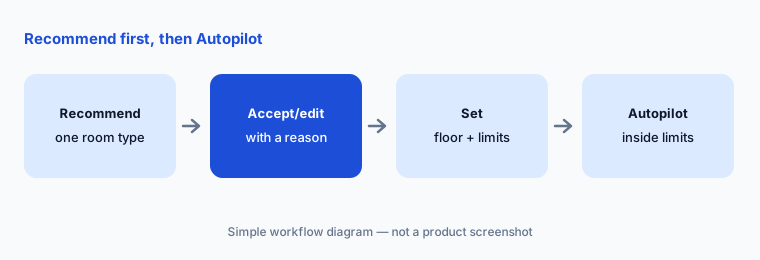
Primary workflow:
Set Cloudbeds RMS to recommend-only for one room type for two weeks. Have the revenue owner accept or edit each rate and write down why before you turn on Autopilot.
2. Guest Experience Agent: plain-language instructions into workflows
What it is: Cloudbeds’s AI page says the Guest Experience Agent works from one guest record — booking and channel, WhatsApp and chat threads, digital check-in documents, preferences, and staff notes — is trained on your listings and SOPs, and turns a plain-language instruction into an automated workflow. Guest Experience also includes an AI chatbot for your website, WhatsApp, or SMS and a unified inbox.
A workflow written from one sentence can message more guests than you meant. Read the trigger and the audience before it goes live.
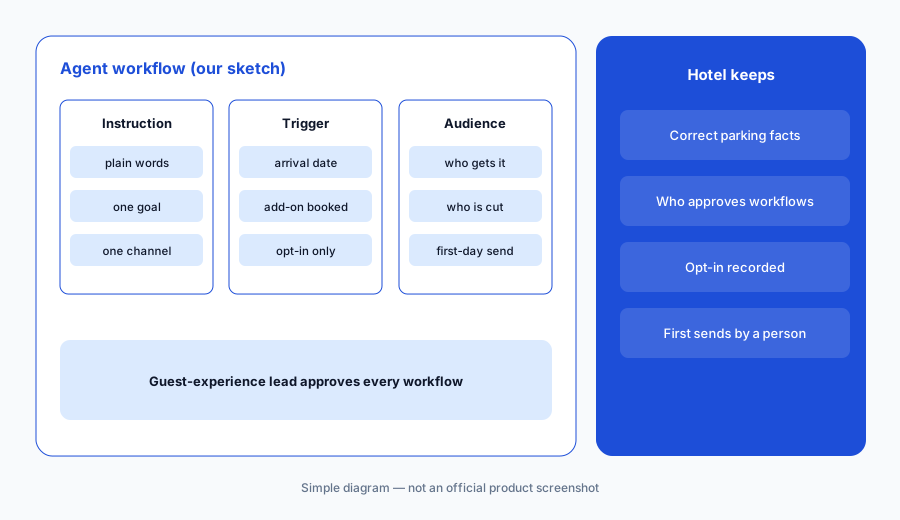
Read the workflow:
Give the Guest Experience Agent one plain-language instruction. Before it runs, write down who it will message and when, and cut anyone you did not mean.
3. Ask Signals: questions about pickup, pace, and guests
What it is: Ask Signals is a conversational interface over operational, guest, distribution, and revenue records — pickup trends, booking pace, channel mix, ADR, direct bookings, and guest context such as booking source and review history. Cloudbeds opened early-pilot signups on 21 May 2026; its own AI FAQ still described Ask Signals as coming soon on 14 Oct 2026, so confirm access before you plan around it.
A fluent answer about “why last week underperformed” can still mix up dates or segments. Open the report it should have used.
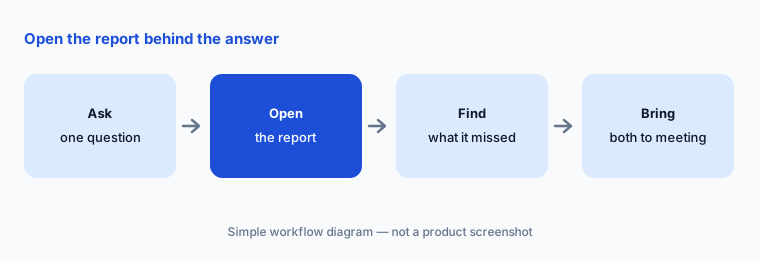
Open the source:
If you are in the pilot, ask Ask Signals one question about last week’s pickup. Open the matching report and note anything the answer left out.
4. Reputation Management: AI themes and response drafts
What it is: Cloudbeds Reputation Management reads guest reviews across Google, Booking.com, and Airbnb, identifies what guests consistently praise and criticize, and recommends what to fix first. The pricing page also mentions AI-powered insights and automated responses.
A drafted review reply can promise a refund or blame a staff member. A person reads every reply that mentions money, safety, or a named employee.
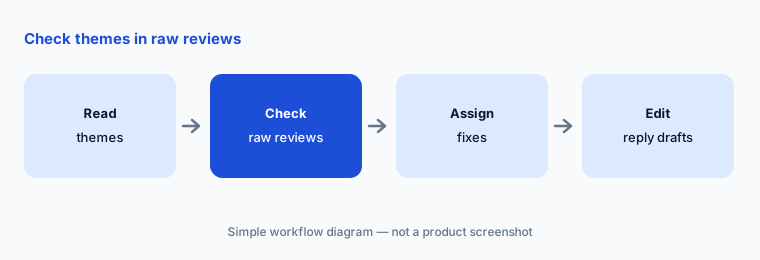
Check the theme:
Pick the top complaint theme Cloudbeds shows. Read ten of the underlying guest reviews yourself before you act on it.
5. WhatsApp and unified inbox: know the per-message cost
What it is: Guest Experience centralizes email, SMS, WhatsApp, and OTA chats in one inbox. Cloudbeds’s help article (updated 28 Sep 2026) says WhatsApp is charged per outbound message through messaging credits (inbound messages are free), conversations must start with an approved template, and templates must be created in Cloudbeds rather than Meta Business Manager.
Automated WhatsApp sends cost money per message and need guest consent. Check both before you widen a workflow.
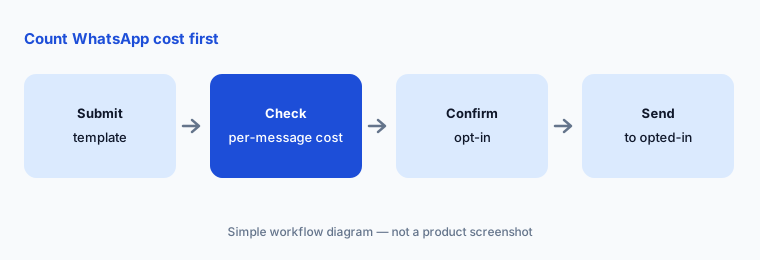
Count the cost:
Before automating one WhatsApp message, estimate a month of sends with Cloudbeds’s per-message pricing and confirm guest opt-in is recorded.
6. Signals: one data layer, one permission model
What it is: Cloudbeds says Signals is not a separate product but the architecture under the platform: reservations, revenue, channels, payments, guests, and marketing in one data model, one permission model from single property to portfolio, and the same governed data exposed through APIs. Cloudbeds notes GDPR obligations vary by market — confirm with your compliance team.
One permission model is only safe if roles are set well. Check who can see guest profiles and payment data before you add AI tools on top.
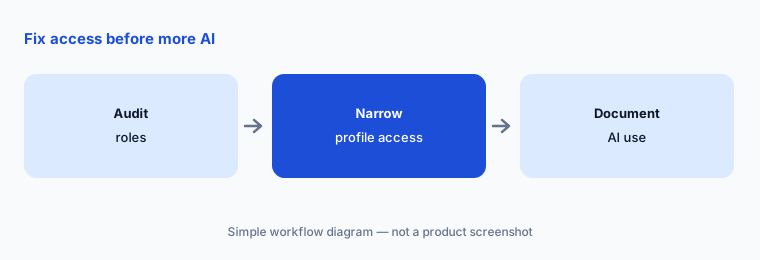
Fix access first:
List every Cloudbeds role that can see full guest profiles. Remove any that do not need it before you enable more AI features.
Pricing context (October 2026)
Cloudbeds’s pricing page (read 14 Oct 2026) shows four plans without prices: Flex (PMS, payments, marketplace — bring your own distribution), One (adds Cloudbeds channel manager and booking engine), Experience (adds Guest Experience and Reputation Management), and Enterprise (custom). Revenue Management, Guest Marketing CRM, Digital Marketing, Websites, and Reputation Management are listed as add-ons “powered by Signals.”
Cloudbeds says it charges no added commission on Booking Engine or Channel Manager bookings; Metasearch is commissioned after the stay. WhatsApp and SMS use messaging credits charged per outbound message. Ask sales for RMS and Experience pricing.
Uncertainty: No plan prices were published on 14 Oct 2026. Ask Signals was an early pilot (May 2026) and still called coming soon on Cloudbeds’s AI FAQ. Uplift and accuracy figures (18% RevPAR, 95% forecast accuracy, 8.4% revenue) are Cloudbeds’s claims, not our measurement.
When it’s useful (honest take)
Useful when you run independent hotels or a small group, want PMS, distribution, guest messaging, and a native RMS on one data model, and have a revenue owner who sets Autopilot limits and a guest-experience lead who reads every new workflow.
Less useful when you only need a channel manager beside a PMS you keep (SiteMinder AI), you run a large chain on enterprise systems (Oracle OPERA Cloud AI), or your portfolio is vacation rentals (Hostaway AI).
Paying for Cloudbeds AI and a few other AI tools? The $9 AI toolkit spreadsheet lists every AI subscription you have, what each one costs, and how fast it pays for itself, so you can see which ones are worth the money.
Want someone to do it for you? AI toolkit audit — $19
Related options (educational)
| Need | Better home | Why |
|---|---|---|
| Independent-hotel platform on one data layer | Cloudbeds AI (this page) | Flex → Enterprise — quote |
| Hotel PMS with native Mews Agent | Mews AI | Core / Pro — quote |
| Channel manager and pricing add-ons | SiteMinder AI | Dynamic Revenue Plus |
| Chain or enterprise PMS | Oracle OPERA Cloud AI | Assistant at no extra cost |
| Short-term rental pricing | PriceLabs AI | Per-listing STR pricing |
FAQ
How much does Cloudbeds cost in October 2026?
Cloudbeds does not publish prices. Flex, One, Experience, and Enterprise plans are quoted by sales, as read 14 October 2026, with Revenue Management and marketing tools as add-ons and WhatsApp/SMS charged per outbound message.
What is Cloudbeds Signals?
The unified data and AI architecture under the Cloudbeds platform. Cloudbeds says it is not a separate product you buy; it feeds RMS, Guest Experience, reporting, and marketing.
When did Cloudbeds RMS launch?
Cloudbeds announced Cloudbeds RMS on 15 September 2026, with Autopilot managing routine rate changes within the limits and exceptions each property sets.
Can I use Ask Signals today?
Cloudbeds opened early-pilot signups in May 2026, and its AI FAQ still called Ask Signals coming soon on 14 October 2026. Ask your Cloudbeds contact about access.
Who should approve Cloudbeds Autopilot and agent workflows?
The revenue owner sets Autopilot limits and reviews recommendations first; a guest-experience lead approves every Guest Experience Agent workflow and chatbot source.
Optional next step (if seats overlap)
If you pay for a PMS, a separate RMS, and a separate messaging tool that now overlap with Cloudbeds add-ons, that is worth mapping. Map the overlap with the $19 AI toolkit audit or the $9 AI toolkit spreadsheet. Email Audit $19 or Toolkit spreadsheet $9.
Checkout is live via Stripe. After you pay, we email delivery (spreadsheet) or intake next steps (audit).