Tool · Hospitality ops · IDeaS · Oct 2026
IDeaS G3 RMS AI review (Oct 2026): automated pricing decisions, forecasting, and group evaluation for hotels
IDeaS (a SAS company) sells G3 RMS, a hospitality revenue management system that uses AI to set scientific pricing and rate-availability decisions at the room-type and key product level. It forecasts demand, automates routine pricing and restrictions, notifies you when something needs a person (manage by exception), and evaluates group business with displacement analysis. This page is about letting G3 automate decisions while a named revenue manager still owns overrides and every group quote. Each section has a Try this.
What this IDeaS G3 page covers
This page is for a hotel revenue manager, cluster RM, or commercial lead evaluating an enterprise RMS. The question it answers: what G3 automates today, how group evaluation and approval workflows work after the February 2026 redesign, how pricing is sold, and who must own overrides.
IDeaS’s buyer’s guide (read 14 October 2026) describes G3 as delivering AI-driven pricing at room type and rate-code level, with forecasts, restrictions, overbooking, and group pricing evaluation. The February 2026 release redesigned Group Pricing with Wish/Walk Price and approval workflows. The FAQ and buyer’s guide both say costs vary — no public dollar amount.
Ground rules: the revenue manager owns every override and decision-delivery setting; sales does not quote a group rate until RM has explained the evaluation; vendor RevPAR growth figures are IDeaS’s claims, not our measurement; no guest PII in any test.

Major features (with how someone uses them)
Examples at a glance: each feature has a concrete example from a real job plus a short Try this you can run this week.
1. Group Pricing Evaluation with Wish / Walk Price and approvals (primary)
What it is: G3’s group pricing evaluates whether a group is worth more than the transient demand it would displace, including ancillary spend. IDeaS’s February 2026 redesign adds clearer Wish and Walk Price up front, built-in approval workflows across departments, and a toggle back to the previous layout while teams adjust. Multi-property and function-space evaluations were unchanged at that release.
An evaluation without a named approver becomes a quote nobody owns. Have the revenue manager explain the recommended rate before sales sends it.
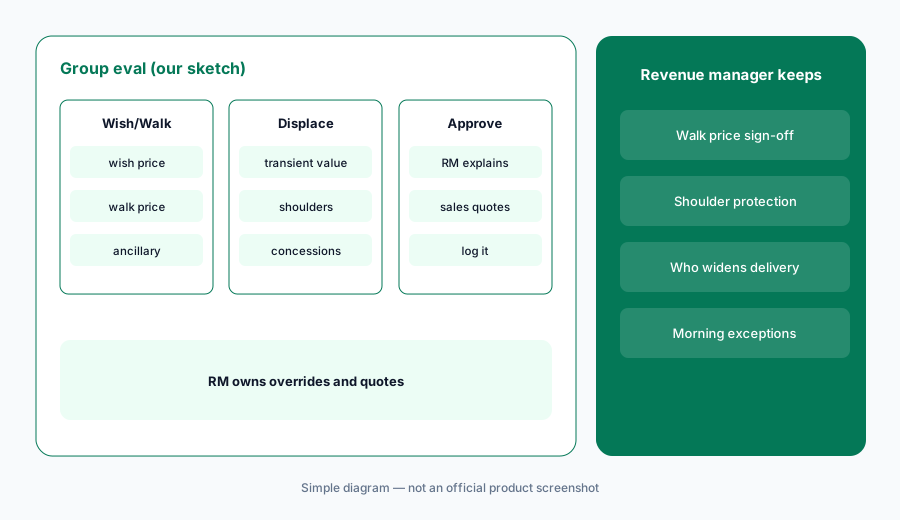
Primary workflow:
Pick one group request. Run it through the group evaluation and have the revenue manager explain the recommended rate before you quote it.
2. Automated pricing decisions at room type and rate code
What it is: G3 continually re-optimizes prices using demand, cancellations, no-shows, price sensitivity, and market behaviour. It can price by room type, rate product, length of stay, and segment, and manage rate availability, upgrades, and overbooking. IDeaS positions this as automated decisions — not only recommendations — with manage-by-exception alerts when you should step in.
Automated decisions still need floors and a person who can override. Start by reviewing a week of decisions on one room type.
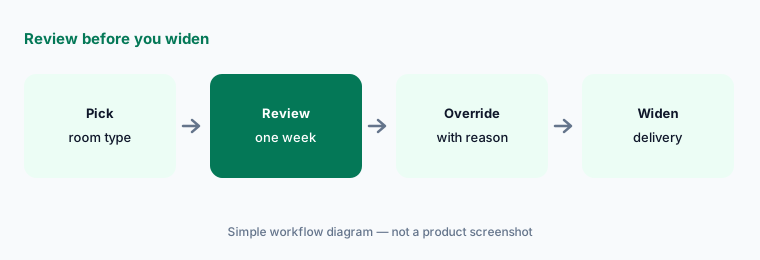
Primary workflow:
Pick one room type. Review a week of G3 automated price decisions and write the reason beside every override before you widen decision delivery.
3. Demand forecasting and responsive analytics
What it is: G3’s forecasts factor historical patterns, on-the-books, booking pace, price sensitivity, market data, and unconstrained demand. The buyer’s guide says the forecast becomes the compass for pricing and for tactical sales and marketing on soft days.
A forecast the sales team does not trust will be ignored. Sit together once a month and check three soft dates by hand.
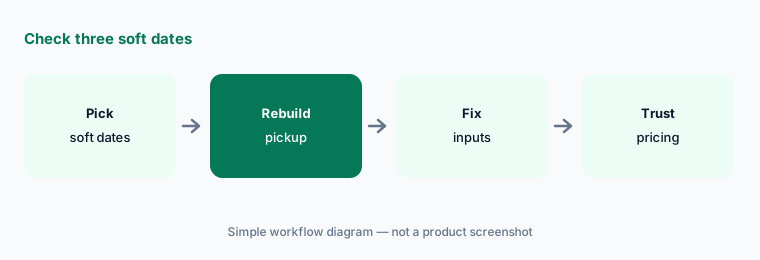
Check the compass:
From this month’s G3 forecast, pick three soft dates and rebuild pickup from your PMS before you trust the pricing on those nights.
4. Manage by exception
What it is: G3 automates routine rate updates and inventory controls and notifies you when a situation needs a closer look. The pitch is time back for strategy — IDeaS cites 20 to 40 hours a month saved as a category benefit in its buyer’s guide (vendor framing).
Exception alerts only help if someone owns the queue every morning. Name who clears it.
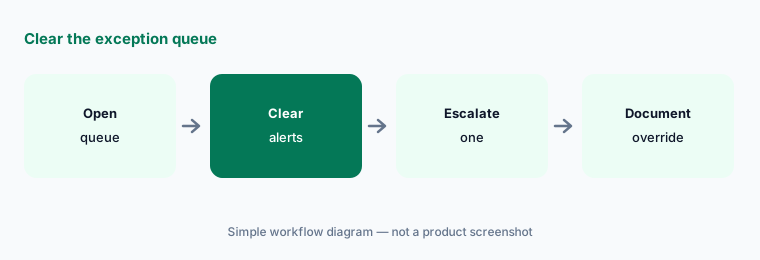
Own the queue:
Name who clears the G3 exception queue each morning and how escalations reach the revenue director.
5. Override workflow and decision delivery
What it is: G3 lets revenue teams override automated decisions and control how aggressively decisions are delivered to selling systems. The February 2026 group redesign also carries roles and permissions into the new Group Pricing pages automatically.
If decision delivery is wide and overrides are rare, you have automation without ownership. Audit who can widen delivery.
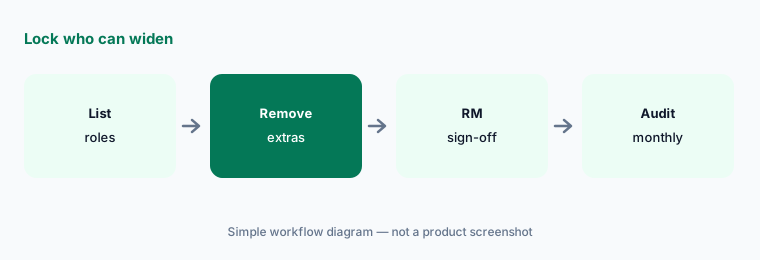
Lock who can widen:
List every role that can change G3 decision-delivery settings. Remove anyone who is not a named revenue owner.
6. Who approves automated rates and group quotes
What it is: On G3, automated room pricing and group evaluation both touch real money. The revenue manager owns overrides and decision delivery; sales owns the conversation with the client but not the Walk price without RM explanation; the GM reads portfolio outcomes.
A group quote that bypasses RM is how you sell below displacement value.
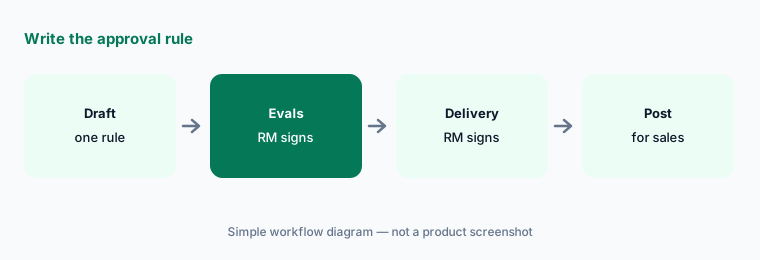
Write the rule:
Write one sentence: no group quote and no decision-delivery change without the revenue manager’s name on it.
Pricing context (October 2026)
IDeaS does not publish a fixed G3 price. The buyer’s guide (read 14 Oct 2026) says costs vary with rooms/units, number of properties, and features. The FAQ says IDeaS offers a range of price points and asks you to talk to the team. Treat every figure as a consultation quote.
Implementation, training, and which modules (rooms, function space, multi-property) you buy will change the number. Ask for a written quote at your room count with group evaluation and decision-delivery options named.
Uncertainty: No public price on 14 Oct 2026. Multi-property and function-space group evaluation UX was still on the prior layout as of the February 2026 note. Vendor time-saved and RevPAR figures (including client case studies) are IDeaS’s claims, not our measurement.
When it’s useful (honest take)
Useful when you run a hotel or portfolio that wants automated pricing decisions with manage-by-exception, serious group evaluation, and a revenue manager who will own overrides.
Less useful when you want Open Pricing as the headline approach (Duetto AI), you mainly need PMS-native recommendations (Cloudbeds AI), or you are a small B&B (Little Hotelier AI).
Paying for IDeaS G3 RMS AI and a few other AI tools? The $9 AI toolkit spreadsheet lists every AI subscription you have, what each one costs, and how fast it pays for itself, so you can see which ones are worth the money.
Want someone to do it for you? AI toolkit audit — $19
Related options (educational)
| Need | Better home | Why |
|---|---|---|
| Automated decisions + group evaluation | IDeaS G3 RMS AI (this page) | Quote-only |
| Open Pricing + Advance AI | Duetto AI | Quote-only |
| PMS-native RMS Autopilot | Cloudbeds AI | Plan quote |
| PMS + Mews RMS | Mews AI | Per-room quote |
| Enterprise PMS AI | Oracle OPERA Cloud AI | OPERA quote |
FAQ
How much does IDeaS G3 cost in October 2026?
IDeaS does not publish a fixed price. Cost varies by rooms, properties, and features — get a written consultation quote (checked 14 October 2026).
Does G3 only recommend rates, or does it decide?
IDeaS describes G3 as delivering automated pricing decisions at room-type and rate-code level, with manage-by-exception when you should intervene. You still control overrides and decision delivery.
What changed in Group Pricing in February 2026?
IDeaS redesigned Group Pricing with Wish and Walk Price up front, approval workflows, in-product help, and a toggle to the old layout. Multi-property and function-space evaluations were unchanged at that release.
Who should approve G3 group quotes?
A named revenue manager should explain the recommended rate before sales quotes the group. Sales owns the client conversation; RM owns the Walk price and displacement call.
Is IDeaS part of SAS?
Yes. IDeaS is a SAS company. G3 RMS is its hospitality revenue management system.
Optional next step (if seats overlap)
If you pay for an RMS, a separate group tool, and spreadsheet displacement that now overlap inside G3, that is worth mapping. Map the overlap with the $19 AI toolkit audit or the $9 AI toolkit spreadsheet. Email Audit $19 or Toolkit spreadsheet $9.
Checkout is live via Stripe. After you pay, we email delivery (spreadsheet) or intake next steps (audit).