Tool · GRC & compliance · Anecdotes · Oct 2026
Anecdotes AI review (Oct 2026): data-first GRC with AI for evidence and controls
Anecdotes is an enterprise GRC platform built around one idea: compliance evidence should be data pulled from your systems, not screenshots someone pastes into a folder. Its Data Engine collects and structures that data through 230+ plugins; on top sit analysis rules that test it, an Agentic GRC layer — Agent Studio, a ready-made Agent Library, the conversational ChatGRC, and an MCP server — and applications for compliance, risk, governance, and, newest, Agentic TPRM for vendors. This page explains each piece and where a control owner still signs off. Each section has a Try this.
What this Anecdotes page covers
This page is for a GRC lead, compliance manager, or security engineer at a company large enough to run several frameworks, entities, or audits at once — the buyer Anecdotes aims at. The question it answers: what “data-first” means in practice, what the AI and agents do with that data, and where a person still has to decide.
A note on names. Anecdotes calls the whole thing an “enterprise agentic GRC platform.” The pieces you will see in a demo are the Data Engine (plugins, normalized evidence), Data Studio with an AI Evidence Lab for custom data pipelines, Analysis rules, the Agentic GRC stack (Agent Studio, Agent Library, ChatGRC, MCP), and solution names with an “A-” prefix: A-CCM (agentic continuous control monitoring), A-TPRM, A-ERM, and A-PLM (policy lifecycle). The homepage was announcing Agentic TPRM as new on the day we checked.
Ground rules: a tool collects and tests evidence; auditors attest, and a named control owner decides whether a control works. Anecdotes’ own TPRM page says agents handle routine work and a focused queue surfaces the calls that need human judgment — keep that queue staffed. Facts come from Anecdotes’ website and press pages as read on 10 October 2026; its accuracy, coverage, and efficiency figures are vendor claims and aren’t repeated here.
Major features (with how someone uses them)
Examples at a glance: each feature has a concrete example from a real job plus a short Try this you can run this week.
1. Evidence as data: the Data Engine and Evidence Analyzer (primary)
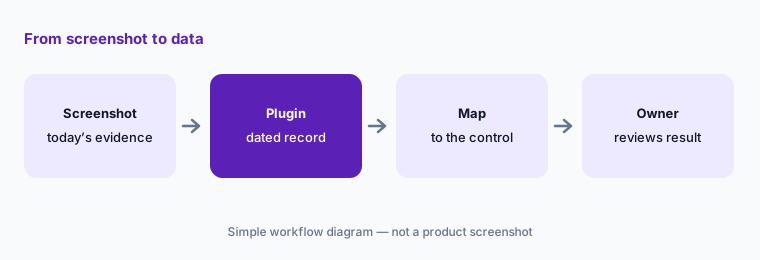
What it is: The Data Engine connects to your systems — Anecdotes lists 230+ native plugins, from AWS, Azure, and Okta to GitHub and Jira, and 1,000+ predefined evidence artifacts — and stores what it collects as structured records mapped to controls, risks, policies, and frameworks. Each data point carries a collection timestamp and its source system, the raw JSON is kept, and Anecdotes describes hash checks and change detection so you can show an auditor the data wasn’t altered. For systems without a plugin, Data Studio builds custom pipelines; its Evidence Lab takes a plain-English goal, reads the target system’s API documentation, and proposes the endpoint and data structure. Where screenshots and documents remain, the Evidence Analyzer agent turns them into searchable evidence with AI-generated names and summaries.
The quickest test of “data-first” is your worst control: the one where someone still takes a screenshot every quarter. If Anecdotes can collect it as a record with a date and source, the control gets easier to test and to show. If it can’t, you will still be uploading files — just with a better summary on top. Either way, decide who reviews the result before it counts as evidence.
Primary workflow:
Pick one control with manual screenshots as evidence. Check whether Anecdotes can collect it as data and who reviews the result.
2. Framework mapping and analysis rules
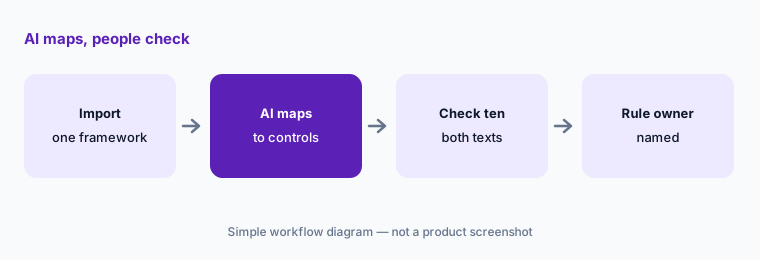
What it is: Anecdotes offers 60+ pre-mapped frameworks and says you can import any framework and “let AI map your existing requirements and evidence automatically,” using requirement-level cross-mapping so one piece of evidence can serve several frameworks. Analysis rules then test the collected data: start from a library of pre-built rules (it mentions NIST and CIS benchmarks and framework requirements), adjust thresholds, or write your own with a no-code builder or in natural language. When a rule fails, the control shows a gap with the underlying data attached.
AI mapping saves typing, not judgment. A mapping says two requirements are the same; often they are close but not identical — different review frequencies, different scope. Check a sample of mappings against both requirement texts before you rely on one set of evidence for two audits, and have someone own each custom rule.
Check the mapping:
Import one framework you already know well. Read ten of the AI’s mappings against both requirement texts and fix any that differ in scope or frequency.
3. Agent Studio and the Agent Library
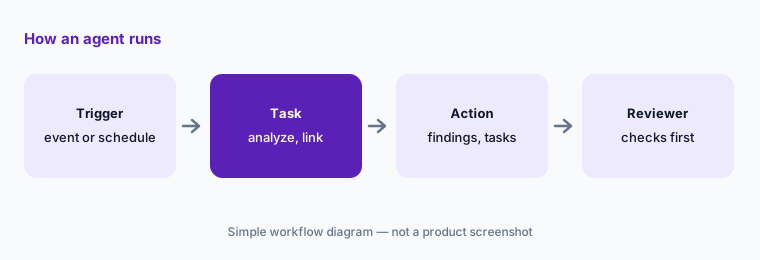
What it is: Agents in Anecdotes follow a simple pattern: a trigger (a schedule, a status change, an evidence update, or a user request), a task (analyze data, link records, recommend), and an action (update a GRC record, notify people, create findings or tasks, write a report). Agent Studio lets you build them with no code — pick a trigger, choose a pre-built recipe or write instructions in plain English — with execution logs and an audit trail. The Agent Library has ready-made ones: Policy Guardian (checks written policies against real system data), Control Assessment (scans audit reports and pentests, then creates findings with remediation tasks), Risk Enricher, and Evidence Analyzer, plus recipes and MCP-based orchestrations such as a Jira ticket matcher and a Terraform-writing GRC engineering agent.
Agents that only read and suggest are easy to trust; agents that create findings, assign tasks, or change records need a reviewer. Start each new agent with its output going to one person who checks it, and only widen the audience once its findings hold up.
One reviewer first:
Run Control Assessment on one recent pentest or audit report. Have one person check every proposed finding against the report before any remediation task is assigned.
4. ChatGRC and the MCP server: questions, then careful changes
What it is: ChatGRC is the conversational layer across the platform. You can ask about control status, owners, evidence timestamps, access reviews, policies, risks, and Trust Center settings, and drill into the collected records themselves. It also has write access: Anecdotes lists changing control ownership, risk treatment plans, policy approvers, due dates, evidence scoping, and framework mappings, plus triggering evidence collection, starting policy approval cycles, and creating tasks in Jira, ServiceNow, or Asana. The MCP server brings the same data into outside AI assistants — Anecdotes’ press release names Claude and ChatGPT.
A chat box that can reassign owners and change mappings is powerful and easy to misuse. Treat read questions and write actions differently: anyone on the team can ask, but changes to ownership, scope, or mappings should go through one named admin and be checked in the audit trail.
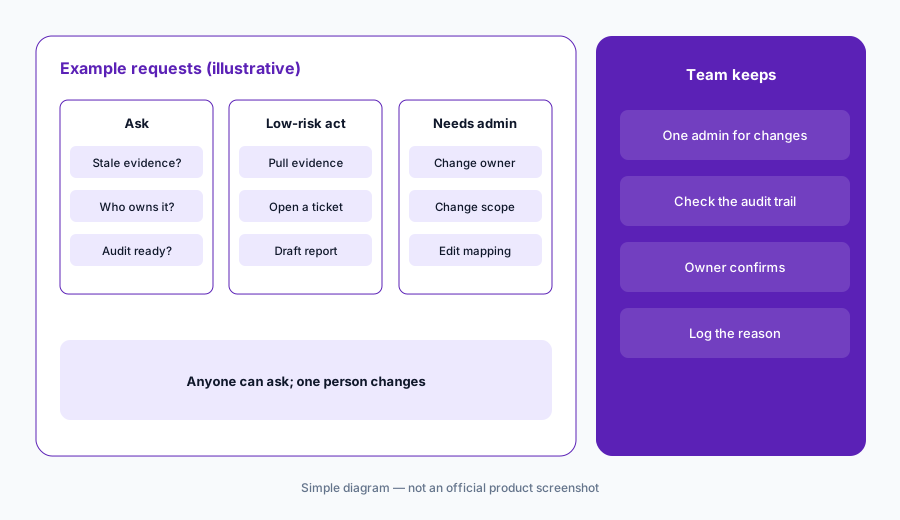
Ask first, change carefully:
For a week, use ChatGRC only for questions and evidence pulls. Route every ownership, scope, or mapping change through one named admin and check it in the audit trail.
5. Agentic continuous control monitoring (A-CCM)
What it is: Classic continuous control monitoring stops at an alert. Anecdotes’ A-CCM adds what happens next: tailored notifications (the control owner gets remediation steps, the risk owner hears that a risk level went up, the technical team gets a ticket), managed remediation, and re-checking. Pre-built agents include a Control Gap Response agent, an Evidence Collection Failure agent, a Risk Appetite Breach agent, and a Policy Review agent. The loop Anecdotes describes runs gap → remediation → fresh evidence → rule re-runs → control back to monitoring → residual risk recalculated. Its examples go as far as an agent calling the Okta API to enforce MFA.
Notifications and tickets are low risk; an agent changing a production identity setting is not. Run the notify-and-ticket half for a while, see how often the gaps are real, and only then decide — with the system owner — whether any fix should happen automatically.
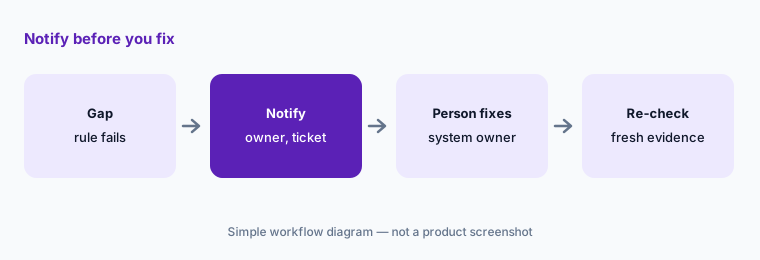
Notify before you fix:
Turn on one pre-built monitoring agent in notify-and-ticket mode for a month. Count real gaps versus false alarms before letting any agent change a system setting.
6. Agentic TPRM: vendor answers from documents
What it is: Agentic TPRM runs each vendor through a chain of agents: Discovery & Enrichment builds the vendor profile, Classification assigns a tier by your rules, Evidence Collection fetches public documents and requests private ones, Assessment answers your question set from SOC reports, certifications, and trust centers — each answer citing the document, the section, and a confidence level — and a risk agent sets a residual risk level with a written rationale. Background agents track expiring documents and trigger reassessment on your cadence. Anecdotes calls the approach “question-driven, not questionnaire-driven,” and it runs on the same Data Engine and risk register as compliance.
A citation shows where an answer came from, not that it was read correctly, and a written rationale is still the agent’s opinion. Check a handful of answers at the cited section, and keep the final vendor decision with the business owner and the security reviewer.
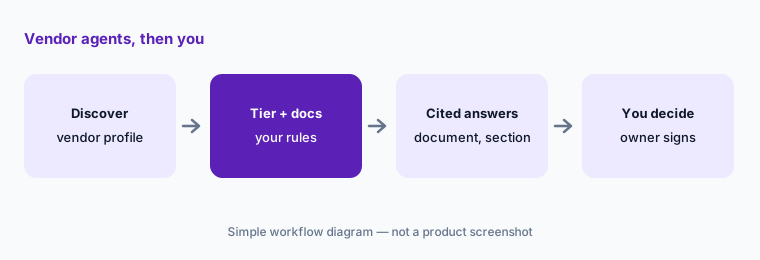
Check the cited section:
Run five vendors you already know through Agentic TPRM. Open three cited sections per vendor and note any answer that relies on an expired or wrong document.
Pricing context (October 2026)
Anecdotes publishes no prices (checked 10 Oct 2026). Its pricing page says “One Platform, Simple Pricing” with a Request Pricing button, so this is quote-only. See anecdotes.ai/pricing.
What the page says is included rather than sold separately: unlimited frameworks, all 230+ native plugins, custom integrations, all GRC modules, AI features, and custom AI agents — it contrasts this with per-framework and per-module fees elsewhere. Professional services are listed separately on the site. Ask what drives the quote (entities, users, connected systems) and whether Agentic TPRM is part of the same platform price.
Uncertainty: Anecdotes doesn’t publish prices, so we can’t say what a typical contract costs. Its pages differ on plugin counts (230+ on most pages, 250+ on the ChatGRC page), and one press page carries a dateline that doesn’t match its posting date, so we haven’t dated the agent launches. Agentic TPRM was billed as new on the homepage, and an AI “Insights” feature was marked coming soon. Accuracy and efficiency figures on its site are vendor claims.
When it’s useful (honest take)
Useful when an enterprise GRC team runs several frameworks or entities, most evidence lives in systems with plugins, and named control owners will review what the platform collects and what its agents propose — especially if your audits still depend on quarterly screenshots.
Less useful when you are a small team chasing a first SOC 2 and want a guided checklist, most of your evidence is paper or on-premise systems without plugins, nobody has time to review agent output, or you want a tool to make you compliant. It collects and tests evidence; auditors attest.
Paying for Anecdotes AI and a few other AI tools? The $9 AI toolkit spreadsheet lists every AI subscription you have, what each one costs, and how fast it pays for itself, so you can see which ones are worth the money.
Want someone to do it for you? AI toolkit audit — $19
Related options (educational)
| Need | Better home | Why |
|---|---|---|
| Evidence as data with agents on top | Anecdotes AI (this page) | Data Engine, Agent Studio, ChatGRC |
| Internal audit and SOX workpapers | AuditBoard AI (now Optro) | Narratives, fieldwork, autonomous testing |
| Risk registers with configurable workflows | LogicGate AI | Risk Cloud agents, control linking |
| Privacy and AI governance programs | OneTrust AI | AI inventory, privacy assessments |
| Guided first SOC 2 or ISO audit | Vanta AI or Drata AI | Checklists, questionnaires, trust centers |
| Multi-framework control mapping | Hyperproof AI | Mapping and evidence linking |
FAQ
What is Anecdotes AI?
Anecdotes is an enterprise GRC platform that collects compliance evidence as structured data through 230+ plugins and adds an agentic layer on top: Agent Studio for custom agents, an Agent Library of ready-made ones, ChatGRC for conversational questions and actions, and an MCP server for outside AI assistants.
Does Anecdotes make us compliant or pass the audit for us?
No. It collects and tests evidence and can open findings and tasks; your auditors attest and your control owners decide whether a control works. Anecdotes’ own pages describe human checkpoints and a queue of decisions that need people.
How much does Anecdotes cost in October 2026?
Anecdotes publishes no prices (checked 10 October 2026); its pricing page asks you to request pricing. It says frameworks, plugins, custom integrations, GRC modules, AI features, and custom agents are included rather than sold per module.
Can ChatGRC change records, or only answer questions?
Both. Anecdotes lists write actions such as changing control owners, risk treatment plans, due dates, evidence scoping, and framework mappings, plus starting evidence collection and creating Jira, ServiceNow, or Asana tasks. Route those changes through a named admin.
What is Agentic TPRM in Anecdotes?
A chain of vendor agents — discovery, classification, evidence collection, assessment, a risk agent, and background monitoring — that answers your security questions from vendors’ SOC reports, certifications, and trust centers, citing the document and section, instead of starting with a questionnaire.
Optional next step (if seats overlap)
If your GRC platform, a vendor risk tool, and a questionnaire tool each collect the same SOC 2 reports and access lists, that overlap is worth mapping. Map the overlap with the $19 AI toolkit audit or the $9 AI toolkit spreadsheet. Email Audit $19 or Toolkit spreadsheet $9.
Checkout is live via Stripe. After you pay, we email delivery (spreadsheet) or intake next steps (audit).