What’s new · Property ops · AppFolio · Sep 2026
What’s new in AppFolio (Sep 2026): the new Realm-X, Receptionist Performer, and Column banking
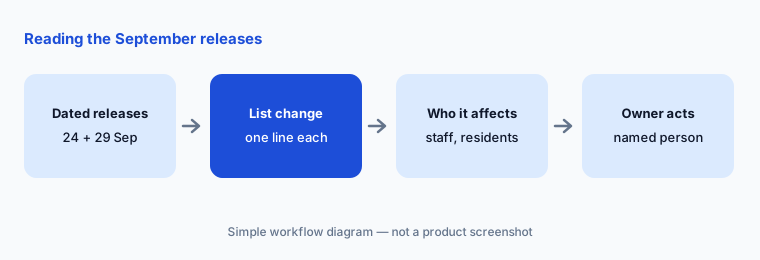
AppFolio made two dated announcements in September 2026: Column as its featured banking partner on 24 September, and the new Realm-X with a set of Performer, accounting, and resident-experience updates on 29 September at its FUTURE conference. For a property-ops lead, five changes need an owner: what goes into the Realm-X Knowledge Base and who may share Skills, which calls the Receptionist Performer may answer, who checks the Accounting Performer’s work, what the Column partnership means for your trust accounts, and how fraud flags in screening get reviewed. This page is not a review — for that, see our AppFolio AI review. Every item comes from AppFolio’s newsroom, read on 13 October 2026.
What this page covers
This page is for a property manager, operations director, controller, or AppFolio administrator who wants September’s AppFolio changes without reading every press release — especially anything that changes what Realm-X and the Performers may do on your behalf, who checks AI work in accounting and screening, and what is announced versus what is available now.
We list only entries dated September 2026 in AppFolio’s newsroom: the 24 September press release on Column and the 29 September press release on the new Realm-X. AppFolio describes some items as available now and others as coming soon (reconciliation in the Accounting Performer, for example), and its press release includes forward-looking statements, so an item can be announced before it reaches your account. Re-read the releases and ask your AppFolio contact before acting.
Property-ops guardrails stay the same: Realm-X and the Performers may draft, answer, route, or act within permissions you set, but a named person owns every notice, every rent change, every screening decision, every bill and owner statement, and every Skill shared with the team. AppFolio itself says the Performers operate within the permissions and guardrails each customer sets, with human oversight. Vendor figures about AI actions, showings, or hours saved are AppFolio’s claims, not our measurement.

Major features (with how someone uses them)
Examples at a glance: each feature has a concrete example from a real job plus a short Try this you can run this week.
1. Five changes a property-ops lead should act on (primary)
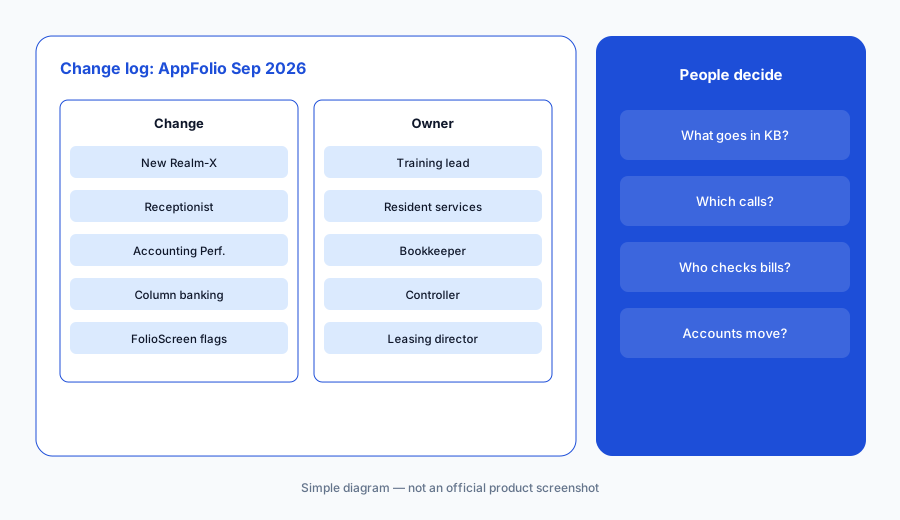
What it is: From AppFolio’s September announcements, these five need a decision, not just awareness: (1) the new Realm-X — Memory, a Knowledge Base of your documents and policies, shareable Skills, and Prompt-to-Flow and Prompt-to-Dashboard — which AppFolio says is available with all plans, now including the Realm-X Connector for Anthropic’s Claude (press release, 29 Sep); (2) the Receptionist Performer, which answers incoming calls, handles simple questions, and routes anything else to the right person or Performer at any hour (29 Sep); (3) the Accounting Performer, now available to customers for bill entry, financial close, and budgeting, with reconciliation listed as coming soon (29 Sep); (4) Column N.A., Member FDIC, named AppFolio’s featured banking partner — an exclusive designation — with new financial capabilities inside the platform available only through Column (press release, 24 Sep); and (5) resident-experience changes: Snappt document-fraud detection inside FolioScreen Trusted Renter and Online Certified Funds at Move-In, all running through the FolioSpace resident app (29 Sep).
Primary workflow:
From AppFolio’s Sep 2026 announcements, list 5 changes a property-ops lead should act on — cite sources.
2. New Realm-X: Memory, Knowledge Base, and Skills
What it is: The 29 September release says the new Realm-X handles multi-step work and remembers the conversation. Memory personalizes answers by remembering the user from previous conversations; the Knowledge Base gives Realm-X a repository of a customer’s documents and policies for context; Skills let a user create and share prompts so they repeat across teams — AppFolio’s example is a manager using a “reassign showings” Skill to redistribute tours when a leasing agent calls in sick, with user approval. AppFolio says Realm-X Flows and Performers handle processes a business has already defined, and the new Realm-X handles what comes up in between.
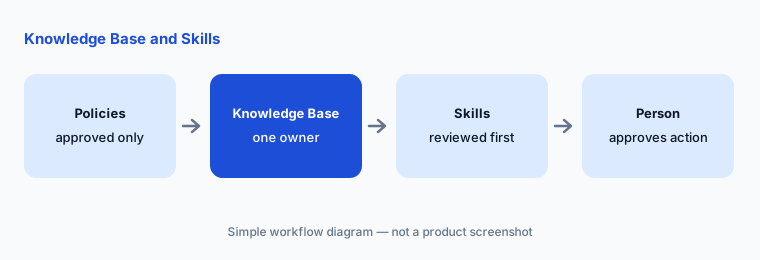
The Knowledge Base is the decision. Whatever goes in becomes context for answers, so load only approved, current policies — the signed version of the pet policy, not last year’s draft — and name one owner who removes old versions. Treat a shared Skill like a shared template: someone reviews it before the whole team can run it, especially anything that touches residents, prospects, or money. Anything prospect-facing still gets a fair-housing review by a person.
Approved sources only:
List the documents you would put in the Realm-X Knowledge Base and the current version of each. Name one owner who removes old versions, and have that owner review every Skill before it is shared.
3. Prompt-to-Flow, Prompt-to-Dashboard, and Claude on all plans
What it is: The same release says Prompt-to-Flow and Prompt-to-Dashboard let a user describe a workflow or dashboard in plain language for Realm-X to build, and that the new Realm-X is available with all AppFolio plans, now including the Realm-X Connector for Anthropic’s Claude, first introduced in June 2026. For context, AppFolio’s June connector post said Core customers had read access and Plus and Max customers read and write access; the September release does not restate those permission levels, so confirm what your plan allows today.
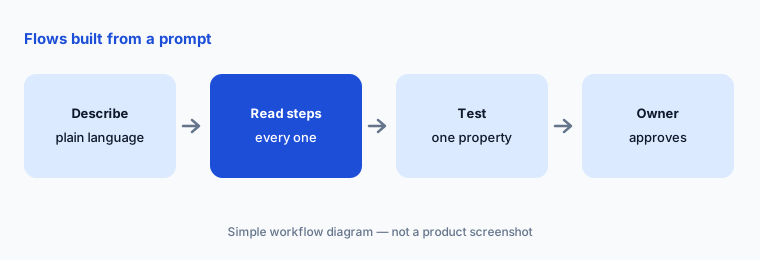
A Flow built from a prompt is still a Flow: it can send messages or create tasks on a trigger. Before turning one on, read every step it built, run it against a test property, and name who owns it. A dashboard built from a prompt is a starting point; check one number against the report it summarizes before it goes to an owner. If your team also uses Claude for drafting, see Claude and the Stack map for property ops for where that overlap sits.
Read every built step:
Describe one routine Flow to Realm-X in plain language, then read every step it builds before turning it on. Test it on one property and have the property manager approve any resident-facing message.
4. Receptionist Performer: which calls it may answer
What it is: The 29 September release introduces the Receptionist Performer: it answers incoming calls, handles simple questions on the spot, and routes anything else to the right person or Performer so every caller reaches someone at any hour. AppFolio says it is customizable, with a range of voice options available at launch, and that Performers work within the permissions and guardrails each customer sets.
Write the call list before it answers a phone. Decide which questions it may answer (office hours, how to submit a maintenance request), which go straight to a person (a gas smell, a flood, a lockout, anything about a lease dispute or a legal notice), and which go to another Performer. Leasing questions get a fair-housing review of the script — no answers about protected characteristics. Compare how other platforms handle this in DoorLoop AI and EliseAI.
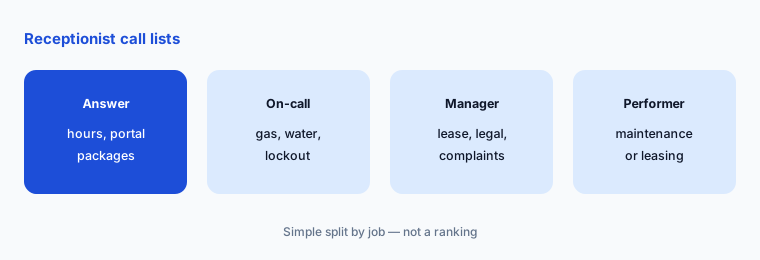
Write the call list:
Write three lists for the Receptionist Performer — questions it may answer, emergencies that go straight to on-call, and topics that go to a manager. Listen to 20 calls in the first week and move anything misrouted.
5. Accounting Performer and the Column partnership
What it is: The 29 September release says AppFolio is expanding entity-based accounting, portfolio cash management, and credit card accounting, and that the Accounting Performer is now available to customers to automate bill entry, financial close, and budgeting; reconciliation is listed as coming soon, connecting bank data directly to the ledger through the Column partnership. The 24 September release names Column N.A., Member FDIC, as AppFolio’s featured banking partner — an exclusive designation — and says customers will gain new financial capabilities inside the platform available only through Column.
Two owners, two questions. The bookkeeper owns the Performer’s output: an AI-entered bill is not accurate until someone checks it against the invoice, and trust-accounting and security-deposit rules stay with the bookkeeper and your broker of record. The controller owns the banking question: the release announces a partnership, not a requirement to move accounts, so any change to where trust funds sit is a decision for the owner, the controller, and your state’s trust-account rules — not a default.
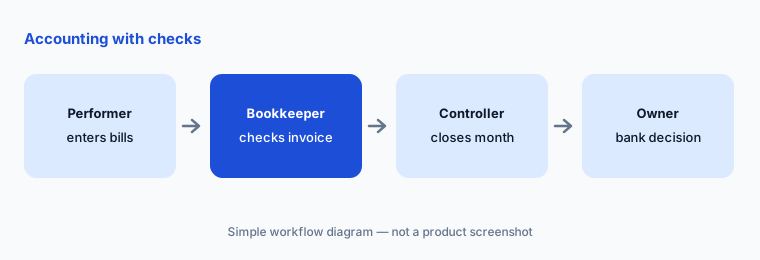
Check every AI-entered bill:
Turn on the Accounting Performer for one task only and have the bookkeeper check every AI-entered bill against its invoice for a month. Put any banking change on the owners’ agenda as a question before anything moves.
6. Screening fraud flags, certified funds, and owners for each change
What it is: Also on 29 September: a partnership with Snappt adds document-fraud detection inside FolioScreen Trusted Renter, which AppFolio says catches fraudulent income documents before an application is approved, and Online Certified Funds at Move-In lets residents pay move-in costs with guaranteed funds instead of a check or a trip to the bank. AppFolio says all of it now runs through FolioSpace, its resident app, to which every resident has transitioned. Owners: Realm-X Knowledge Base and Skills → the training lead; Receptionist Performer → resident services; Accounting Performer and Column → the controller and bookkeeper; FolioScreen fraud flags → the leasing director; move-in payments → the property manager.
A fraud flag is a reason to look, not a decision. A person reviews the flagged document and the applicant’s explanation under your written screening criteria, applies them the same way to every applicant, and keeps screening reports inside the screening tool. Adverse-action and fair-housing obligations do not change because a tool raised the flag.
One owner per change:
For the five September changes above, write one named owner and one review date each. Have the operations director approve the list before anyone turns on a new Performer or changes a screening step.
Pricing context (October 2026)
The September releases describe availability, not prices, though the 29 September release says the new Realm-X is available with all AppFolio plans. AppFolio’s pricing page (as listed 13 October 2026) shows Core, Plus, and Max, each with “Get a Quote”; Core notes a minimum spend and a 50-unit minimum, and Plus and Max note minimum spend and units. No visible plan card publishes a dollar price.
Whether the Receptionist Performer, Accounting Performer, Snappt fraud detection, or certified funds carry separate fees isn’t stated in the releases — ask AppFolio before you plan around them. For our dated review of AppFolio’s AI and plans, see AppFolio AI and AppFolio vs Buildium.
Uncertainty: We read AppFolio’s newsroom and the two September 2026 press releases on 13 October 2026. The releases include forward-looking statements, and some items are described as coming soon, so availability can differ by plan and account and can change. The Claude connector permission levels come from a June 2026 post and may have changed with the new Realm-X. This is product education, not advice on trust accounting, screening, fair housing, or banking.
When it’s useful (honest take)
Useful when you run AppFolio and want September’s changes with an owner and an action for each, especially the Realm-X Knowledge Base, Skills, and the Receptionist Performer.
Useful when your controller is deciding what the Column partnership and the Accounting Performer mean for month-end close.
Less useful when you want a full product review — read AppFolio AI — or you don’t use Realm-X, the Performers, or FolioScreen.
Paying for AppFolio and a few other AI tools? The $9 AI toolkit spreadsheet lists every AI subscription you have, what each one costs, and how fast it pays for itself, so you can see which ones are worth the money.
Want someone to do it for you? AI toolkit audit — $19
Related options (educational)
| Need | Better home | Why |
|---|---|---|
| Full review of AppFolio’s AI | AppFolio AI | Not a changelog |
| Two residential PMS platforms side by side | AppFolio vs Buildium | Realm-X vs Lumina, not a ranking |
| Another PMS’s September notes | What’s new in Entrata (Sep 2026) | Same format |
| Inventory property-ops AI seats | Stack map for property ops | Jobs, tools, overlaps |
| Drafting in Workspace instead | Gemini for property ops | Sheets, Docs, Gmail |
FAQ
What did AppFolio announce in September 2026?
Per its newsroom: on 24 September, Column N.A. as its featured banking partner; on 29 September, the new Realm-X (Memory, Knowledge Base, Skills, Prompt-to-Flow and Prompt-to-Dashboard) on all plans including the Claude connector, the Receptionist Performer, the Accounting Performer now available with reconciliation coming soon, Snappt fraud detection in FolioScreen Trusted Renter, and Online Certified Funds at Move-In.
Is the new Realm-X only on higher AppFolio plans?
AppFolio’s 29 September release says the new Realm-X is available with all AppFolio plans, now including the Realm-X Connector for Anthropic’s Claude. Confirm with AppFolio what your plan and permissions allow.
Does the Receptionist Performer replace our on-call process?
No. AppFolio says it answers simple questions and routes anything else to the right person or Performer. Write which calls it may answer and send every emergency and every lease or legal question to a person.
Do we have to move our bank accounts to Column?
The 24 September release names Column as AppFolio’s featured banking partner and says new financial capabilities will be available only through Column; it does not say customers must move accounts. Any change to trust accounts is a decision for the owner, controller, and your state’s rules.
Did AppFolio change prices in September 2026?
The releases we read don’t mention price changes. As of 13 October 2026, AppFolio’s pricing page lists Core, Plus, and Max with “Get a Quote” and no published dollar prices on the plan cards.
Optional next step (if seats overlap)
If property ops pays for AppFolio’s Performers, a separate answering service, and a chat assistant that all answer the same resident calls and draft the same notices, fix that overlap before adding another seat. Map the overlap with the $19 AI toolkit audit or the $9 AI toolkit spreadsheet. Email Audit $19 or Toolkit spreadsheet $9.
Checkout is live via Stripe. After you pay, we email delivery (spreadsheet) or intake next steps (audit).