Compare · Recruiting · Interview notes · Oct 2026
Metaview vs BrightHire (Oct 2026): AI interview notes for recruiters
Metaview and BrightHire both record interviews, transcribe them, and write structured notes for recruiters and interviewers. The differences that matter are practical: where the notes need to land — the ATS interview feedback form, Slack, or a hiring manager’s inbox — how each gets into the call, and how each handles candidate notice and consent. This page compares them on those points, not as a ranking, with a Try this for each.
What this comparison covers
This page is for recruiters, recruiting coordinators, and talent leads choosing one interview notetaker — often when the ATS or the company’s meeting tool already offers one. The question it answers: which product gets usable notes to the right place with the least editing, and how does each handle telling candidates they are being recorded?
Ownership (checked 6 October 2026): Metaview is venture-backed; a banner on its site announces “$60M more, led by Insight Partners.” BrightHire announced on 13 November 2025 that it had agreed to be acquired by Zoom, and Zoom says the deal closed in December 2025; BrightHire says it continues as a standalone brand within Zoom.
Who decides: notes record what was said. Metaview tells customers to explain that it is for note-taking, not automatic decision-making, and its browser extension leaves the subjective parts of a feedback form blank for the interviewer. BrightHire drafts the feedback form for the interviewer to review, adjust, and submit. In both, interviewers write their judgment and the hiring team decides. Facts come from each vendor’s own pages and help docs as we read them on 6 October 2026. Recording rules vary by place; this is product education, not legal advice.
Major features (with how someone uses them)
Examples at a glance: each feature has a concrete example from a real job plus a short Try this you can run this week.
1. Record the same mock interview in both (primary)
What it is: The fastest honest test is one mock interview, recorded by both tools, with a colleague playing the candidate who has agreed to be recorded. Use your real interview feedback form and the same questions. Then look at the notes the way an interviewer would at 5 p.m.: which sections could go into the form as written, which need edits, and which are wrong. Metaview offers a free Notetaker tier; BrightHire is sold by demo, so ask for a trial or pilot account.
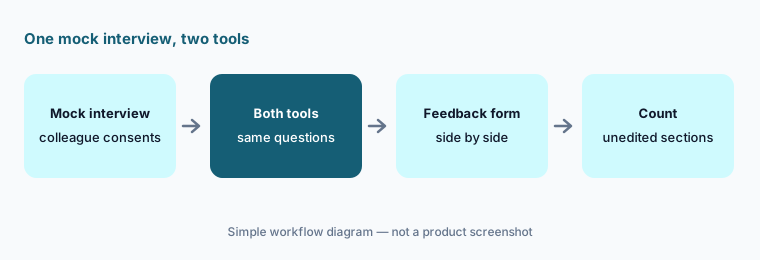
Primary workflow:
Record the same mock interview in both. Compare which notes you would paste into the feedback form unedited.
2. Where the notes land: ATS form, Slack, hiring manager
What it is: Metaview can send notes to your ATS (when the call is matched to a candidate and you have permission), open the ATS feedback form beside your notes, and — through its browser extension for Ashby and Greenhouse — autofill the factual parts of the form (experience, skills, tech stack) while leaving the subjective evaluation sections blank. A TLDR gives a one-paragraph summary with footnotes to the transcript, ready to paste into email or Slack, and Zapier can push notes to Slack, Notion, Google Drive, or a CRM. BrightHire maps its notes to the fields of each interviewer’s ATS feedback form and pushes a draft after the call; the interviewer reviews, adjusts, and submits in one click. It lists Greenhouse, Lever, Ashby, and Workday, plus a Slack integration, and on its Teams tier, clips and highlights you can replay from the ATS.
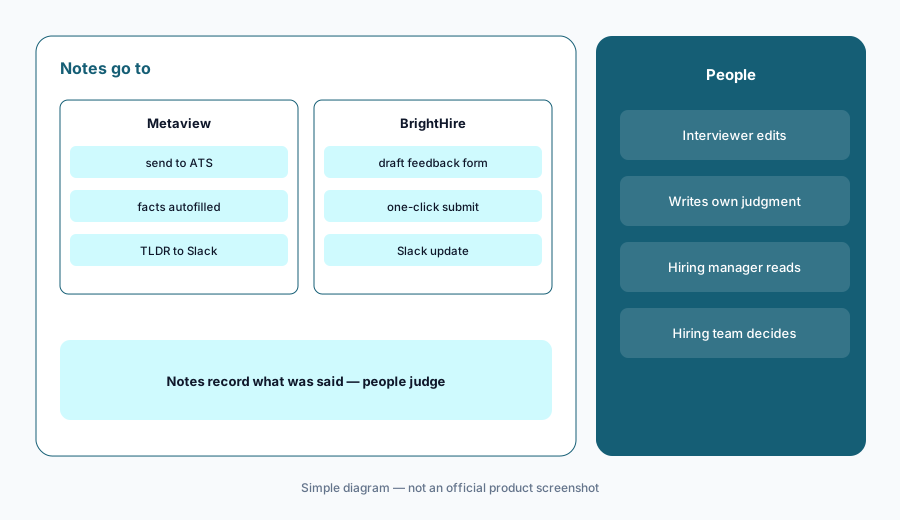
Follow the notes:
Write down where your hiring managers actually read interview notes (ATS, Slack, email). For one week, check whether each tool’s output reached that place without someone copying it by hand.
3. How each gets into the call
What it is: Metaview joins Google Meet, Zoom, Microsoft Teams, and Webex calls automatically from your calendar, Calendly, or ATS, or when you invite its bot address; it can capture phone screens through a registered number and accepts uploaded recordings or transcripts. Metaview says it deliberately does not offer a way to hide the notetaker from participants, so everyone can see recording is happening. BrightHire connects to interviewers’ calendars: on Zoom its Interview Assistant runs inside Zoom with no per-call bot; on Google Meet it joins as a participant; on Microsoft Teams you add its recorder address. It can also capture phone and in-person interviews.
One recorder per call:
Look at next week’s interview calendar. For each call, list every notetaker that could join (ATS, standalone, video platform, company-wide) and switch off all but one.
4. Candidate notice and consent workflow
What it is: Metaview recommends notifying participants in advance, explaining that the tool is for note-taking and not automatic decision-making, saying it is not required, and letting them choose. Its managed notice form uses your own wording in an opt-in or opt-out format; it remembers each candidate’s latest response for future calls, emails interviewers before the call when someone has opted out, and keeps the bot from joining. Interviewers can opt out too, and Metaview’s privacy page says candidates can opt out in one click without affecting their candidacy. BrightHire says it sends consent notifications to candidates automatically before interviews and provides an opt-out, with role-based access, customer-controlled retention, and zero-data-retention options; its pricing table lists “robust consent & recording controls” on the Teams tier. Both cite SOC 2 and GDPR compliance, and BrightHire cites a third-party bias audit.
Whichever you choose, the notice should say what is recorded, why, who sees it, how long it is kept, and how to say no — and saying no must not hurt the candidate.
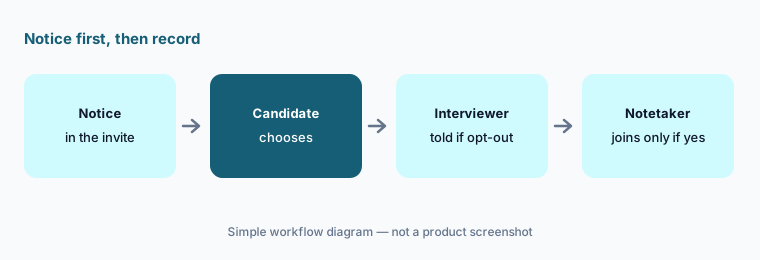
Dry-run an opt-out:
Have a colleague book a test interview as a candidate and opt out. Confirm the notetaker does not join, the interviewer is told before the call, and the opt-out applies to their next interview too.
5. Beyond notes: screening, review, and coaching
What it is: Both vendors sell more than notes, and each extra product touches candidates more directly. Metaview sells Application Review (it says it never auto-rejects and that humans always decide), an AI Screening interviewer, and a Sourcing agent, each priced separately. BrightHire sells BrightHire Screen, an asynchronous AI interviewer that asks the same structured questions and scores or summarizes answers against your rubric, plus coaching, interview topic coverage, and candidate side-by-side views on its higher tiers. Treat each as its own decision with its own owner, rubric, and candidate notice.
Separate decisions:
List every add-on each vendor offered you. For each, write who owns it, which rubric it uses, what the candidate is told, and who reads its output before any candidate decision.
6. Overlap with your ATS and video platform
What it is: Before buying either, check what you already pay for. Greenhouse lists its own AI Notetaker on the Core plan, and Ashby sells an AI Notetaker add-on. BrightHire is now part of Zoom, which matters if your interviews run on Zoom. A second recorder on the same interview is wasted spend and a consent problem. The question is not which notetaker is better but which one owns interviews, and what the others are switched off for.
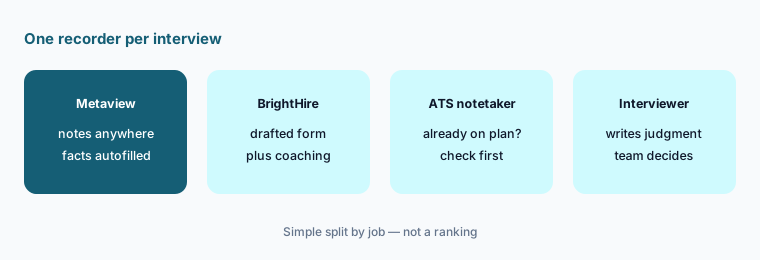
Count the recorders:
List every tool in your company that can record an interview. Pick the one that owns interviews and write down why the others are blocked from interview calendars.
Pricing context (October 2026)
Metaview publishes Notetaker prices. On its pricing page (checked 6 October 2026), Notetaker Free is $0 per user per month (25 calls a month, basic transcription), Pro is $60 per user per month (unlimited calls, priority processing), and Enterprise is tailored. Sourcing, Application Review, and the full platform are priced separately; see our Metaview review for those cards.
BrightHire does not publish prices. Its pricing page lists Interview Intelligence tiers — Recruiters, Teams, and Enterprises — each with “Request a Demo,” plus BrightHire Screen, sold on its own or with the platform. Its FAQ says there are no extra fees for training or implementation.
Uncertainty: BrightHire’s packaging may change as it integrates with Zoom; confirm tiers and any Zoom bundle in writing. Metaview’s free tier has usage limits, so a short pilot may not show how it handles your full volume. Neither vendor’s accuracy can be judged from its marketing — the mock interview is the test.
When it’s useful (honest take)
Metaview is useful when notes need to go to several places — the ATS, Slack, email — interviewers want the factual parts of the form filled and the judgment left to them, and you want to start on a free or per-user plan.
BrightHire is useful when you want each interviewer’s feedback form drafted in the ATS for one-click submission, your interviews run on Zoom, and interviewer coaching and interview coverage matter to you.
Less useful when (either one) your ATS notetaker already covers your needs, you run few interviews, or no one will own the candidate notice and opt-out process. In both, interviewers write their own assessment and the hiring team decides.
Still choosing between Metaview and BrightHire? The $19 AI toolkit audit gives you a written plan for which tools to keep using and which to drop across your whole AI stack, including this pair.
Prefer to do it yourself? Spreadsheet — $9
Related options (educational)
| Need | Better home | Why |
|---|---|---|
| Hiring-specific notes with flexible output | Metaview | ATS, TLDR, Zapier, extension autofill |
| Feedback forms drafted in the ATS plus coaching | BrightHire | One-click submit; Zoom-native assistant |
| Notes inside the ATS you already run | Greenhouse AI or Ashby AI | See Ashby vs Greenhouse |
| General meeting notes outside hiring | Zoom AI Companion or Fireflies | Set rules before using on candidate calls |
| Inventory of recruiting and people tools | Stack map for people ops | Find overlapping recorders |
Related comparisons
- Ashby vs Greenhouse AI
- Juicebox vs LinkedIn Hiring Assistant
- Fireflies vs Otter
- HireVue AI for screening and video interviews
FAQ
Is Metaview or BrightHire better for interview notes?
Neither in general, and this page is not a ranking. Metaview is flexible about where notes go and leaves judgment fields blank; BrightHire drafts each interviewer’s ATS feedback form for one-click submission and adds coaching. Record one mock interview in both and compare.
Do candidates have to agree to be recorded?
Rules vary by place, so check with counsel. Both vendors support notice and opt-out: Metaview has a managed notice form with opt-in or opt-out wording, and BrightHire sends consent notifications before interviews with an opt-out. Saying no should never affect a candidate.
How much do Metaview and BrightHire cost in October 2026?
On 6 October 2026 Metaview listed Notetaker Free at $0 and Pro at $60 per user per month, with Enterprise tailored. BrightHire does not publish prices; its tiers are sold by demo. Check Metaview and BrightHire.
Do the notes decide who moves forward?
No. Notes record what was said. Metaview leaves subjective feedback sections for the interviewer, and BrightHire’s draft is reviewed and adjusted by the interviewer before submitting. The hiring team decides.
Who owns BrightHire now?
Zoom. BrightHire announced the agreement on 13 November 2025, Zoom says the deal closed in December 2025, and BrightHire says it continues as a standalone brand within Zoom.
Optional next step (if seats overlap)
If you pay for Metaview or BrightHire, an ATS notetaker, and a company-wide meeting assistant — and more than one can record the same interview — that overlap is worth mapping before renewal. Map the overlap with the $19 AI toolkit audit or the $9 AI toolkit spreadsheet. Email Audit $19 or Toolkit spreadsheet $9.
Checkout is live via Stripe. After you pay, we email delivery (spreadsheet) or intake next steps (audit).