Ops · Wiki · Runbooks
Confluence AI review (Sep 2026): wiki answers for ops runbooks
When Confluence is already the system of record, Confluence AI (Rovo) can turn a pasted runbook into a short FAQ, a checklist with owner blanks, and a contradiction list — without inventing steps that are not on the page. This page maps page answers, drafting, search, credit honesty, and when Notion AI or a Claude Project is clearer.
Who this page helps
Ops leads on small teams already living in Confluence who want AI for runbook FAQs, checklists, and contradiction checks inside the wiki — not another chat seat that invents a second SOP. If Confluence is not where procedures live, this page is the wrong buy question; start with AI in your real system of record or a dedicated chat Project instead.
What Confluence AI is
Confluence AI is Atlassian’s native AI layer in Confluence — publicly framed as Rovo in Confluence: page-grounded Q&A and chat, create/rewrite help, AI-powered search across knowledge, and credit-metered agents. This review focuses on what an ops team already on Confluence can use week to week for runbooks — without assuming you should migrate to Confluence for AI alone.

Major features (with how someone uses them)
Examples at a glance: each feature has a concrete ops example plus a Try this mini-workflow.
1. Page answers on runbooks
What it is: Ask questions against a Confluence page (or related space context) and get answers grounded on what is written — ideal for turning a long runbook into FAQ-shaped guidance. Treat model routing and space permissions as moving targets; confirm on Atlassian’s Confluence AI / Rovo help pages.
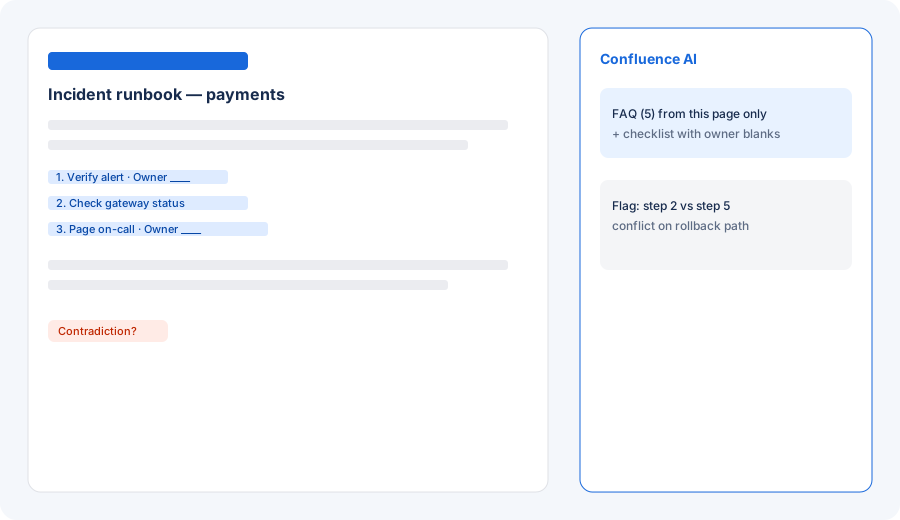
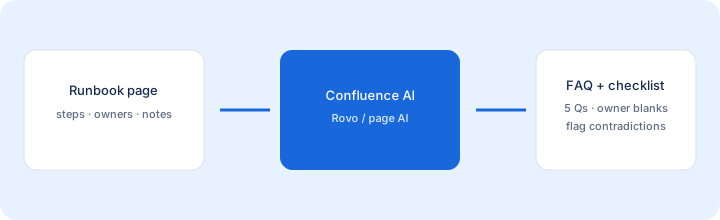
On one real runbook page you already own:
Using only this pasted runbook page: Produce a short FAQ (5 Qs) and a checklist of steps with owner blanks. Flag contradictions.
2. Drafting & rewrite help
What it is: Public Confluence AI packaging includes create-with-AI and polish/rewrite help (tone, clarity, structure). The high-ROI ops pattern is cleaning a messy SOP into purpose → steps → owners — not asking AI to invent a healthier process than the team actually runs.
After pasting one messy SOP section:
Rewrite this Confluence section into: purpose, numbered steps, owner blanks, and exit criteria. Mark any missing owner as Unknown. Do not add controls that are not in the paste.
3. AI search across spaces
What it is: Rovo Search / AI search aims to answer from Confluence (and connected Atlassian context) instead of keyword hunting. Useful when ops knows the answer “lives somewhere in the wiki” but not which space. Still respect permissions — AI should not surface pages a user cannot open.
Before treating search answers as policy:
Find the canonical Confluence page for this topic. Return title, space, last updated date if shown, and a one-line why. If two pages conflict, list both and do not pick a winner.
4. Rovo credits & plan gates
What it is: Public Atlassian Rovo packaging (Sep 2026) describes credit allowances included with Confluence Cloud plan tiers — commonly cited as about 25 credits / user / month on Standard, about 70 on Premium, and about 150 on Enterprise, with monthly reset. Advanced agents and heavy usage can burn credits faster than light page Q&A. Confirm on Atlassian’s Confluence pricing and Rovo licensing pages — this is the uncertainty that bites budgets.
Before upgrading Confluence or buying extra AI capacity:
Estimate monthly runbook FAQ / rewrite / search jobs. Map them to Atlassian’s published Rovo credit allowances for our Confluence plan. If we cannot name a credit owner and a monthly ceiling, keep page Q&A only for 30 days.
Public pricing (September 2026)
Confluence AI / Rovo sits on top of Confluence Cloud seats — AI credit allowances are plan-tied in public packaging, not a free unlimited forever. From public Confluence pricing and Rovo licensing pages we cross-checked in September 2026:
- Confluence Cloud seats: Free / Standard / Premium / Enterprise — seat list prices are the real floor. Check live on Atlassian’s Confluence pricing page (rates change by region and annual vs monthly).
- Rovo credit allowances (commonly cited for Jira/Confluence): about 25 credits / user / month (Standard), about 70 (Premium), about 150 (Enterprise); monthly reset. Teamwork / Service collections publish higher included pools — confirm which SKU you are on.
- What burns credits: Light page Q&A vs heavier agents can differ; Atlassian’s credit docs are the source of truth for your org.
- Overage / add-ons: Packaging and purchase paths for extra capacity change; do not budget from a blog table alone.
Uncertainty flags: Branding shifted from “Atlassian Intelligence” toward Rovo in Confluence. Credit pools, which features are included vs metered, and collection SKUs can change with short notice. Never budget from this page alone — open Atlassian’s live Confluence pricing + Rovo licensing for your site.
When Confluence AI is useful (honest take)
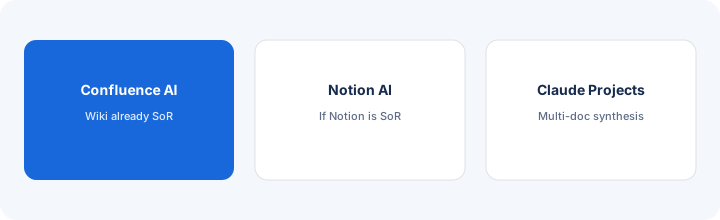
Confluence AI tends to help when Confluence is already the system of record, runbooks have clear steps (even if messy), and you want FAQ/checklist drafts without exporting to another chat. It tends not to help when you hoped AI would invent missing owners and controls, when most SOPs live in Google Docs/Notion instead of Confluence, or when you need long multi-doc strategy memos a dedicated Claude/ChatGPT Project handles better. Buying Confluence “for AI” while keeping another wiki is usually the expensive parallel stack this page warns against.
Paying for Confluence AI and a few other AI tools? The $9 AI toolkit spreadsheet lists every AI subscription you have, what each one costs, and how fast it pays for itself, so you can see which ones are worth the money.
Want someone to do it for you? AI toolkit audit — $19
Alternatives compared: stay native vs parallel tools
| Axis | Confluence AI | Notion AI | Claude Projects | Docs + LLM paste |
|---|---|---|---|---|
| Best when… | Confluence is already wiki SoR. | Notion pages are already truth. | Long memos / multi-doc synthesis. | One-off hygiene without more SaaS. |
| Cost shape (Sep 2026) | Confluence seats + Rovo credit pool. | Notion seats + Notion AI (see Notion AI). | Chat seat + paste/export time. | Near $0 tooling; human time is the cost. |
| Less useful when… | Confluence is not where SOPs live. | You only need Confluence-native runbooks. | You only need in-page FAQ/checklists. | You need multi-user wiki-grounded agents. |
Also see Notion AI, Claude Projects, Coda AI, Claude for ops, and the ops & automation hub.
Same job, two products: GitBook AI vs Confluence AI.
Inventory seats by job on the stack map for knowledge ops.
FAQ
What is Confluence AI?
Atlassian’s in-wiki AI layer (Rovo in Confluence): page-grounded answers, drafting/rewrite help, AI search, plus credit-metered agents — built on Confluence data, not a separate wiki.
How much does Confluence AI cost in September 2026?
Public packaging ties Rovo credits to Confluence plan tiers (commonly ~25 / ~70 / ~150 credits per user/month for Standard / Premium / Enterprise). Confirm on Atlassian Confluence pricing + Rovo licensing.
Should we buy Confluence just for AI?
Rarely for this page’s job. Prefer AI inside the wiki you already run. Confluence AI shines when Confluence is already paid for and trusted.
Will Confluence AI fix a messy runbook library?
No. Clean owners, steps, and contradictions first — or AI will confidently draft from bad pages.
Optional next step (if seats overlap)
If Confluence AI is one of several AI seats and you want a written pass across the whole list, the optional $19 AI toolkit audit produces a short memo. Prefer an editable grid? The $9 AI toolkit spreadsheet is a one-time CSV. Soft offer only — this deep-dive stands alone.
Checkout is live via Stripe. After you pay, we email delivery (spreadsheet) or intake next steps (audit).