Sales · RevOps · Enrichment
Apollo.io review (Sep 2026): prospecting data for ops/revops workflows
Enrichment and prospecting ops — when Apollo replaces repetitive VA research for company/person fields, with compliance and hygiene notes, and when a human QA gate must stay in front of any send. Sep 2026 pricing included.
Who this page helps
Ops and revops people who build prospecting or enrichment lists and want a clear plan: which fields to pull, what to QA, and what never to auto-send. If you only need a one-off founder network spreadsheet with heavy judgment, a VA path or Clay may fit better than an Apollo seat.
What Apollo.io is
Apollo.io is a sales intelligence / prospecting platform: search and enrich companies and people, run sequences, and (on higher plans) dialer and intent tools, metered with credits that differ by plan. Public packaging in 2026 folds seats into Free / Basic / Professional / Organization, with annual vs monthly pricing. This review focuses on the ops/revops enrichment job — not a full outbound playbook.

Major features (with how someone uses them)
Examples at a glance: each feature has a concrete ops/revops example plus a Try this mini-workflow.
1. Enrichment plan from domains
What it is: Start from a domain list and define which fields matter before burning credits. Apollo-style enrichment shines when the field set is repeatable (company, person, title, email) and every row gets a confidence/source note.
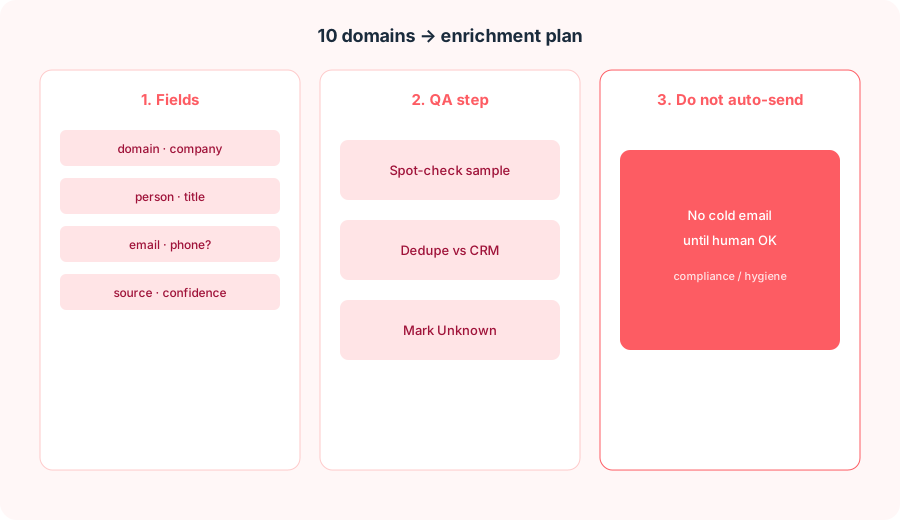
Given 10 company domains, outline an Apollo-style enrichment plan: fields, QA step, and what not to auto-send.
Given 10 company domains, outline an Apollo-style enrichment plan: fields, QA step, and what not to auto-send.
2. QA, hygiene & compliance
What it is: Treat enrichment as draft data. Spot-check a sample, dedupe against the CRM, mark Unknown, and keep consent/compliance rules in front of sequences. Enrichment is not permission to contact.
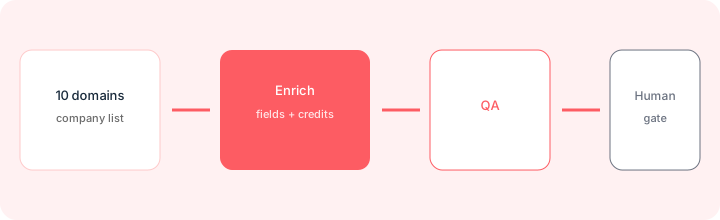
After you draft the field list:
Write a QA checklist for this enrichment batch: sample size ____, CRM dedupe fields ____, bounce/role checks ____, Unknown labels ____. List what must stay off sequences until a human signs off. Do not invent consent.
3. When Apollo replaces VA research
What it is: Apollo helps when the same enrichment job repeats weekly and credits beat hours of copy-paste research. Keep a VA (or Clay) when the work is judgment-heavy, one-off, or must stay offline from sequenced outreach.
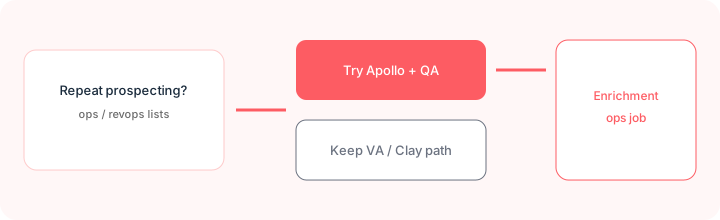
Before adding Apollo seats:
List last month’s enrichment jobs: Job | Volume | Tool (VA / Clay / Apollo / other) | Auto-send? Y/N. If the same field set repeats and send stays human-gated, pilot Apollo on 10 domains. If work is one-off or judgment-heavy, keep VA/Clay first.
4. Plans, credits & send gates
What it is: Apollo meters reveals and enrichment with credits that scale by plan. Sequences, dialer, and intent tools gate by tier. Credits burn on email/phone/company reveals — so field selection and “what not to auto-send” are budget controls as much as compliance.
In your Apollo plan / credits view:
Write: plan ____, seats ____, credits remaining ____, phone reveals enabled? Y/N, sequences live? Y/N. Estimate reveals for the next 10-domain batch. If Unknown, do not assume unlimited enrichment — confirm apollo.io/pricing before budgeting.
Public pricing (September 2026)
From apollo.io/pricing and public plan write-ups we cross-checked in September 2026 (per seat where listed; confirm live):
- Free / Starter: $0 — thin credit pool and capped sequences on public cards. Confirm live caps.
- Basic: about $49/user/month on annual public cards (monthly billing higher, often cited near $59–$65) — enrichment, sequences, CRM sync; credit pools commonly cited around tens of thousands per year per seat.
- Professional: about $79/user/month annual (monthly higher, often ~$99) — adds dialer / automation / intent-style features on many public tables; larger credit pools.
- Organization: about $119/user/month annual (monthly higher; often a 3-seat minimum) — SSO, advanced admin, international dialing on public cards.
- Credits: email/company/enrichment reveals commonly cost credits (phone reveals often cost more). Exact credit math and Fair Use caps change — read the live pricing page.
Uncertainty flags: Seat prices, credit allotments, reveal costs, Free-tier limits, and which features sit on which plan moved through 2025–2026. Regional pricing and legacy credit systems vary. Never budget from this page alone — check apollo.io/pricing and your admin console. Compliance (CAN-SPAM, GDPR, TCPA, local rules) is your responsibility — this page is educational, not legal advice.
When Apollo.io is useful (honest take)
- Useful when: You repeatedly enrich the same field set across many domains; credits beat VA hours; a human QA gate sits before any sequence or dialer.
- Less useful when: Research is one-off or judgment-heavy; you would auto-send from unverified rows; Clay or CRM-native enrichment already covers the job without another seat.
If prospecting, CRM AI, and chat seats overlap on the same weekly jobs, a light trim pass may help — see the AI stack trim playbook. This Apollo review stands alone.
Paying for Apollo.io and a few other AI tools? The $9 AI toolkit spreadsheet lists every AI subscription you have, what each one costs, and how fast it pays for itself, so you can see which ones are worth the money.
Want someone to do it for you? AI toolkit audit — $19
Alternatives compared
| Axis | Apollo.io | Clay | HubSpot AI |
|---|---|---|---|
| Best when… | Repeat domain→person enrichment + sequences. | Custom waterfall research tables. | CRM hygiene already inside HubSpot. |
| Less useful when… | You would auto-send unverified rows. | You only need a simple credit DB. | You need an external prospecting DB. |
See Clay, HubSpot AI, Salesforce Einstein, stack trim playbook, the sales & marketing hub, and the ops & automation hub.
Inventory seats by job on the stack map for sales ops.
FAQ
What is Apollo.io?
A sales intelligence and prospecting platform for search, enrichment, and sequences, metered with credits. For ops/revops, treat it as draft enrichment with a human gate — not auto-send.
How much does Apollo.io cost in September 2026?
Public cards commonly cite Free $0, Basic ~$49/user/month annual, Professional ~$79, Organization ~$119 (often with a seat minimum). Credits power reveals. Confirm apollo.io/pricing — meters change.
When does Apollo replace VA research?
When the same enrichment job repeats and you can QA before send. Keep VA/Clay for one-off or judgment-heavy research.
What should ops not auto-send from Apollo?
Cold email, SMS, or dialer sequences from freshly enriched rows until a human checks compliance, duplicates, and Unknown fields. Enrichment is not permission to contact.