Ops · Work tracker · AI
Asana AI review (Sep 2026): rules and summaries inside the work tracker
Educational look at Asana AI when Asana is already the tracker: Smart Features, Dash, AI Studio, request/credit honesty, and when ClickUp, monday, or Linear fits the same job better.
Who this page helps
Ops leads on small teams already living in Asana who want Monday plans, overdue-by-assignee views, and blocker lists without exporting the project into another chat seat every week. If Asana is not where work is tracked, this page is the wrong buy question — evaluate AI inside ClickUp, monday, Linear, or whatever is actually the system of record.
What Asana AI is
Asana AI is Asana’s native AI layer on the work graph: Smart Features (smart chat, editor, fields, project/task summaries, status and risk assists), Asana Dash as a conversational entry point across meetings/email/tasks where enabled, AI Teammates for repeatable agent-style jobs, and AI Studio for building smart workflows with credit pools. This review focuses on rules and summaries for ops teams already on Asana — not a pitch to migrate your whole company to Asana for AI alone.
Major features (with how someone uses them)
Examples at a glance: each feature has a concrete ops example plus a Try this mini-workflow.
1. Smart summaries & status (rules inside the tracker)
What it is: Asana’s Smart Features help summarize tasks and projects, draft status updates, and surface risk from work already in the graph. Public pricing tables (Sep 2026) list smart chat, editor, fields, project summaries, and related assists on paid tiers. Best when owners, dues, and blockers are already filled — AI will not invent a clean project for you.
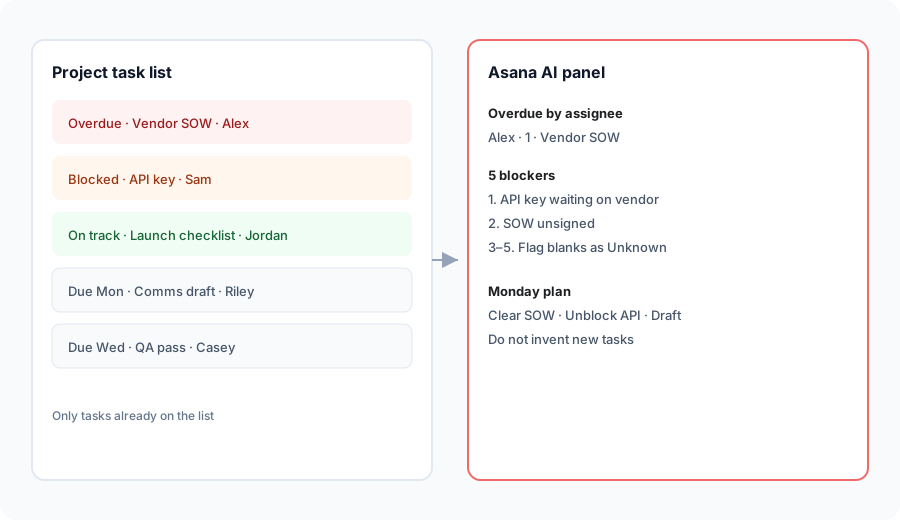
Paste a project task list you already trust:
Paste a project task list. Produce overdue by assignee, 5 blockers, and a Monday plan. Do not add tasks that aren’t listed.
2. Asana Dash (tracker-aware assistant)
What it is: Dash is Asana’s assistant surface for catching up, prioritizing, and taking basic actions across work in context. Public help/community notes (Sep 2026) distinguish lighter find/summarize/basic create-update actions from complex work that consumes an AI request (integrations, web search, long-form generation, or handoff to an AI Teammate). Confirm which interactions are included for your account — the boundary can be hard to see before you send.
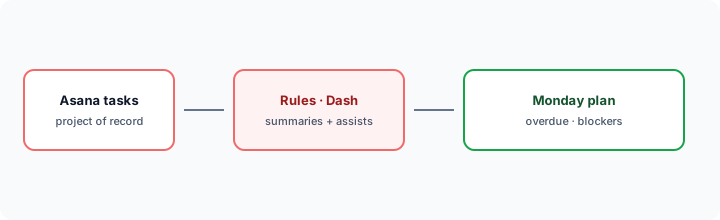
On one real project:
Using only visible tasks in this project, list overdue items with blank owners or blank dues. Produce three Slack bullets. Do not invent tasks not in the project.
3. Rules & AI Studio
What it is: Classic Asana rules automate if-this-then-that on tasks. AI Studio adds smart workflows with monthly credit pools on paid plans (public help: Basic included with tier rate limits; Plus/Pro as paid expansions). Use Studio for repeatable enrichment or routing — not for inventing strategy that belongs in a leadership memo.
Before turning on an AI Studio rule across a project:
Draft a rule that only: (1) labels Priority High/Med/Low from the task name + description, (2) posts Slack if High. Refuse any rule that invents new tasks or reassigns owners without a human step.
4. AI requests & plan gates
What it is: On public asana.com/pricing (Sep 2026), AI Teammates and Asana Dash share a request pool: commonly 5 requests per user per month, capped around 50 on Starter/Advanced and 250 on Enterprise/Enterprise+. Extra usage is sold as prepaid packs (~$0.50/request) or pay-as-you-go (~$0.60/request). AI Studio Basic credit pools are commonly listed around 50K / 75K / 200K credits per billing account by Starter / Advanced / Enterprise. Seat prices are separate — check the live configurator.
Before scaling Dash or AI Teammates:
Estimate monthly Dash complex asks and Teammate runs. Map them to Asana’s published request allotments. If we cannot name a request owner and a monthly ceiling, keep Smart summaries-only for 30 days.
Public pricing (September 2026)
Asana AI rides on paid work-management seats plus request/credit meters — not a single flat “AI SKU.” From public asana.com/pricing and AI Studio pricing (Sep 2026):
- Seats: Personal (free, 2 people) vs Starter / Advanced / Enterprise / Enterprise+. AI features listed above sit on paid tiers. Confirm live seat prices in Asana’s configurator (third-party roundups often cite Starter around ~$11/user/mo annual and Advanced around ~$25/user/mo annual — treat as approximate until you open asana.com/pricing).
- AI Teammates + Dash requests: included allotments commonly 5 / user / month with account caps (~50 Starter/Advanced; ~250 Enterprise tiers). Extra: ~$0.50 prepaid or ~$0.60 pay-as-you-go per request.
- AI Studio Basic credits: commonly 50K / 75K / 200K per billing account per month by Starter / Advanced / Enterprise(+). Plus/Pro expand pools for a fee.
- Often lighter / included: many Smart Feature assists and some Dash administrative tasks are described as included without burning a request — confirm the live help article for your domain.
Uncertainty flags: Request caps, which Dash turns consume a request, Studio credit multipliers by model, and seat list prices can change. Never budget from a blog table alone — open Admin usage and asana.com/pricing.
When Asana AI is useful (honest take)
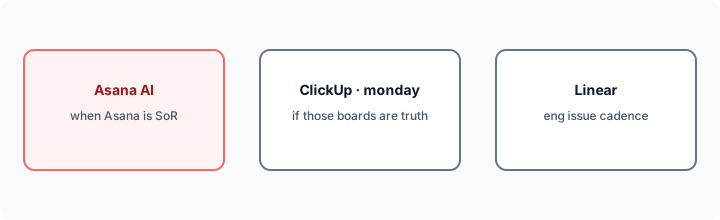
Asana AI tends to help when Asana is already the truth, fields are clean enough to trust, and you want overdue/blocker/Monday summaries without re-exporting to ChatGPT/Claude every week. It tends not to help when you hoped AI would fix empty owners and dues, when work mostly lives in email/Sheets/another PM tool, or when eng lives in Linear and ops only mirrors tickets. Buying Asana “for the AI” while keeping another tracker is usually the expensive parallel stack this page warns against.
Paying for Asana AI and a few other AI tools? The $9 AI toolkit spreadsheet lists every AI subscription you have, what each one costs, and how fast it pays for itself, so you can see which ones are worth the money.
Want someone to do it for you? AI toolkit audit — $19
Alternatives compared: stay native vs parallel tools
| Axis | Asana AI | ClickUp Brain | monday.com AI | Linear / Sheets + LLM |
|---|---|---|---|---|
| Best when… | Asana projects are already truth. | ClickUp is already system of record. | monday boards are already truth. | Eng issues (Linear) or one-off hygiene (Sheets). |
| Cost shape (Sep 2026) | Asana seats + AI requests/Studio credits. | ClickUp seats + Brain add-on (see ClickUp Brain). | monday seats + AI credits (see monday.com AI). | Linear seats or near-$0 paste time. |
| Less useful when… | Asana is not where work lives. | You only need Asana Monday plans. | You only need Asana overdue lists. | You need multi-user Asana-grounded agents. |
Also see ClickUp Brain, monday.com AI, Notion AI, Claude for ops, and the ops & automation hub.
Same job, two products: ClickUp Brain vs Asana Intelligence.
Same job, two products: Asana Intelligence vs Jira AI.
FAQ
What is Asana AI?
Asana’s native AI layer: Smart Features, Dash, AI Teammates, and AI Studio — built on Asana tasks/projects, not a separate PM tool.
How much does Asana AI cost in September 2026?
Paid seats plus included Dash/Teammate request allotments (commonly 5/user/mo with account caps) and AI Studio credit pools. Extra requests around $0.50–$0.60. Confirm on asana.com/pricing.
Should we buy Asana just for AI?
Rarely for this page’s job. Prefer AI inside the tracker you already run. Asana AI shines when projects are already paid for and trusted.
Will AI fix a messy Asana project?
No. Clean owners, statuses, and dues first — or AI will confidently summarize blank rows.
Optional next step (if seats overlap)
If Asana AI is one of several AI seats and you want a written pass across the whole list, the optional $19 AI toolkit audit produces a short memo. Prefer an editable grid? The $9 AI toolkit spreadsheet is a one-time CSV. Soft offer only — this deep-dive stands alone.
Checkout is live via Stripe. After you pay, we email delivery (spreadsheet) or intake next steps (audit).