Compare · Sales & marketing · Nov 2026
Beehiiv vs Substack (Nov 2026): Free to 2,500 subs, Lite $49, Pro $95 vs free with a 10% cut — when a flat plan beats a revenue share
Beehiiv lists a Free plan up to 2,500 subscribers, then Lite at $49 a month and Pro at $95 on yearly billing, with a 0% take rate. Substack is free to publish and says writers keep 90% of paid revenue minus card fees. Run your own numbers on list size and paid revenue, and name who owns each send before you move. This page is not a ranking.
What this comparison covers
This page is for writers, creators, founders, and small media teams choosing between Beehiiv and Substack for a newsletter, free or paid. A named person owns each send and the subscriber list.
Facts come from the Beehiiv pricing page and Substack’s going-paid page, both read on 7 November 2026. We did not move your list, so run one real issue on whichever you shortlist.
The core difference is how cost grows. Beehiiv charges a plan fee that rises with subscriber count and lists a 0% take rate on paid subscriptions. Substack is free to publish and keeps a 10% share of paid revenue. Which is cheaper depends on your paid revenue, not your free list alone.
Ground rules: every scheduled send has an owner; pricing, sponsor, and results claims get a human check before publish. This page is not a ranking.
| Beehiiv | Substack | |
|---|---|---|
| Cost to start | Free plan, up to 2,500 subscribers | Free to publish |
| Paid plans | Lite $49 a month (up to 100,000); Pro $95 a month (up to 250,000), shown with yearly billing; Enterprise custom | No monthly plan fee listed |
| Cut of paid subscriptions | 0% take rate on paid plans; Stripe 2.9% + $0.30 per transaction | Writers keep 90% of revenue minus card fees |
| How cost grows | With subscriber count (plan tiers) | With paid revenue (percentage) |
| Email sends | FAQ says no limit on email sends | Not priced per send on the page we read |
Major features (with how someone uses them)
Examples at a glance: each feature has a concrete example from a real job plus a short Try this you can run this week.
1. Flat plan vs revenue share
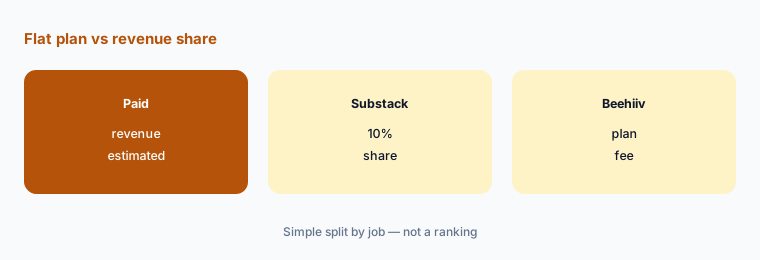
What it is: Beehiiv shows Free at $0 up to 2,500 subscribers, Lite $49 a month up to 100,000, and Pro $95 a month up to 250,000, displayed with yearly billing; its FAQ says yearly saves up to 20% versus monthly (Beehiiv pricing). Substack says writers keep 90% of their revenue minus credit card fees (Substack going-paid).
At $500 a month in paid subscriptions, Substack’s 10% share is about $50 before card fees, close to Beehiiv Lite. At $5,000 a month, the share is about $500 while Beehiiv Pro stays $95. With no paid subscriptions, Substack costs nothing and Beehiiv Free covers up to 2,500 readers.
Do the math once:
Write down your subscriber count, how many paid subscribers you expect in 12 months, and your planned monthly price. Work out Substack’s 10% cut on that revenue and compare it with Beehiiv’s plan price for your list size before you move a single subscriber.
2. Who owns the list and the domain
What it is: Both let you publish a newsletter with a web archive; Beehiiv’s plans add custom features as you move up (Beehiiv pricing). Substack frames the platform around writers getting paid directly by readers (Substack going-paid).
Export your subscriber list on day one in whichever tool you pick, and store a copy where your team can find it. A list nobody can export is a risk no matter which logo you choose.
Export a copy:
Export your current subscriber list today. Save it with the date, and write who is allowed to import or delete subscribers.
3. Discovery vs growth tools
What it is: Substack’s pitch centers paid subscriptions and direct reader support (Substack going-paid). Beehiiv’s pricing page lists growth and monetization features such as a recommendation network, ad monetization, and paid subscriptions on paid plans (Beehiiv pricing).
Pick the growth path you will actually run. Recommendations and ads need someone to manage them weekly; a paid-subscription push needs someone to write the offer and handle churn.
Name the growth owner:
Write the one growth tactic you will run next month, who runs it, and how you will count new paying readers.
4. Ads, sponsors, and paid tiers
What it is: Beehiiv lists a 0% take rate and ad monetization on Lite and Pro; Stripe’s 2.9% + $0.30 still applies to payments (Beehiiv pricing). Substack’s 10% share applies to paid subscription revenue (Substack going-paid).
If sponsors are your main revenue, the plan fee is what matters. If paid subscriptions are the main revenue, the percentage matters. Write which one you expect before comparing.
Split your revenue:
List last quarter’s newsletter revenue by source: sponsors, paid subscriptions, products. Price Beehiiv and Substack on that split.
5. When moving is worth it
What it is: Moving a newsletter means moving subscribers, paid billing, the archive, and the sending domain. Check the import and export steps on each side before you commit (Beehiiv pricing; Substack going-paid).
Move only when the numbers or a missing feature cost you money this year, and someone owns the migration date. A nicer editor is not enough reason.
Write the reason to move:
Write the one number or missing feature that justifies moving. If you cannot name it, stay put and revisit next quarter.
6. One owner per publication
What it is: Beehiiv and Substack both keep sending on schedule after the person who set it up has moved on (Beehiiv pricing; Substack going-paid).
A named owner matters more than the platform. A scheduled issue with an outdated offer still reaches every reader.
List the owners:
Write each publication, its owner, a backup editor, and the last date pricing and links were checked. Review it monthly.
Pricing context (November 2026)
Beehiiv (pricing page, read 7 Nov 2026): Free $0 up to 2,500 subscribers; Lite $49 a month up to 100,000; Pro $95 a month up to 250,000 (shown with yearly billing; FAQ says yearly saves up to 20%); Enterprise custom. 0% take rate on paid plans; Stripe 2.9% + $0.30 per transaction.
Substack (going-paid page, read 7 Nov 2026): free to publish; writers keep 90% of revenue minus credit card fees.
For the single-tool view, see the Beehiiv review. For an email tool priced by subscribers with a free tier, see MailerLite.
Uncertainty: Beehiiv’s displayed prices use yearly billing; monthly billing costs more and the page toggle can change. Substack’s revenue share and card fees are stated on its marketing page; confirm on your dashboard before you price. Check both live pages on the day you decide.
When it’s useful (honest take)
Beehiiv tends to fit when paid or sponsor revenue is large enough that a flat plan costs less than a 10% share, or when you want its growth and ad tools. Substack tends to fit when you want to start free, paid revenue is modest, and you value its reader network.
Neither helps if nobody owns the send calendar. Export your list either way, and cancel any email tool the winner replaces.
Still choosing between Beehiiv and Substack? The $19 AI toolkit audit gives you a written plan for which tools to keep using and which to drop across your whole AI stack, including this pair.
Prefer to do it yourself? Spreadsheet — $9
Related options (educational)
| Need | Better home | Why |
|---|---|---|
| Beehiiv alone | Beehiiv review | See that review for current plans |
| Email tool with a free tier | MailerLite review | See that review for current plans |
| Funnels plus email | Systeme.io review | See that review for current plans |
| LinkedIn audience | Taplio review | See that review for current plans |
FAQ
Is Beehiiv cheaper than Substack?
It depends on paid revenue. Substack is free to publish and keeps 10% of paid revenue; Beehiiv charges Lite $49 or Pro $95 a month on yearly billing with a 0% take rate, as listed on 7 November 2026. At low paid revenue Substack often costs less; at higher paid revenue a flat plan can. This page is not a ranking.
Does Beehiiv have a free plan like Substack?
Yes. Beehiiv Free is listed at $0 for up to 2,500 subscribers. Substack is free to publish.
How much does Substack take?
Substack’s going-paid page says writers keep 90% of their revenue minus credit card fees, as read on 7 November 2026.
Can I move from Substack to Beehiiv?
Moving means carrying over subscribers, paid billing, the archive, and the domain. Test with a smaller publication or a copy first and confirm each step on both platforms.
Who should own a newsletter after a move?
One named person per publication, with a backup editor and a monthly check that offers and links still match the website.
Optional next step (if seats overlap)
If you pay for a newsletter tool plus another email platform, map which one Beehiiv or Substack would replace before you move subscribers. Map the overlap with the $19 AI toolkit audit or the $9 AI toolkit spreadsheet. Email Audit $19 or Toolkit spreadsheet $9.
Checkout is live via Stripe. After you pay, we email delivery (spreadsheet) or intake next steps (audit).