How-to · Revenue cycle · athenahealth · Oct 21, 2026
Use athenahealth’s Express Coding on ambient visits, and have the biller review every code before the claim drops
athenahealth’s athenaAmbient drafts the visit note and suggests diagnoses and order types, and its AI-powered Express Coding helps with charge capture on the billing side. Together they can turn one visit into a claim with very little typing. This page shows how to pilot both with two clinicians, so a named attending signs every note and the biller reviews every code before a claim goes out.
Who this is for
Practice managers, billing supervisors, and billers at ambulatory practices on athenaOne. The job here is the hand-off from a signed ambient note to a reviewed code. This is an operations how-to, not medical, coding, or billing advice. For piloting Epic’s Art AI Charting in a health system — a different job on a different EHR — see Epic Art AI Charting clinician sign-off. For nursing charting on Oracle Health — also a different job — see Oracle Health nursing charting review.
How to do it
This is a how-to, not a ranking of EHRs. Per the athenahealth AI review, athenaAmbient captures the visit on desktop and mobile, drafts the note, and suggests potential diagnoses and order types; athena says it is delivered at no additional cost as part of routine updates (athena’s claim — confirm for your contract). On the revenue-cycle side athena describes AI-powered Express Coding for charge capture and cleaner claims, and AI that times claim follow-up. None of that replaces a coder or biller checking the claim. The ground rule: the attending clinician signs every note and order, and the biller reviews every code before the claim drops.

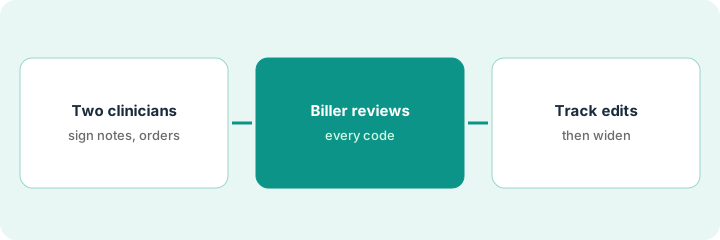
1. Pilot with two clinicians who sign every note and order
What it is: Start with two clinicians in one specialty. Each attending reads every athenaAmbient draft and every suggested order against the visit before signing or placing anything.
- Name the two attending clinicians and the practice manager as pilot owner.
- Read the Assessment and Plan line by line before signing.
- Delete any suggested order that was only discussed as a future option.
- Check the review-of-systems for details that were never asked.
- Only signed notes move on to coding.
A family physician reviews ten athenaAmbient drafts from one morning. Eight need light edits. One adds a review-of-systems detail she never asked about, and one suggests an imaging order she mentioned only as a future option. She deletes both and signs the rest.
Pick two attending clinicians, and for one week have each read every draft note and suggested order against the visit before signing or placing anything.
2. Biller reviews every Express Coding suggestion before the claim drops
What it is: For the pilot visits, the biller checks each Express Coding suggestion against the signed note and holds the claim until it matches.
- Review codes only from signed notes.
- Compare each suggested code with what a coder would assign from the note.
- Check diagnosis specificity and procedure codes.
- Send documentation gaps back to the clinician instead of coding around them.
- Hold the claim until every code is reviewed.
The billing supervisor samples fifty Express Coding suggestions from the pilot specialty. Forty-two match what the coder would have used, five need a more specific diagnosis code, and three would have under-coded a procedure. She keeps dual review on and logs the three under-codes for training.
For every pilot visit, have the biller compare each Express Coding suggestion with the signed note before releasing the claim.
3. Track edits before widening
What it is: Keep a simple log of clinician edits and biller code changes for the pilot. Widen to more clinicians only when the log shows the misses are understood.
- Log each clinician edit by type: added detail, wrong order, missing refusal.
- Log each biller code change by type: specificity, under-coding, wrong code.
- Review the log with the practice manager after two weeks.
- Keep dual coding review where changes repeat.
- Add clinicians one at a time.
After two weeks the log shows most clinician edits are about suggested orders and most code changes are diagnosis specificity. The practice manager adds a third clinician, keeps dual review on, and asks athena which coding suggestions are live for that specialty.
Keep a two-column log — clinician edits and biller code changes — for two weeks, and review it with the practice manager before adding another clinician.
Pricing context (October 2026)
This how-to isn’t a price sheet. Per the athenahealth AI review, athenahealth publishes no public price list for athenaOne seats or most AI features; athena says athenaAmbient is available at no additional cost as part of routine updates — confirm that on your order form. Treat Express Coding and other AI features as quote-only. Dated October 2026.
Checked Oct 21, 2026 on the vendor’s own site: athenahealth publishes no prices; our direct fetch of athenahealth.com/pricing and athenahealth’s home page was blocked, so we read the home page through a reader tool and found no price list. This page quotes no athenahealth dollar figure; ask athenahealth for a written quote and see our review for what is known.
Uncertainty: The only prices this site sells here are the optional $9 AI toolkit spreadsheet and $19 AI toolkit audit.
When this helps (honest take)
Useful when your practice already runs athenaOne, clinicians finish charts after hours, billers rework coding misses, and someone will name who signs notes and who reviews codes.
Not useful when you are a health system on Epic or Oracle Health, nobody will hold claims for review during the pilot, or your main gap is denials after submission.
Related options (educational)
| Need | Where to look | Why |
|---|---|---|
| Ambient notes and Express Coding on athenaOne | athenahealth AI | Primary path; quote only |
| Art AI Charting with clinician sign-off on Epic | Epic Art AI Charting clinician sign-off | A different job |
| Nursing charting review on Oracle Health | Oracle Health nursing charting review | A different job |
| Choosing an ambulatory vs health-system EHR | athenahealth vs Epic Systems EHR · Oracle Health vs athenahealth | Side-by-side explainers |
FAQ
Can athenaAmbient sign notes or place orders on its own?
Do not configure it that way. The attending clinician reviews drafts and suggested orders and signs or places them intentionally.
Is athenaAmbient really included at no extra cost?
Per our review, athena says so; confirm that language on your order form.
How much does athenahealth cost?
athenahealth publishes no public price list. Treat Express Coding and other AI features as quote-only (checked Oct 21, 2026).
Optional next step
If you want a one-page toolkit map for the tools you already pay for, use the optional $9 AI toolkit spreadsheet. If you want a short review of seat waste and unused tools, use the optional $19 AI toolkit audit. Neither is required to follow this how-to.