What’s new · Finance close · FloQast · Sep 2026
What’s new in FloQast (Sep 2026): close and AI changes accounting teams should notice
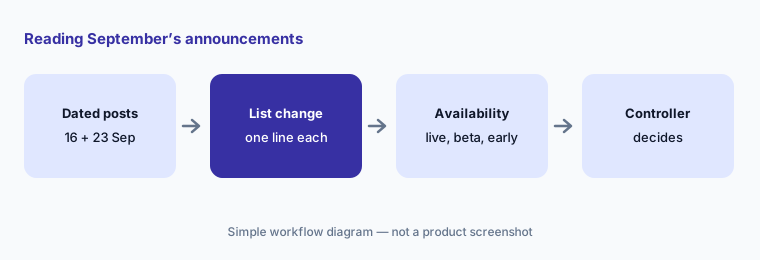
FloQast announced five products at its TakeControl 2026 conference and published dated posts about them on 16 and 23 September 2026. This page pulls out what a controller should act on — what each one does, what it is still waiting on (beta or early access), and where a person still signs off — with the date and link for each. It isn’t a review; for that, see our FloQast AI review. Every item comes from a public FloQast page we opened on 6 October 2026.
What this page covers
This page is for the controller or accounting manager who uses FloQast (or is evaluating it) and wants September’s announcements in one place — especially what is generally available versus beta or early access, and where an accountant still signs off.
FloQast announced these in dated September 2026 blog posts, one per product plus a conference recap, so those posts are our sources. We list only what those posts say. Customer results quoted in FloQast’s posts are FloQast’s claims, not ours, and we don’t repeat them as benchmarks.
Major features (with how someone uses them)
Examples at a glance: each feature has a concrete example from a real job plus a short Try this you can run this week.
1. Five changes a controller should act on (primary)
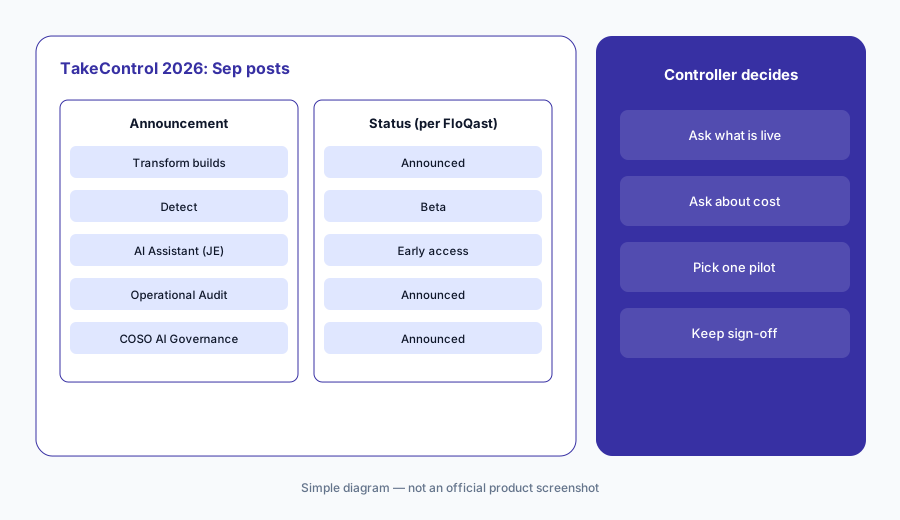
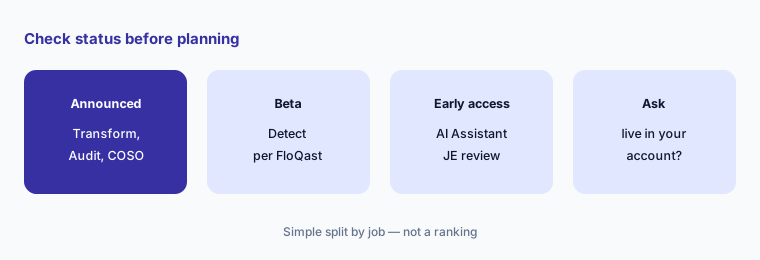
What it is: FloQast’s September 23 recap lists five announcements: (1) Transform can build an agent from last month’s close; (2) Detect monitors the GL for anomalies during the period; (3) AI Assistant runs a first-pass review on journal entries before they post; (4) Operational Audit gives internal audit one platform to plan, test, and report; and (5) a COSO AI Governance module that maps agent capabilities to risks and controls. The status differs: the September 16 posts say Detect is in beta and AI Assistant journal entry review is in early access for a select group of customers. Sources: recap (23 Sep), Transform, AI Assistant, Detect, Operational Audit (16 Sep).
Primary workflow:
From FloQast’s public Sep 2026 notes, list 5 changes a controller should act on — cite sources.
2. 16 Sep: Transform builds agents from last month’s close
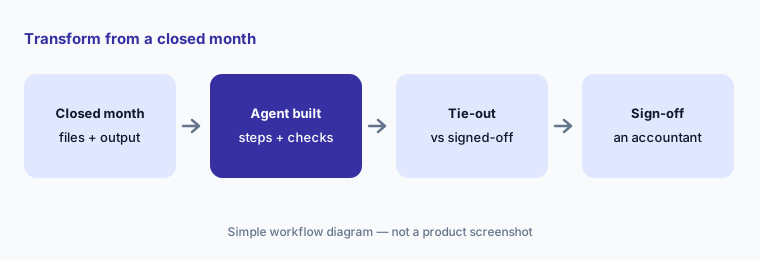
What it is: Per FloQast’s Transform post, you can hand Transform the input files and the reviewed output from a close your team already completed, and it reverse-engineers the steps and checks into an agent with a plain-language playbook and audit trail. You can also describe the process, start from a prebuilt agent, or build step by step. FloQast says that before any workflow goes live it runs against your prior-period data and is verified column by column, entity by entity, against work your team signed off on; if it doesn’t match, it doesn’t save. It stops to ask when it finds a judgment call, nothing deploys without an accountant’s sign-off, and you decide where human review steps sit.
Start from a closed month:
Pick one recurring process from a month that is already closed and signed off. Gather the input files and the reviewed output, and write down where a person must review before anything posts.
3. 16 Sep: AI Assistant journal entry review (early access)
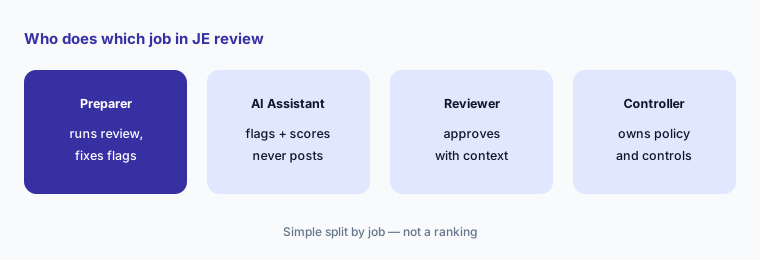
What it is: Per FloQast’s AI Assistant post, the Assistant is built into Journal Entry Management. A preparer can run a review before submitting; a reviewer can request one during approval. It checks for duplicate postings, empty subledger fields, missing reversal dates, and GL account and dimension combinations that differ from roughly 180 days of your own posting history. It also gives an audit risk score in three bands — Low (0–29), Moderate (30–59), Elevated (60–100) — based on signals such as after-hours creation, suspense or intercompany accounts, amounts just below thresholds, and manual preparation. FloQast says it never posts, corrects, or decides anything; your team makes the final call. It is in early access for a select group of customers.
Test against known entries:
List ten journal entries from last quarter that a reviewer or auditor questioned. If you get early access, run the Assistant on them first and compare its flags with what a person found.
4. 16 Sep: Detect anomaly monitoring (beta)
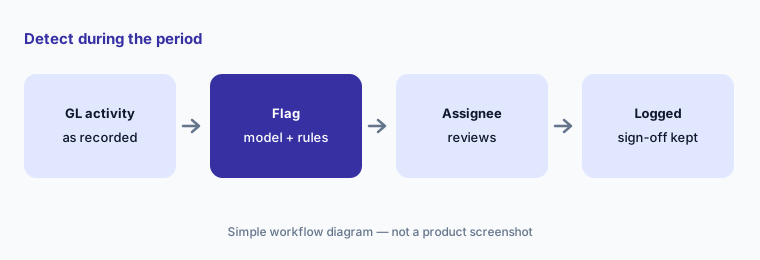
What it is: Per FloQast’s Detect post, Detect monitors GL data continuously during the period, learns what normal looks like for each account and subsidiary, and flags transactions outside those patterns in near real time. A user-defined rules layer sits on top of the model for your own policies. Flagged items route to assignees through a review, resolve, and sign-off workflow, with ERP source records shown alongside, and every detection, comment, and sign-off is logged with time and person. Detect is in beta.
Write your rules first:
Write down the anomaly rules your team already checks by hand each month and name one assignee per entity for flagged items. Use that list to judge Detect if you join the beta.
5. 16 Sep: Operational Audit for internal audit
What it is: Per FloQast’s Operational Audit post, the platform FloQast has used for SOX and compliance audits since 2023 now covers operational audits (process, IT, and department audits). You upload process documentation, a risk register, and prior findings, and AI drafts an audit plan to iterate on. Milestones carry documents, owners, and status; evidence requests and testing work as they do for compliance audits, including AI testing for PDF and Excel files; and AI generates an executive report from the plan, evidence, and test results. FloQast says a finding can become a governed Transform agent.
Pick one audit to compare:
List the operational audits your team runs outside FloQast today. Pick one with good prior documentation and compare an AI-drafted plan with your own before changing anything.
6. 23 Sep: COSO AI Governance module + what to ask
What it is: FloQast’s September 23 recap says the COSO AI Governance module puts the COSO generative AI framework inside the platform — mapping agent capabilities to risks and controls and capturing audit evidence as agents run. The posts we read don’t give a general-availability date for it, Detect, or AI Assistant. Before planning around any of the five, ask in writing which ones are live in your account, which are beta or early access, and whether any cost extra — FloQast doesn’t publish prices. If you are comparing close tools, see FloQast vs Numeric.
Ask what’s live:
Email your FloQast contact the five September announcements. For each, ask whether it is live in your account, beta, or early access, and whether it costs extra. Save the reply with your renewal file.
Pricing context (October 2026)
FloQast doesn’t publish prices: its pricing page (checked Oct 6, 2026) lists products such as Close Management, Close AI, and Risk & Compliance without dollar amounts and asks you to contact sales. None of the September posts we read mention prices or whether the new products cost extra.
For dated notes on FloQast’s close products, see the FloQast AI review and FloQast vs Numeric.
Uncertainty: We read only the five FloQast posts linked above. Detect is in beta and AI Assistant journal entry review is in early access per FloQast; the posts give no dates for wider release. Customer results in FloQast’s posts are vendor claims. Check with FloQast and your auditor before relying on any new control.
When it’s useful (honest take)
Useful when you run the close in FloQast and want September’s announcements with status, sources, and one action each.
Useful when you are preparing a renewal and need a list of questions about what is live and what costs extra.
Less useful when you want a full review of FloQast — read FloQast AI — or you aren’t on FloQast and aren’t evaluating it.
Paying for FloQast and a few other AI tools? The $9 AI toolkit spreadsheet lists every AI subscription you have, what each one costs, and how fast it pays for itself, so you can see which ones are worth the money.
Want someone to do it for you? AI toolkit audit — $19
Related options (educational)
| Need | Better home | Why |
|---|---|---|
| Full review of FloQast’s close AI | FloQast AI | Not a changelog |
| Comparing close tools | FloQast vs Numeric | Split by job |
| Reconciliation-heavy close | BlackLine AI | Another close platform |
| Accounts payable | Stampli AI | AP, not close |
| Inventory finance AI seats | Stack map for finance ops | Jobs, tools, overlaps |
FAQ
What did FloQast announce in September 2026?
At TakeControl 2026, per FloQast’s posts of Sep 16 and Sep 23, 2026: Transform building agents from last month’s close, Detect anomaly monitoring (beta), AI Assistant journal entry review (early access), Operational Audit, and a COSO AI Governance module.
Does the AI Assistant post journal entries?
No. FloQast says the Assistant never posts, corrects, or decides anything; it flags issues, gives an audit risk score, explains its findings, and recommends a fix. The preparer and reviewer make the call.
Is Detect available now?
FloQast’s Sep 16, 2026 post says Detect was announced at TakeControl 2026 and is in beta. Ask FloQast whether your account can join.
Can Transform deploy an agent without review?
Per FloQast, no. A workflow is verified against your prior-period, signed-off work before it saves, and nothing deploys without an accountant’s sign-off. You choose where human review steps sit.
Did FloQast publish prices for the new products?
No. On Oct 6, 2026 FloQast’s pricing page listed no dollar amounts, and the September posts don’t mention prices. Ask in writing whether any new product costs extra.
Optional next step (if seats overlap)
If finance pays for a close platform, a separate reconciliation tool, and chat assistants that all draft the same flux explanations, fix that overlap before adding another tool. Map the overlap with the $19 AI toolkit audit or the $9 AI toolkit spreadsheet. Email Audit $19 or Toolkit spreadsheet $9.
Checkout is live via Stripe. After you pay, we email delivery (spreadsheet) or intake next steps (audit).