How-to · Warehouse operations · Manhattan Associates · Oct 21, 2026
Pilot Manhattan Active’s Wave Coordinator agent, and have the warehouse manager approve every agent action
Manhattan Active’s Wave Coordinator agent researches waves that come up short, explains why items were deselected, finds inventory elsewhere in the building, and recommends alternatives. A recommendation that looks right on screen can still send pickers to a blocked location. This page shows how to pilot it in one building while the warehouse manager approves every agent action.
Who this is for
Warehouse managers, operations managers, and IT leads at companies on Manhattan Active Warehouse Management. The job here is execution on the floor — waves, picks, and labor. For reading Blue Yonder’s forecast explanations with a planner approving plan changes — a different job on the planning side — see Blue Yonder forecast explanation approval.
How to do it
This is a how-to, not a ranking of warehouse software. Per the Manhattan Active AI review, Manhattan announced commercial availability of Manhattan Active Agents on 8 January 2026, embedded in all Manhattan Active solutions and with Agent Foundry. The Wave Coordinator agent researches short waves; the Warehouse Labor agent tracks work against plan and, per Manhattan, can “initiate labor moves by communicating directly with associate devices”; Agent Foundry builds custom agents where approval steps are something you add. Manhattan’s productivity figures are its claims. The ground rule: the warehouse manager approves anything that changes a wave or moves people.

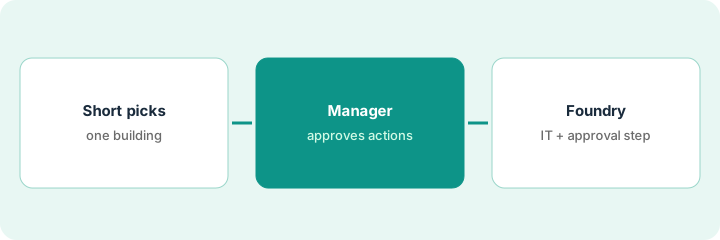
1. Start the Wave Coordinator on short picks in one building
What it is: Pick one building and one recurring exception — short picks — and have the agent suggest fixes on real cases while the warehouse manager marks each one.
- Pick one building and one shift.
- Name the warehouse manager as approver and a floor lead who knows locations.
- Have the agent suggest a fix for ten real short-pick cases.
- Mark each suggestion: would act, would change, would reject.
- Note locations that were blocked, already counted out, or on hold.
The agent suggests fixes for ten short waves. Seven point to good inventory elsewhere. Two point to a location blocked for a cycle count, and one to stock on quality hold. The manager rejects those three and asks IT to check why held stock appeared available.
Have the Wave Coordinator suggest fixes for ten real short picks, and have the warehouse manager mark each one before any agent action is allowed.
2. Warehouse manager approves every agent action; add the Labor agent after two weeks
What it is: During the pilot, every wave change goes through the warehouse manager. After two clean weeks, add the Labor agent — with labor moves also on approval.
- Keep every wave change on manager approval.
- Log approvals and rejections with a reason.
- After two weeks, review the log before adding anything.
- Turn on the Labor agent’s recommendations, but keep labor moves to associate devices on approval.
- Check each suggested move against who is trained for that zone.
After two weeks the log shows most wave suggestions are approved; rejections cluster on held stock. The manager adds the Labor agent. In its first week it suggests moving two pickers into a zone where neither is trained on the equipment, and she rejects both.
Keep a two-week approval log for wave changes, and when you add the Labor agent, keep every labor move on the warehouse manager’s approval.
3. Use Agent Foundry only with IT, and write the approval step in
What it is: Agent Foundry lets your team build agents from a conversation, a template, or scratch. Build only with IT, list the services each agent may call, and add a human approval step for any action that changes an order, wave, or load.
- Have IT own every Foundry build.
- List the services the agent may call.
- Add a human approval step before any change to an order, wave, or load.
- Read execution traces for ten decisions after the first week.
- Have the operations manager sign the list before publishing.
The IT lead drafts a Foundry agent from a template to flag waves at risk of missing carrier cut-off. She lists the two services it may call, adds an approval step before any wave change, and has the operations manager sign the list before publishing.
Before publishing a Foundry agent, list the services it may call, add an approval step for changes to orders, waves, or loads, and get the operations manager’s signature.
Pricing context (October 2026)
This how-to isn’t a price sheet. Per the Manhattan Active AI review, Manhattan does not publish prices; its editions page lists Essentials, Enterprise, and Enterprise Premier with no amounts. When we checked on Oct 21, 2026, manh.com/pricing sent us to the home page and we found no prices. Treat it as quote-only and ask which agents your edition includes. Dated October 2026.
Checked Oct 21, 2026 on the vendor’s own site: Manhattan publishes no prices; manh.com/pricing sent us to Manhattan’s home page, which lists no prices. This page quotes no Manhattan dollar figure; ask Manhattan for a written quote and see our review for what is known.
Uncertainty: The only prices this site sells here are the optional $9 AI toolkit spreadsheet and $19 AI toolkit audit.
When this helps (honest take)
Useful when your company runs Manhattan Active Warehouse Management, short picks eat supervisor time, and the warehouse manager will approve every agent action during the pilot.
Not useful when nobody will log approvals, held or blocked inventory is not reliable in the system, or you want labor moves sent to devices from day one.
Related options (educational)
| Need | Where to look | Why |
|---|---|---|
| Wave Coordinator, Labor, Agent Foundry | Manhattan Active AI | Primary path; quote only |
| Forecast explanations with planner approval | Blue Yonder forecast explanation approval | A different job |
| Choosing between planning and execution suites | Blue Yonder vs Manhattan | Side-by-side explainer |
| Where supply chain tools fit | Stack map: logistics ops | Broader map |
FAQ
What does the Wave Coordinator agent do?
Per our review, it researches waves that come up short, explains why items were deselected, finds inventory elsewhere in the building, and recommends alternatives.
Can Manhattan’s agents act without a person?
Per our review, some can. Decide which actions need approval and add that step yourself, especially in Agent Foundry.
How much does Manhattan Active cost?
Manhattan publishes no prices. Treat it as quote-only (checked Oct 21, 2026).
Optional next step
If you want a one-page toolkit map for the tools you already pay for, use the optional $9 AI toolkit spreadsheet. If you want a short review of seat waste and unused tools, use the optional $19 AI toolkit audit. Neither is required to follow this how-to.