How-to · Shipper transportation · Loadsmart · Oct 21, 2026
Run Loadsmart’s free proof of concept on load audits, and have the logistics manager approve every adjustment
Loadsmart launched six AI agents for shippers on 17 September 2026, backed by its own Freight Experts, and its launch release says Loadsmart AI starts with a free Proof of Concept on a single workflow. The load audit agent checks every load before pickup and every charge before payment. A flagged charge is a question, not a dispute. This page shows how to run the proof of concept on audits while the logistics manager approves every adjustment.
Who this is for
Logistics managers, transportation managers, and freight audit leads at mid-size and enterprise shippers. The job here is one workflow — load audits — under Loadsmart’s proof of concept. For checking Uber Freight Insights AI numbers before a carrier review — a different job — see Uber Freight Insights AI KPI check.
How to do it
This is a how-to, not a ranking of freight tools. Per the Loadsmart AI review, the load audit agent checks every load before pickup against the rate, routing guide, appointment, and required documents, and “audits every charge against the contracted rate and approved accessorial before it’s paid”; anything outside your guardrails escalates to a Loadsmart Freight Expert or back to your team, whichever you choose. Loadsmart says agent decisions are logged and reviewable. Its penalty-reduction figures are its claims. The ground rule: the logistics manager approves every audit adjustment and dispute.

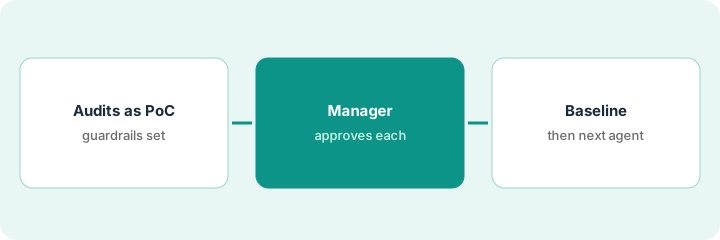
1. Pick load audits as the proof-of-concept workflow
What it is: Loadsmart’s release offers the free proof of concept on a single workflow. Choose audits, write your guardrails, and decide where exceptions go.
- Confirm in writing what the proof of concept covers and what counts as the agent doing the work.
- Note the release says the average proof-of-concept implementation is 60 days.
- Write the guardrails: contracted rates, approved accessorials, routing guide.
- Decide which exceptions go to Loadsmart’s Freight Experts and which come back to your team.
- Record last quarter’s avoidable penalty charges as your baseline.
The logistics manager picks audits, writes the approved accessorial list, and routes all exceptions back to her own team for the proof of concept. She pulls last quarter’s late-pickup and detention charges as the baseline.
Write what the proof of concept covers, your audit guardrails, where exceptions go, and last quarter’s baseline before the agent starts.
2. Logistics manager approves every flagged adjustment
What it is: Every charge the agent flags goes to the logistics manager, who checks it against the rate confirmation before anyone disputes it with a carrier.
- Run the audit agent on twenty delivered loads first.
- Check every flagged charge against the rate confirmation.
- Check accessorials against the approved list.
- Approve, adjust, or reject each flag in writing.
- Dispute only what the rate confirmation supports.
Of twenty delivered loads, the agent flags six charges. Four are real overcharges against the rate confirmation. One is a detention charge the facility caused, and one is an accessorial approved by email that never reached the list. She disputes four and updates the accessorial list.
Run the audit agent on twenty delivered loads, and have the logistics manager check every flag against the rate confirmation before disputing any.
3. Measure avoided charges against your baseline, then decide the next agent
What it is: At the end of the proof of concept, compare charges with your baseline using your own figures, then pick the next agent and its owner.
- Compare avoidable penalty charges with last quarter’s baseline from your own records.
- Count flags that were wrong and why.
- Read a sample of logged agent decisions.
- Pick the next agent by pain: tender failures, documents, tracking, scheduling, or claims.
- Name its owner and limits before it starts — for example, a cost ceiling per lane for tender failures.
At day sixty, the team’s own records show fewer late-pickup charges than the baseline quarter, and most wrong flags trace to the outdated accessorial list. The transportation manager picks the tender agent next and writes a cost ceiling for each major lane before it starts.
At the end of the proof of concept, compare charges with your baseline from your own records, and name the next agent’s owner and limits before it starts.
Pricing context (October 2026)
This how-to isn’t a price sheet. Per the Loadsmart AI review, Loadsmart does not publish prices. When we checked on Oct 21, 2026, loadsmart.com/pricing showed a “Not Found” page and the AI pages offer a working session. Loadsmart’s 17 September 2026 launch release still says Loadsmart AI starts with a free Proof of Concept on a single workflow and that if the agent doesn’t do the work, the shipper doesn’t pay for it. Beyond that it is quote-only. Dated October 2026.
Checked Oct 21, 2026 on the vendor’s own site: Loadsmart publishes no prices; loadsmart.com/pricing showed a “Not Found” page and Loadsmart’s AI page offers a working session. Loadsmart’s 17 September 2026 launch release still says Loadsmart AI starts “with a free Proof of Concept on a single workflow” and that “if the agent doesn’t do the work, the shipper doesn’t pay for it.” This page quotes no Loadsmart dollar figure; ask Loadsmart for a written quote and see our review for what is known.
Uncertainty: The only prices this site sells here are the optional $9 AI toolkit spreadsheet and $19 AI toolkit audit.
When this helps (honest take)
Useful when you are a shipper paying avoidable accessorials and penalties, you have a clean rate and accessorial list, and the logistics manager will approve every adjustment.
Not useful when your rate confirmations are scattered, you want disputes filed automatically, or nobody has a baseline to measure against.
Related options (educational)
| Need | Where to look | Why |
|---|---|---|
| Six agents with Freight Experts | Loadsmart AI | Primary path; free proof of concept, then quote |
| KPI checks before a carrier review | Uber Freight Insights AI KPI check | A different job |
| Analyst questions and booking rules | project44 Mo booking rule approval | A different job |
| Where freight tools fit | Stack map: logistics ops | Broader map |
FAQ
Is Loadsmart AI software or a service?
Per our review, both: the agents are software, and Loadsmart’s Freight Experts resolve exceptions unless you route them back to your team.
Does the audit agent dispute charges for you?
Per our review, Loadsmart says it audits every charge before payment and routes exceptions. Have the logistics manager check each flag against the rate confirmation before disputing.
How much does Loadsmart AI cost?
Loadsmart publishes no price list. Its launch release offers a free Proof of Concept on one workflow; after that it is quote-only (checked Oct 21, 2026).
Optional next step
If you want a one-page toolkit map for the tools you already pay for, use the optional $9 AI toolkit spreadsheet. If you want a short review of seat waste and unused tools, use the optional $19 AI toolkit audit. Neither is required to follow this how-to.