Tool · Procurement · Zip · Oct 2026
Zip AI review (Oct 2026): intake-to-procure assists for procurement ops
Zip is a procurement orchestration platform: employees request purchases in one place, and Zip routes each request through procurement, legal, security, and finance before a PO goes out. Its AI drafts intake fields from what the requester wrote or uploaded, answers policy questions, and — via “Superagents” — moves work along under rules you set. This page shows each assist with an example, a Try this, and where procurement and legal still approve.
What this Zip AI page covers
This page is for the procurement ops lead or finance manager who owns “how do I buy something?” at a mid-size or enterprise company, and wants to know which parts of intake Zip’s AI can draft, which parts it can act on, and which approvals stay with people.
A housekeeping note: Zip’s site moved from ziphq.com to zip.com (old links redirect). Zip’s AI comes in three layers we cover here: AI intake automation (extracting order-form data to pre-fill requests), the AI Procurement Concierge (an AI front door for requesters), and Superagents (AI users in Zip that plan, act, and collaborate under permissions and approval rules). At Zip Forward on 16 September 2026, Zip added more agents and products, which we list below.
Facts come from zip.com’s Superagents, Intake management, and Procurement Concierge pages and Zip’s 16 September 2026 Zip Forward announcement, all read on 5 October 2026. Zip does not publish prices; we don’t guess them.
Major features (with how someone uses them)
Examples at a glance: each feature has a concrete example from a real job plus a short Try this you can run this week.
1. Intake fields drafted from a request (primary)
What it is: Zip’s intake page describes AI intake automation that extracts order-form data and pre-fills request details, plus preferred vendor routing that suggests existing and preferred vendors. The Concierge goes further, combining conversation context, uploaded documents, and company policy to complete intake details. The useful test is how many fields a reviewer still has to fix.
Zip builds intake flows from templates in its Orchestration Library and routes requests through dynamic workflows based on what the requester enters — so a wrong field early (category, amount, data access) can send a request down the wrong approval path.
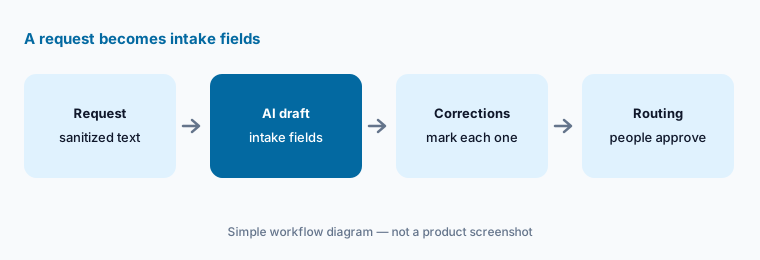
Primary workflow:
Paste one sanitized purchase request (and its order form, if you have one). Ask for the intake fields. Mark every field you had to correct, and note which corrections would have changed the approval path.
2. The Procurement Concierge front door
What it is: The AI Procurement Concierge is Zip’s AI front door: one entry point where employees describe what they need and get real-time guidance, preferred-supplier suggestions based on category rules, and plain-language answers drawn from your procurement policy. Zip’s page claims “50% fewer inquiries”; that’s Zip’s own figure, not something we measured.
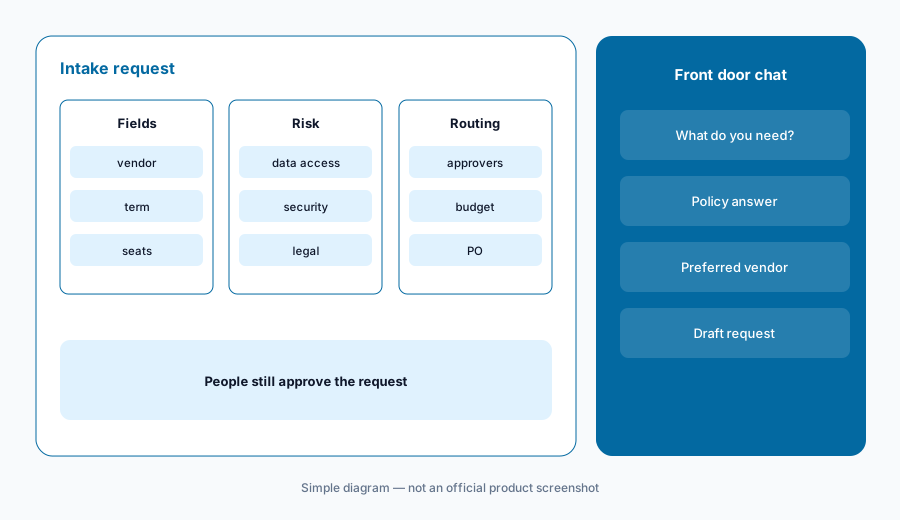
Test the policy answers:
Write five questions requesters ask you weekly (card limits, preferred vendors, who signs NDAs). Ask each one in a demo or pilot, and check every answer against the policy document it should come from.
3. Superagents and the controls around them
What it is: Zip describes Superagents as AI users that plan, take action, and collaborate across the business. The core five are Intake, Procurement, Contract, AP, and Config. You shape them with skills (instructions), actions (what they may do in Zip and integrations), and context (policies and playbooks). Zip lists the controls: permission-aware by design (same roles and permissions as your users), granular action controls with human-in-the-loop approvals, an audit trail with reasoning, deterministic logic for critical actions such as system updates, role-based access to who can edit agents, and drafts and versioning of agent configuration. Superagents can work in Slack, Teams, and email.
Zip’s own FAQ positions Superagents against “copilots like Coupa Navi and SAP Joule,” saying copilots mainly assist while Superagents execute. That’s Zip’s framing of a competitor; Coupa describes its own agents differently (see Coupa Navi).
Draw the line:
List the actions you’d let an agent take alone (reminders, status updates) and the ones that need a person (vendor contact, PO changes, payments). Ask Zip in a demo to show each control configured that way.
4. Zip Forward 2026: what launched in September
What it is: At Zip Forward in New York on 16 September 2026, Zip announced: AI Risk Orchestration (third-party risk management that triages requests, pre-fills questionnaires, and scores suppliers against your framework); Accrual Automation (prepares journal entries from purchase data — Zip says a person always reviews and approves, and nothing posts on its own); a Sourcing Superagent and a PO Superagent (recommends closures and change orders that requesters execute with one click); a Marketplace of 20+ integration templates built on its App Studio; and AI data partners (NPI, SpendHound, Tropic, Beroe, Brightfield, and TEEM) for price benchmarking and supplier discovery.
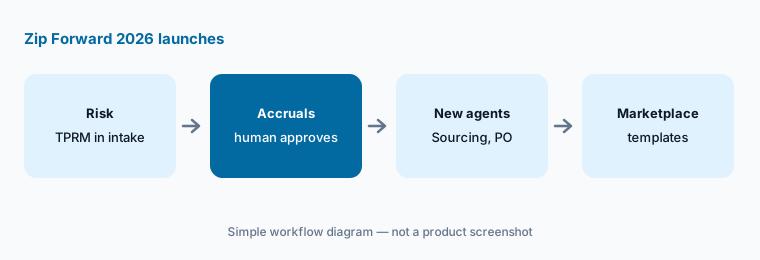
Ask what’s live:
Before a renewal or demo, list the Zip Forward items you care about and ask Zip which are generally available, which are add-ons, and which are included in your current contract.
5. Versus Coupa, ChatGPT, and an intake form
What it is: Zip fits companies that need one front door and approval orchestration across teams, often in front of an ERP. Coupa is a full spend suite — and since buying Tonkean in May 2026 it sells its own intake front door too, so compare carefully (see Zip vs Coupa). ChatGPT can draft an RFP or summarize quotes but doesn’t route approvals. A small team may only need a good form and a shared inbox.
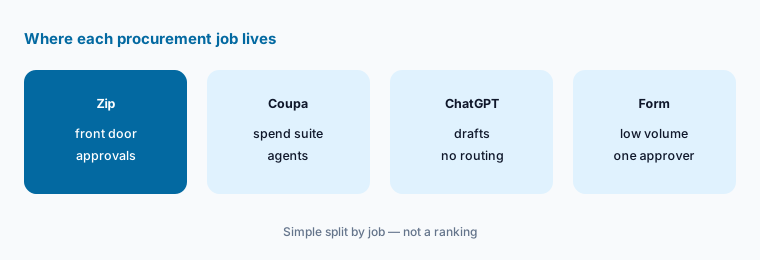
Home for the job:
Count last month’s purchase requests and how many needed more than one reviewer. Low volume, single approver: a form may do. Many cross-team reviews: that’s the job Zip is built for.
Pricing context (October 2026)
Zip does not publish prices. On 5 October 2026, the old pricing URL returned “page not found” on zip.com, and Zip’s pages direct buyers to request a demo. We don’t list or estimate a price. Expect pricing to depend on modules (intake-to-procure, procure-to-pay, risk orchestration, add-ons) and company size — ask Zip which AI capabilities, including Superagents and the September 2026 launches, are included in your quote.
Uncertainty: Without public prices, the only reliable numbers are the ones on your quote. Ask for the AI line items in writing, how agent usage is metered (if at all), and what changes at renewal. Zip’s ROI and “fewer inquiries” figures are vendor claims.
When it’s useful (honest take)
Useful when many purchases need cross-team review (security, legal, finance), requesters don’t know the process, and you want one front door that drafts the intake and routes approvals — with a person approving anything high-impact.
Less useful when purchase volume is low and one person approves everything, or when Coupa (with its own intake front door since the Tonkean acquisition) is already your spend system and you haven’t compared the two.
Paying for Zip AI and a few other AI tools? The $9 AI toolkit spreadsheet lists every AI subscription you have, what each one costs, and how fast it pays for itself, so you can see which ones are worth the money.
Want someone to do it for you? AI toolkit audit — $19
Related options (educational)
| Need | Better home | Why |
|---|---|---|
| One front door and approval orchestration | Zip (this page) | AI drafts intake; people approve |
| Full spend suite with agents across sourcing, AP, expenses | Coupa Navi | Agents where the spend data already lives |
| Intake vs suite, side by side | Zip vs Coupa | Many teams run both |
| RFP drafts and quote comparisons | ChatGPT for procurement | Drafts only; no routing |
| Contract review after the purchase is approved | Ironclad AI | CLM for legal |
FAQ
What does Zip’s AI do?
Zip’s pages describe AI intake automation that extracts order-form data and pre-fills requests, an AI Procurement Concierge front door that guides requesters and answers policy questions, and Superagents that plan and take action under permissions and human approvals.
How much does Zip cost in October 2026?
Zip does not publish prices; the old pricing URL returned not found on 5 October 2026. Pricing comes from a sales quote.
Is it ziphq.com or zip.com?
Zip’s site is now zip.com; old ziphq.com links redirect there.
Can Zip’s AI approve purchases on its own?
Zip says you control which actions agents can take and when human-in-the-loop approvals are required. Keep purchase approvals, vendor contact, and payments with people unless you have a clear reason not to.
What did Zip launch at Zip Forward 2026?
On 16 September 2026 Zip announced AI Risk Orchestration, Accrual Automation, Sourcing and PO Superagents, a Marketplace of integration templates, and AI data partners for price benchmarking and supplier discovery.
Optional next step (if seats overlap)
If procurement pays for an intake tool, a spend suite, and chat seats that all draft the same requests, that overlap is worth mapping before renewal. Map the overlap with the $19 AI toolkit audit or the $9 AI toolkit spreadsheet.
Both pages explain what you get and how delivery works before you decide.