Compare guide · Ops & automation · Nov 2026
n8n vs Make for ops (Nov 2026): self-host cost control vs scenario speed
Educational compare on one weekly handoff job — ownership, cost, connectors; not a scorecard. Link n8n + Make. Also Make scenarios.
How to compare fairly (ops rule)
Ops leads rarely need a winner badge. They need one weekly handoff — form → Slack → Sheet — built, metered, and owned when it breaks on Sunday night. This page walks that job in n8n and Make with build steps, cost shape, connectors, and failure ownership. It is educational, not a scorecard. Product depth lives on the deep-dives; scenario patterns on Make scenarios.
The weekly handoff job (same in both)
A Typeform (or webhook form) submits → notify a Slack channel → append a Google Sheet row. Same inputs, same outputs — only the builder and the failure owner change. That keeps the compare fair.
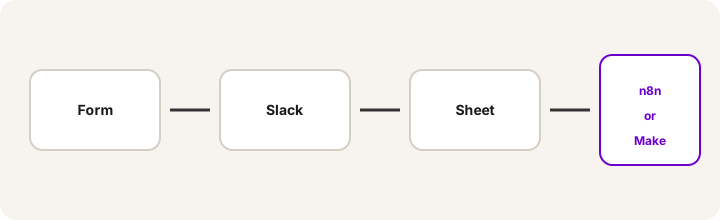
Examples at a glance: each section has a concrete ops example plus a short Try this.
1. Build steps (same workflow)
What the job is: List the concrete steps to ship form → Slack → Sheet in each product so a new ops hire can rebuild it. n8n thinks in nodes/workflows; Make thinks in modules/scenarios.
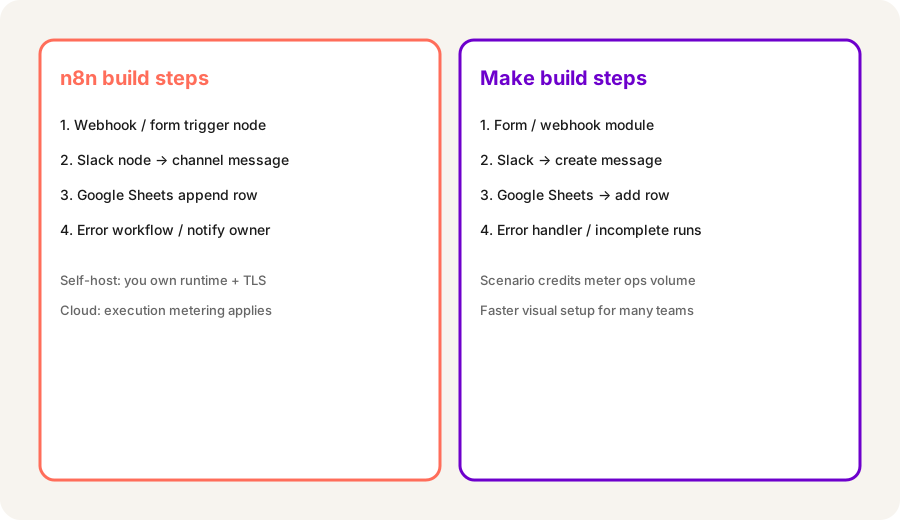
Primary SoT workflow:
Same workflow: form → Slack → Sheet. List build steps in n8n vs Make and who owns Sunday-night failures in each case.
2. Cost control shape
What it is: n8n often wins attention when self-host Community economics or Cloud execution metering fits high-volume internal jobs — with honest server/time costs. Make meters scenario credits; many teams find visual scenario speed worth the credit plan. Confirm dollars on n8n.io/pricing and make.com/en/pricing.
Cost sketch (no invented prices):
For form → Slack → Sheet at ~200 runs/week, list cost drivers only (no dollar guesses): n8n self-host (server, TLS, person-time), n8n Cloud (executions), Make (scenario credits). Note which driver you can measure this month.
3. Connectors & density
What it is: Both cover Slack and Google Sheets for this job. Differences show up on obscure apps, code nodes, and how dense a branch can get before the canvas hurts. Browser/desktop macros are a different class — see Bardeen; human-in-the-loop agents differ again — Relay.app.
Connector check:
List every app in your real handoff after Sheet (CRM, ERP, email). For each, note: native connector in n8n? in Make? needs HTTP/code? Prefer the tool where the awkward step is least painful — not the prettiest first three modules.
4. Who owns Sunday-night failures
What it is: Name the human before go-live. n8n self-host: you own server + workflow. n8n Cloud: vendor uptime + you own workflow logic. Make: vendor platform + you own scenario and credits. Alerts that ping a person beat silent incomplete runs.
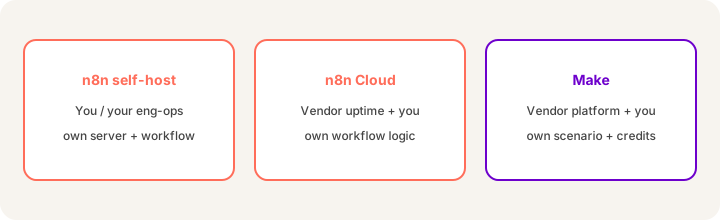
Ownership table:
Fill: Failure mode | n8n self-host owner | n8n Cloud owner | Make owner. Rows: server down, Slack auth expired, Sheet full/permissions, credit/execution cap. Do not leave blanks — put a person or role name.
Pricing context (November 2026)
Public list prices and meters change. n8n (checked Nov 2, 2026): Cloud Free €0 for 50 executions, Starter €20/mo billed annually for 2,500 executions, Pro €50/mo billed annually for 10,000, plus free self-host Community or paid self-host Business from about €667/mo — see n8n.io/pricing. Make (checked Nov 1, 2026): Free $0 with 1,000 credits/mo, then Core $9, Pro $16, and Teams $29 per month, each starting at 10,000 credits — see make.com/en/pricing and the Make review. Do not budget from this compare page alone.
Uncertainty: Credit definitions, execution counting, and enterprise discounts move. Self-host “free” still costs infrastructure and someone’s pager. Re-check vendor pages the week you renew.
When each often fits (honest take)
n8n often fits when self-host or execution economics, denser workflows, or runtime ownership matter — and someone on the team can own Sunday night. Make often fits when scenario speed and visual modules get the handoff live faster, and credit metering matches volume. If Zapier connectors already win a simple path, see Zapier. This page does not crown a winner.
Related options (educational)
| Need | Better home | Why |
|---|---|---|
| Self-host / execution control | n8n | Own runtime or denser node/code workflows |
| Visual scenario speed + credits | Make · Make scenarios | Fast module builds; meter by scenario |
| Polished simple connectors | Zapier | Linear paths; task economics |
| Browser playbooks | Bardeen | Desktop/browser automation, not server workflows |
| Human-in-the-loop agents | Relay.app | Approvals in the loop; different job |
FAQ
Is this an n8n vs Make scorecard?
No. Educational compare on one weekly handoff (form → Slack → Sheet): build steps, cost shape, connectors, Sunday-night ownership. Deep-dives: n8n, Make.
When does n8n often fit ops?
Self-host or tighter execution control, denser workflows, runtime ownership — with a named Sunday-night owner. See the n8n deep-dive.
When does Make often fit ops?
Visual scenario speed and credit metering match volume; team already thinks in modules. See Make + Make scenarios.
Who owns Sunday-night failures?
Self-host n8n: you (server + workflow). n8n Cloud: vendor uptime + you (logic). Make: vendor platform + you (scenario/credits). Name a human before go-live.
Still choosing between n8n and Make? The $19 AI toolkit audit gives you a written plan for which tools to keep using and which to drop across your whole AI stack, including this pair.
Prefer to do it yourself? Spreadsheet — $9
Optional next step (if seats overlap)
If n8n, Make, Zapier, and browser tools all have seats for similar handoffs, optional help mapping overlap: $19 AI toolkit audit or $9 AI toolkit spreadsheet. Email Audit $19 or Toolkit spreadsheet $9.
Checkout is live via Stripe. After you pay, we email delivery (spreadsheet) or intake next steps (audit).