What’s new · n8n · Sep 2026
What’s new in n8n (Sep 2026): release notes that affect self-hosted ops
Dated changelog-style guide — n8n changes that affect self-hosted and cost-sensitive automation teams running production scenarios. Not a rehash of the n8n deep-dive or n8n vs Make — those remain the how-tos; this page is what moved in September 2026 per public n8n sources.
Who this changelog is for
Ops / platform owners who self-host n8n (or run production scenarios on Cloud with the same version train) and need a dated “what actually moved” note for September 2026 — Agents defaults, publication, queue reliability, and credential/runtime checks. Deep how-tos stay on n8n and n8n vs Make. Peers: Zapier, What’s new in Zapier (Sep 2026), Make.
Sep 2026 snapshot (picture)
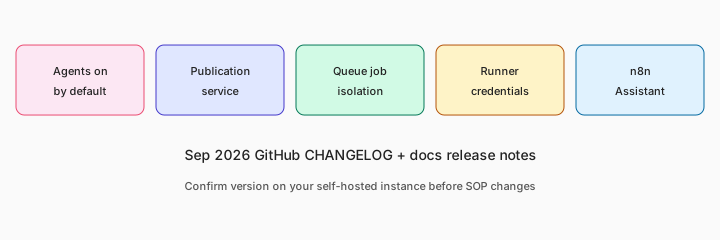

Uncertainty flag: n8n ships frequent minors (examples in Sep 2026 include 2.38.x → 2.42.x trains on GitHub). Features may be behind flags or roll out differently on Cloud vs self-hosted. Confirm your running version and read the CHANGELOG for that tag before you change weekend on-call SOPs.
Primary prompt (Marketing SoT) — run against n8n’s public Sep 2026 release notes, not rumor threads:
From n8n public Sep 2026 release notes, list 5 changes that affect production scenario owners.
Changes that matter for production scenario owners
Examples at a glance: each change below includes a concrete ops example plus a short Try this. Citations point at the public CHANGELOG / docs release notes.
1. Agents enabled by default + durable agent message queue
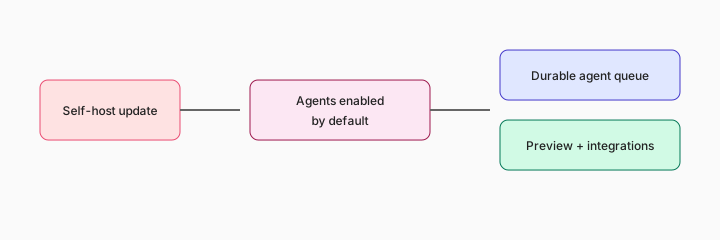
What changed (public ≈ late Sep 2026 — CHANGELOG 2.42.0 window, 2026-09-29): Core work includes Enable Agents by default, a durable agent message queue foundation, and wiring Preview/integrations to that agent queue. Self-hosted ops should expect Agents surfaces to appear (or activate) after upgrade unless you intentionally disable modules — verify instance settings and license/module gates.
Source: CHANGELOG.md (2.42.0 features: Enable Agents by default; durable agent message queue; Connect Preview and integrations to the agent queue).
Post-upgrade checklist:
After noting your n8n version: list whether Agents is enabled, which projects may publish agents, and 3 production actions that stay human-approved.
2. Workflow publication service enabled by default
What changed (public ≈ mid Sep 2026 — CHANGELOG / release notes around 2.40, 2026-09-15): Core enables the workflow publication service by default. Publication-related fixes through September also cover multi-main publish failures, trigger re-registration on publish (e.g. Email/Postgres triggers), and clearer publish UX. Production owners should re-test activate/publish paths after upgrades — silent publish differences are a classic Sunday-night footgun.
Sources: CHANGELOG.md (Enable the workflow publication service by default); docs release notes (Sep feature listings).
Publish verify:
Write a 5-step publish smoke test for one webhook workflow: save → publish → hit test URL → check executions → confirm deactivate still works.
3. Queue-mode reliability — job result isolation + DB ping under lag
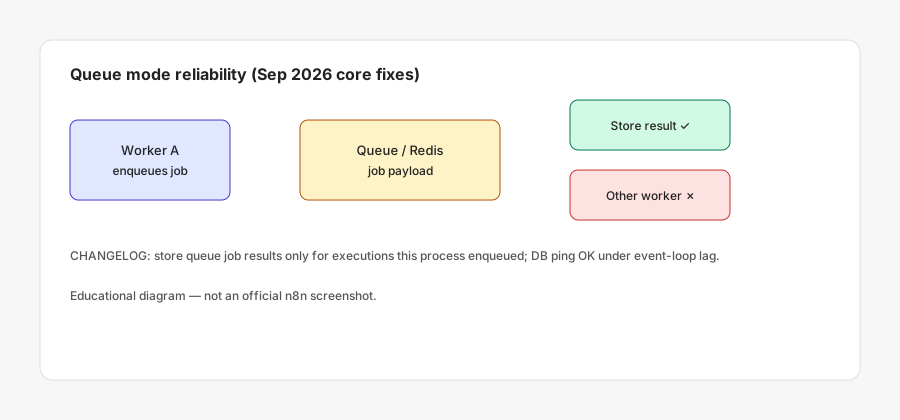
What changed (public ≈ late Sep 2026 — CHANGELOG 2.42.x / 2.41.4 patch notes): Core fixes include store queue job results only for executions this process enqueued and counting a database ping as successful when its reply arrives during event-loop lag. These matter for self-hosted queue mode under load — wrong worker writing results or flaky health checks can look like “random” production failures.
Sources: CHANGELOG.md (2.42.0 bug fixes); patch notes summarized publicly for 2.41.4 (2026-09-30) covering the same themes.
Queue owner brief:
Document your queue topology (mains/workers/Redis/DB). Note which Sep reliability fixes apply and what metric you watch for 48 hours after upgrade.
4. Credentials checked against the person running the workflow
What changed (public ≈ late Sep 2026 — CHANGELOG 2.42.0): Core adds check credentials against the person running the workflow. For production scenario owners, that can change who can execute shared workflows with shared credentials — especially important when contractors, service accounts, and humans share projects. Re-test execute permissions after upgrade; do not assume prior “it worked for the publisher” behavior.
Source: CHANGELOG.md (2.42.0 feature: Check credentials against the person running the workflow).
Credential ownership:
For 3 production workflows: name the credential owner, who can run them, and whether a service account should replace a personal OAuth token.
5. n8n Assistant rename + Agent Builder assists
What changed (public ≈ mid Sep 2026 — docs release notes / CHANGELOG around 2.40–2.41): The product renames AI Assistant → n8n Assistant, adds the Assistant panel into Agent Builder flows, improves builder interactions, and continues shipping Agent Builder tools (e.g. force tool call on first iteration for stubborn small models — 2.40). Useful for builders; production owners should still require human review before publish.
Sources: docs.n8n.io/changelog/release-notes (2.40: Rename AI Assistant to n8n Assistant; Agent Builder items); CHANGELOG.md.
Builder + gate:
Use n8n Assistant (if enabled) to draft a webhook → validate → Sheet workflow. List what you will verify manually before publish.
What did not change for ops (still use the deep-dives)
- You still own Sunday-night failures on self-hosted — see n8n.
- Metering / cost control vs Make still needs a clear compare — n8n vs Make.
- Node-level Sep additions (many Microsoft Teams operations, Confluence visibility, MongoDB bulkWrite, etc.) matter when you use those nodes — skim docs release notes for your integrations; we do not invent node behavior beyond public notes.
- Human review still owns money, access, and external customer sends.
Vs Zapier / Make what’s-new (brief)
What’s new in Zapier (Sep 2026) covers Next Gen Zaps early access and Agentic Management on Zapier Cloud. Make remains the visual scenario peer when you do not want to operate a host. Use Make, Zapier, and n8n vs Make for stack fit — this page is only n8n’s dated Sep notes.
Pricing & access context (September 2026)
Self-hosted community and licensed editions, plus n8n Cloud plans, are documented on n8n.io/pricing and hosting docs. This page is dated September 2026 and is not a price sheet — we do not invent exact seat or execution prices. Gateway credits / Assistant capacity (where applicable) should be verified in your instance settings.
Uncertainty: Version, license, module flags, and Cloud vs self-hosted packaging change. Always confirm on live n8n docs and your admin panel before budgeting.
When this update helps (honest take)
It tends to help when you already self-host (or run production scenarios on a current n8n train), care about queue/publish reliability, are adopting Agents carefully, or need clearer credential-vs-runner behavior.
It tends not to help when you are happy on an older pinned version with no upgrade window, when you need Zapier’s managed Next Gen early access instead, or when a simple Make scenario already covers the job. Soft next step below only if n8n, Zapier, Make, and chat seats overlap on the same weekly jobs.
Paying for n8n and a few other AI tools? The $9 AI toolkit spreadsheet lists every AI subscription you have, what each one costs, and how fast it pays for itself, so you can see which ones are worth the money.
Want someone to do it for you? AI toolkit audit — $19
FAQ
What changed in n8n in September 2026 that self-hosted ops should notice?
Agents default + agent queue, publication service default, queue result isolation / DB ping fixes, credentials checked against the runner, and n8n Assistant / Agent Builder updates. Confirm your version.
Do I need to upgrade immediately?
No. Stage upgrades; re-test publish, queue, and credential paths first.
How does this compare to Zapier’s Sep updates?
Different stacks. See What’s new in Zapier and n8n vs Make.
Where is the deeper n8n guide?
n8n.html. This page is the dated Sep 2026 changelog only.
Optional next step (if seats overlap)
If n8n is one of several automation/AI seats doing the same weekly handoffs, optional help: $19 AI toolkit audit or $9 AI toolkit spreadsheet. Email hello@aiproduct.reviews with subject Audit $19 or Toolkit spreadsheet $9 if you prefer.
Checkout is live via Stripe. After you pay, we email delivery (spreadsheet) or intake next steps (audit).