Semrush review (Sep 2026): how search and AI visibility research works
Semrush is a research suite for keywords, competitors, and (increasingly) AI-answer visibility. This page shows how teams use that data week to week — with dated pricing and educational alternatives.
Pricing as of Oct 17, 2026, from the official pricing page · semrush.com/prices
If search or AI-answer visibility is a real acquisition channel — and you need to know whether Semrush’s price matches weekly use — start here. We cover research workflows, dated pricing (including Semrush One uncertainty), and educational alternatives (Ahrefs, Surfer, Sheets + LLM).
What Semrush is
Semrush is a visibility research platform: keyword databases, competitive intelligence, site audits, content tools, and newer Semrush One bundles that market SEO + AI visibility together. Plan names shifted in 2026 — treat public figures as anchors. This review focuses on what a marketing ops or SEO owner uses weekly.
Major features (with how someone uses them)
Examples at a glance: each feature has a concrete SEO/marketing example plus a Try this mini-workflow.
1. Keyword & domain research
What it is: Look up keywords, volumes, difficulty, and domain overlap so content and SEO plans start from data — not guesswork.
Concrete example (content ops)
Content ops pulls a keyword cluster for “meeting notes AI,” maps intent, and schedules three articles — instead of picking titles in a Slack thread.
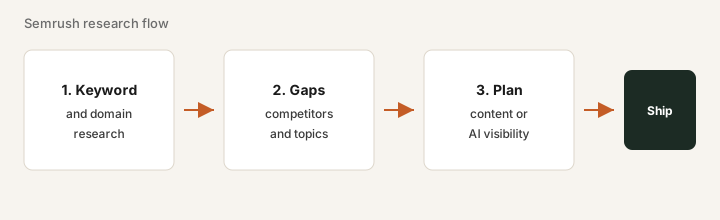
Simple diagram of the flow: research → gaps → plan → ship. We used this instead of a product screenshot.
Try this
On a trial:
Research one real topic you will publish. Export 10 keywords with intent notes. If nobody schedules those URLs this month, Semrush will sit idle.
2. Competitive gaps & audits
What it is: See where competitors rank that you do not, plus technical site audits. Useful when an owner turns gaps into a backlog — not a PDF that dies in Drive.
Concrete example (SEO lead)
The SEO lead runs a gap vs two competitors monthly and adds five URLs to the content board with owners and dates.
Try this
Pick one competitor domain:
List five keyword gaps you could realistically win in 90 days. Assign owners. If you cannot assign, you need process before more tool spend.
3. Content toolkit
What it is: Briefing and on-page helpers inside Semrush’s content tools. Overlap with Surfer/Frase is real — decide which tool owns drafting structure.
Concrete example (editor)
An editor uses Semrush’s outline suggestions for one pillar page, then drafts in Docs — without also paying Surfer for the same checklist.
Try this
Before stacking Surfer + Semrush content tools:
Write which tool owns on-page structure. If both are “nice to have,” keep one and cancel the other trial.
4. Semrush One / AI visibility
What it is: Newer bundles market tracking how brands appear in AI answers alongside classic SEO. As of Oct 17, 2026, the official pricing page lists SEO + AI Search Starter at $199/mo ($165.17/mo billed annually). Only useful if AI visibility work is weekly and owned.
Concrete example (marketing lead)
Marketing tracks a short list of prompts where buyers ask AI tools for vendor recommendations — and feeds gaps into content briefs.
Try this
Before annual Semrush One:
List 10 prompts customers might ask an AI assistant about your category. Check whether Semrush One data changes your next content sprint. If not, stay on classic SEO toolkit.
Public pricing (as of Oct 17, 2026)
As of Oct 17, 2026, the official Semrush pricing page (semrush.com/prices, checked with both the monthly and annual toggle) shows:
SEO plan:$139.95 per month on monthly billing, or $117.33 per month billed annually (the annual card rounds the monthly price to “$139”) (as of Oct 17, 2026).
SEO + AI Search (formerly marketed as Semrush One): Starter $199 per month ($165.17 billed annually), Pro+ $299 ($248.17) (as of Oct 17, 2026).
Advanced: no public price any more — the page now shows “Custom” with “Request demo”. The old published Advanced price is no longer offered; get a quote from Semrush sales.
Additional users start at $45/mo; annual billing saves up to 17%.
Extra seats and add-on toolkits can raise the bill meaningfully.
Uncertainty flags: Plan names reorganized in 2026; Advanced moved to quote-only in October 2026. Prices as of Oct 17, 2026; verify on semrush.com/prices before you buy. Invoice line items (seats, add-ons) often exceed the headline.
When Semrush is useful (honest take)
Semrush tends to help when search or AI visibility is a deliberate channel and someone uses the data weekly. It tends not to help without a site/content plan, an owner, or when the login is quarterly-only. Trial before annual One bundles.
Paying for Semrush and a few other AI tools? The $9 AI toolkit spreadsheet lists every AI subscription you have, what each one costs, and how fast it pays for itself, so you can see which ones are worth the money.
A search and visibility research suite for keywords, competitors, audits, content tools, and newer AI-visibility bundles.
Is $139.95/mo the real bill?
It is the SEO plan’s monthly list price as of Oct 17, 2026 ($117.33/mo billed annually, per semrush.com/prices). Seats and add-ons raise it — check invoice line items.
SEO + AI Search from $199?
Consider only if AI visibility work is real and weekly. Trial before annual.
Do we need Semrush and Surfer?
Not on day one for most small teams. Pick research vs on-page and avoid overlap.
Optional next step (if seats overlap)
If this tool is one of several AI seats and you want a written pass across the whole list, the optional $19 AI toolkit audit produces a short memo. Prefer an editable grid? The $9 AI toolkit spreadsheet is a one-time CSV. Soft offer only — this deep-dive stands alone.
Affiliate disclosure: Some outbound product links may be affiliate links.
We may earn a commission if you subscribe. Prices and features change — always verify on the vendor site.
Full policy: disclosure.