How-to · Hotels · Lighthouse · Oct 15, 2026
Read Lighthouse rate and demand insight once a week, and treat competitor data as context, not orders
Lighthouse Pricing insight and Pricing Optimization show competitor rates and demand. Those signals are context, not orders. This page shows how to pick a fair comp set, run a weekly read, and let the revenue manager decide one action with a written reason.
Who this is for
Independent hotel revenue managers using Lighthouse for rate and demand insight. The job here is a weekly read with one written decision — not copying competitor BAR.
How to do it
This is a how-to, not a ranking of rate-shopping tools. Per the Lighthouse AI review, competitor data is market context; the revenue manager approves every pricing action.

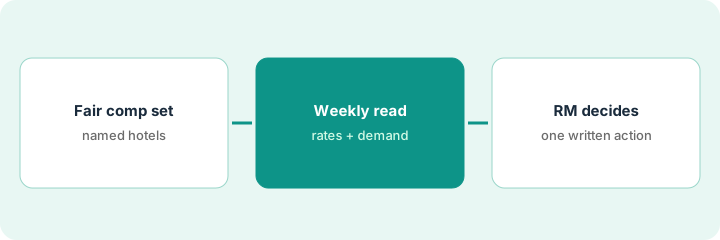
1. Step 1 — Pick a fair comp set
What it is: Name hotels that guests actually compare you to — similar size, location, and quality — and write why each is in the set.
- List 4–8 comparable hotels.
- Write one reason each belongs.
- Remove aspirational luxury comps that guests never cross-shop.
- Name the revenue manager who decides actions.
Comp set: four similar independents within two miles. A large chain resort is removed because guests do not cross-shop it for midweek stays.
Save the comp set with “Why included” notes. Revisit quarterly.
2. Step 2 — Weekly read of rates and demand
What it is: Once a week, read Lighthouse rate and demand insight for your set and write what changed — without changing rates yet.
- Open the same weekly view every time.
- Note rate moves and demand shifts in one paragraph.
- Flag events or anomalies.
- Do not push rates during the read.
Two comps raised Friday rates ahead of a waterfront race. Demand indicators look stronger Friday–Saturday. No rate change yet — only notes.
Use a fixed template: “What moved / What might be noise / Questions for the decision.”
3. Step 3 — Revenue manager decides one action with a written reason
What it is: The revenue manager picks at most one pricing action from the read and writes the reason.
- Choose one action or explicitly choose none.
- Write the reason tied to your floors and strategy.
- Apply the change in your PMS or RMS.
- Store the note with the weekly read.
- Never “match the lowest comp” as the only reason.
Manager raises Friday BAR one step citing the race and remaining inventory — not because one comp undercut midweek.
If the reason is only “competitor is lower,” stop and reassess your floor and value story first.
Pricing context (October 2026)
This how-to isn't a price sheet. Per the Lighthouse AI review, Pricing Optimization for independents lists Starter from €99, Plus from €129, and Complete from €189 per month. Dated October 2026.
Checked Oct 15, 2026 on the vendor’s own pricing page: Lighthouse’s Pricing Optimization page lists Pricing Optimization for independents as Starter from €99 per month, Plus from €129 per month, and Complete from €189 per month (USD and GBP also selectable on the page). Larger Lighthouse Pricing products are sales-led.
Uncertainty: Euro plan amounts are from Lighthouse's Pricing Optimization page; larger products are sales-led. The only prices this site sells here are the optional $9 AI toolkit spreadsheet and $19 AI toolkit audit.
When this helps (honest take)
Useful when you can staff a weekly read and write down decisions.
Not useful when the team copies the lowest competitor rate every morning with no written reason.
Related options (educational)
| Need | Where to look | Why |
|---|---|---|
| Lighthouse AI | Lighthouse AI | Primary path |
| Duetto alternative | Duetto AI | Related RMS path |
| Duetto Autopilot floors | Duetto Autopilot floors | Same day's how-to |
| Hospitality stack map | Stack map: hospitality ops | Where Lighthouse fits |
FAQ
Are competitor rates orders?
No. They are market context. The revenue manager decides.
How often should we change the comp set?
Quarterly, or when a hotel renovates or repositions.
Where do Lighthouse prices live?
See the pricing section; we re-checked Pricing Optimization on Oct 15, 2026. Our Oct 15, 2026 check of the vendor’s own pricing page is summarized in the pricing section above.
Are competitor rates orders?
No. Treat them as market context. The revenue manager decides every pricing action with a written reason.
Optional next step
If you want a one-page toolkit map for the tools you already pay for, use the optional $9 AI toolkit spreadsheet. If you want a short review of seat waste and unused tools, use the optional $19 AI toolkit audit. Neither is required to follow this how-to.